GIT Claude MCQs
 Call Kai
 Learn
 Practice Test
 Spaced Repetition
 Match
 Flashcards
 Knowt Play
1/8

Earn XP
Description and Tags
1-9 = oesophageal & gastric lectures with abdo bacteriology.
9 Terms
A 58-year-old man with 15 years of reflux has salmon-pink mucosa above the gastro-oesophageal junction. Biopsies show glandular columnar epithelium with goblet cells. There is cell crowding with basally located nuclei and mild nuclear atypia. There is no surface involvement, nodule or ulcer. According to your lecture, what is the most appropriate plan?
A. Continue acid suppression with endoscopic surveillance every 3 years
B. Yearly endoscopy, or consider surgery
C. Immediate oesophagectomy
D. Discharge from surveillance because low-grade change is reversible
E. Topical swallowed steroids
A. Low-grade dysplasia in Barrett’s gets 3-yearly surveillance. Yearly follow-up or surgery is for high-grade dysplasia.

A 28-year-old woman’s mother and maternal aunt died of diffuse gastric cancer in their 40s, and her sister has lobular breast cancer. She carries a germline CDH1 mutation. Endoscopy is normal. Random biopsies show small foci of signet ring cells. What is the most appropriate management?
A. 3-yearly surveillance endoscopy
B. H. pylori eradication
C. Endoscopic mucosal resection
D. Trastuzumab
E. Prophylactic total gastrectomy
E. Prophylactic total gastrectomy

A 74-year-old man with osteoarthritis takes ibuprofen. He is also on warfarin, prednisolone and a PPI. Which single factor is associated with the greatest relative increase in the risk of NSAID-related GI toxicity?
A. Age over 60
B. Prior history of an ulcer or GI bleed
C. Concurrent glucocorticoids
D. High-dose NSAID (more than twice normal)
E. Concurrent anticoagulants
E. Concurrent anticoagulants

A 51-year-old woman has iron-deficiency anaemia and epigastric discomfort. She has taken omeprazole for 3 months and has had no recent antibiotics. What is the best approach to diagnosing H. pylori?
A. Serology
B. Urea breath test today
C. Endoscopy with gastric biopsy after stopping the PPI for 2 weeks
D. Faecal antigen test today
E. Empirical triple therapy without testing
C. Endoscopy with gastric biopsy after stopping the PPI for 2 weeks

A 55-year-old man with cirrhosis and tense ascites has fever and diffuse abdominal tenderness. CT shows no perforation, abscess or ischaemia. Which statement is most accurate?
A. This is primary (spontaneous) bacterial peritonitis, managed with antimicrobials without a surgical source
B. This is secondary peritonitis and needs laparotomy for source control
C. This is infected pancreatic necrosis
D. This is cholangitis with bile duct obstruction
E. This is peritonitis from a perforated viscus
A. Primary peritonitis occurs with ascites and no intra-abdominal source. It is treated with antimicrobials without surgical source control.

A gastric adenocarcinoma shows loss of nuclear MLH1 and PMS2 staining in tumour cells, with retained staining in adjacent stromal and lymphoid cells. What is the most accurate interpretation?
A. HER2 amplification, so the patient may benefit from trastuzumab
B. High PD-L1 combined positive score
C. Microsatellite stable tumour with a worse prognosis
D. Intact mismatch repair
E. Mismatch repair deficiency (MSI-high), generally a better prognosis
E. Loss of MLH1 and PMS2 means dMMR/MSI-high, with a better prognosis

A 71-year-old man has a poorly differentiated gastric adenocarcinoma with a prominent dense lymphoid stroma. Which agent is specifically associated with this subtype?
A. HPV
B. EBV
C. CMV
D. HSV
E. H. pylori
B. Carcinoma with lymphoid stroma is EBV associated. H. pylori is the commonest overall cause but not specific to this subtype.

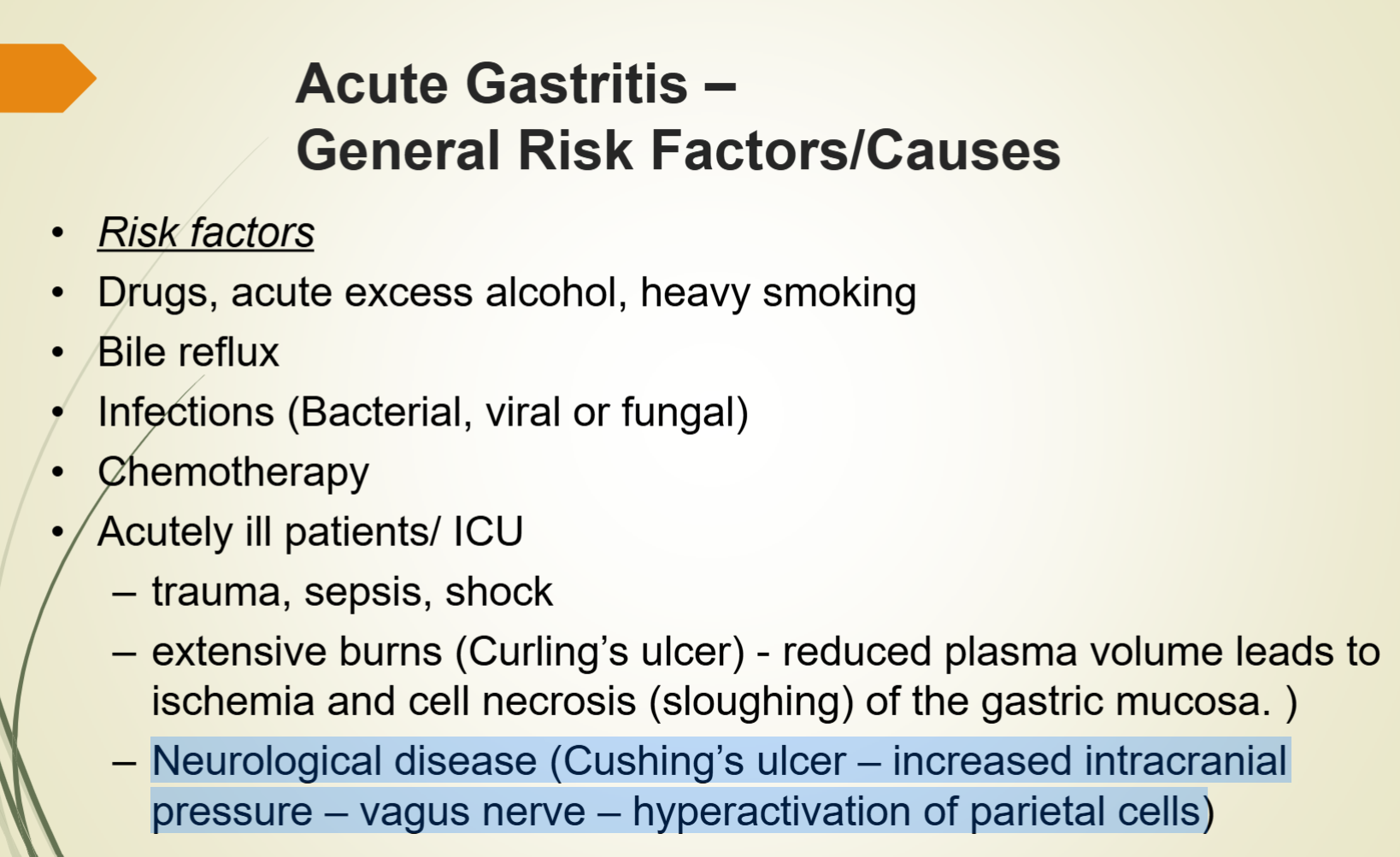
A 26-year-old man in ICU after a road traffic accident has a severe head injury with raised intracranial pressure. On day 3 he develops haematemesis, and endoscopy shows diffuse gastric erosions. What is the most likely mechanism?
A. Reduced plasma volume causing mucosal ischaemia and necrosis
B. Raised ICP causing vagal hyperactivation and parietal cell acid hypersecretion
C. Inhibition of prostaglandin synthesis
D. H. pylori-induced fall in somatostatin
E. Autoimmune destruction of parietal cells
B. This is a Cushing ulcer (raised ICP, vagal drive, parietal cell hyperactivation). Curling’s ulcer (option A) follows burns.
A resected gastric cancer invades through the muscularis propria into subserosal fat without perforating the serosa. Four regional lymph nodes contain metastases and there are no distant metastases. What is the TNM (8th ed.) stage?
A. T2 N1 M0
B. T2 N2 M0
C. T3 N1 M0
D. T3 N2 M0
E. T4 N2 M0
D. Invasion through the muscularis propria into subserosal fat is T3. Metastases in 3 to 6 nodes is N2.
