Greek Religion: Term 2 Week 9: Mystery Cults- Eleusis Kabeiroi at Thebes; Orphism, and Pythagorism
 Call Kai
 Learn
 Practice Test
 Spaced Repetition
 Match
 Flashcards
 Knowt Play
1/91

There's no tags or description
Looks like no tags are added yet.
92 Terms
Why are mystery cults called mystery cults?:
Named after mystes- a Greek world for initiate
These cults where people are initiated tend to have secrets- so little is known about them today
Write out what Pausanias wrote about the Eleusinian mysteries
‘The Eleusinians have a temple of Triptolemus, of Artemis of the Portal, and of Poseidon Father, and a well called Callichorum (Lovely dance), where first the women of the Eleusinians danced and sang in praise of the goddess. They say that the plain called Rharium was the first to be sown and the first to grow crops, and for this reason it is the custom to use sacrificial barley and to make cakes for the sacrifices from its produce. Here there is shown a threshing-floor called that of Triptolemus and an altar.
My dream forbade the description of the things within the wall of the sanctuary, and the uninitiated are of course not permitted to learn that which they are prevented from seeing. The hero Eleusis, after whom the city is named, some assert to be a son of Hermes and of Daeira, daughter of Ocean; there are poets, however, who have made Ogygus father of Eleusis. Ancient legends, deprived of the help of poetry, have given rise to many fictions, especially concerning the pedigrees of heroes.’
Triptolemus is the young man who is taught farming, and potentially has something to do with a revelation about an ear of wheat
What were the Lesser Mysteries?
Lesser Mysteries: Anthesterion- (roughly Feb/March), to complete the main mysteries in the autumn you had to complete the lesser mysteries earlier on in the year- The Lesser Mysteries were a preliminary purification that a candidate had to undergo before taking part in the Greater Mysteries
Where were the lesser msyteries celebrated?
Celebrated near Athens, at Agrai by the Ilissos river
Who were the lesser mysteries rites possibly linked to?
Unclear if rites were linked to Persephone, Dionysus, or Heracles
Identify this and its relevance to the lesser mysteries
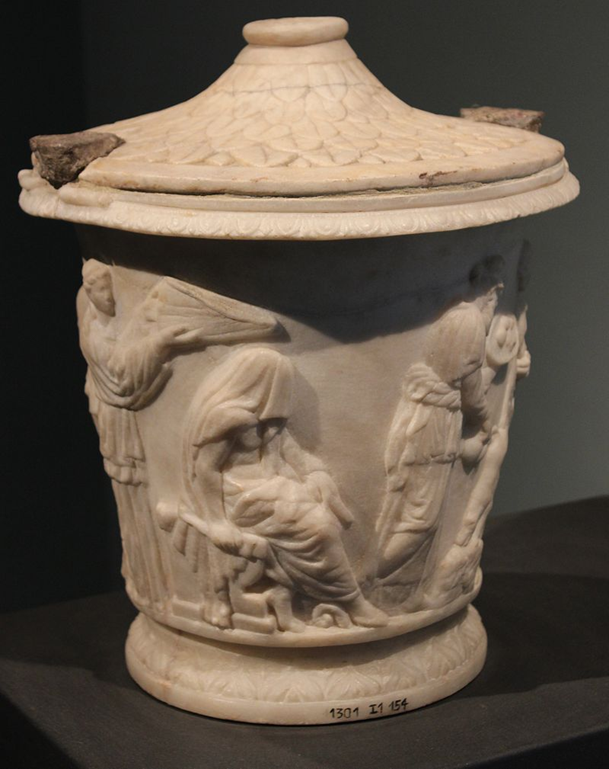
Lovatelli Urn, C1BC, National Roman Museum at Palazzo Massimo, Rome
Work or art that shows Heracles with his head covered- common piece of art in relation to this festival. This gives an idea of what could have potentially happened in the festival. Heracles may be holding a club in this image (Paul isn’t sure)
What would participants sacrifice and to who?
Participants would sacrifice a piglet to Demeter and Persephone, and then ritually purify themselves in the river Illisos.
What happened upon completion of the Lesser Mysteries?
Upon completion of the Lesser Mysteries, participants were deemed mystai (initiates) worthy of witnessing the Greater Mysteries.
When did the greater mysteries take place?
Took place in Boedromion, roughly September
What happened in the Eleusinian mysteries 13-14th?
13-14th: ephebes process from Athens (from Eleusinion at foot of Acropolis) to Eleusis to fetch hiera (holy things- no one knows what they actually are) and bring them back to Athens. This process of moving things is very common at festivals
What happened in the Eleusinian mysteries 15th?
15th Mystai gather at Stoa Poikile (painted stoa) and proclamation made by herald excluding ‘those impure in hands or incomprehensible in speech’ i.e. non Greeks (pretty much as long as you can speak Greek you can take part
What happened in the Eleusinian mysteries 16th?
16th Mystai go to Phaleron, bathe and wash a piglet which is sacrificed on return to the city
What happened in the Eleusinian mysteries 17th?
17th Sacrifices to Demeter and Kore
What happened in the Eleusinian mysteries 20th?
20th Mystai depart for Eleusis with sacred objects, statue of Iakhos, branches.
Give details about the festival
Ritual abuse shouted at them at particular stages. Woolen threads bound to legs of mystai. Fast broken on arrival at Eleusis.
Explain the Gephyrismos
At a certain bridge across the river Kephissos, a curious practice was observed that must have far antedated the days of the procession and been incorporated in it.
As the procession arrived, one of its number sitting on the bridge, and answered possibly by the others, hurled abuse and curses, as one authority says, ‘at the most distinguished of the citizens’ (who?). (this possibly comes from when crude things were said to cheer up Demeter after Persephone is taken from her- it is Imabe that makes the crude jokes)
This ‘bridgery’ (gephyrismos), as the often obscene jesting and cursing came to be called from the scene of its enactment, was not confined to the Eleusinian procession nor to the Kephissos bridge (cf. other aischrologia)
What did Isocrates write about the Eleusinian Mysteries?
‘Our city [Athens] was not only so beloved of the gods but also so devoted to mankind that, having been endowed with these great blessings [of the cult of Artemis], she did not begrudge them to the rest of the world, but shared with all men what she had received. The mystic rite we continue even now, each year, to reveal to the initiates; and as for the fruits of the earth, our city has, in a word, instructed the world in their uses, their cultivation, and the benefits derived from them.’
Isocrates Panegyricus 29
How was Eleusis/the Eleusinian festival a Panhellenic centre?
Requests for tithes (funding) sent out to all the Greeks
Announcement of a truce to allow safe passage for foreigners to Eleusis at the time of the Mysteries (see Aeschines 2.133, IG I3 6)
‘…and when your heralds carried the proclamation of the sacred truce of the Mysteries, the Phocians alone in all Hellas refused to recognize the truce.’
Identify this scene:
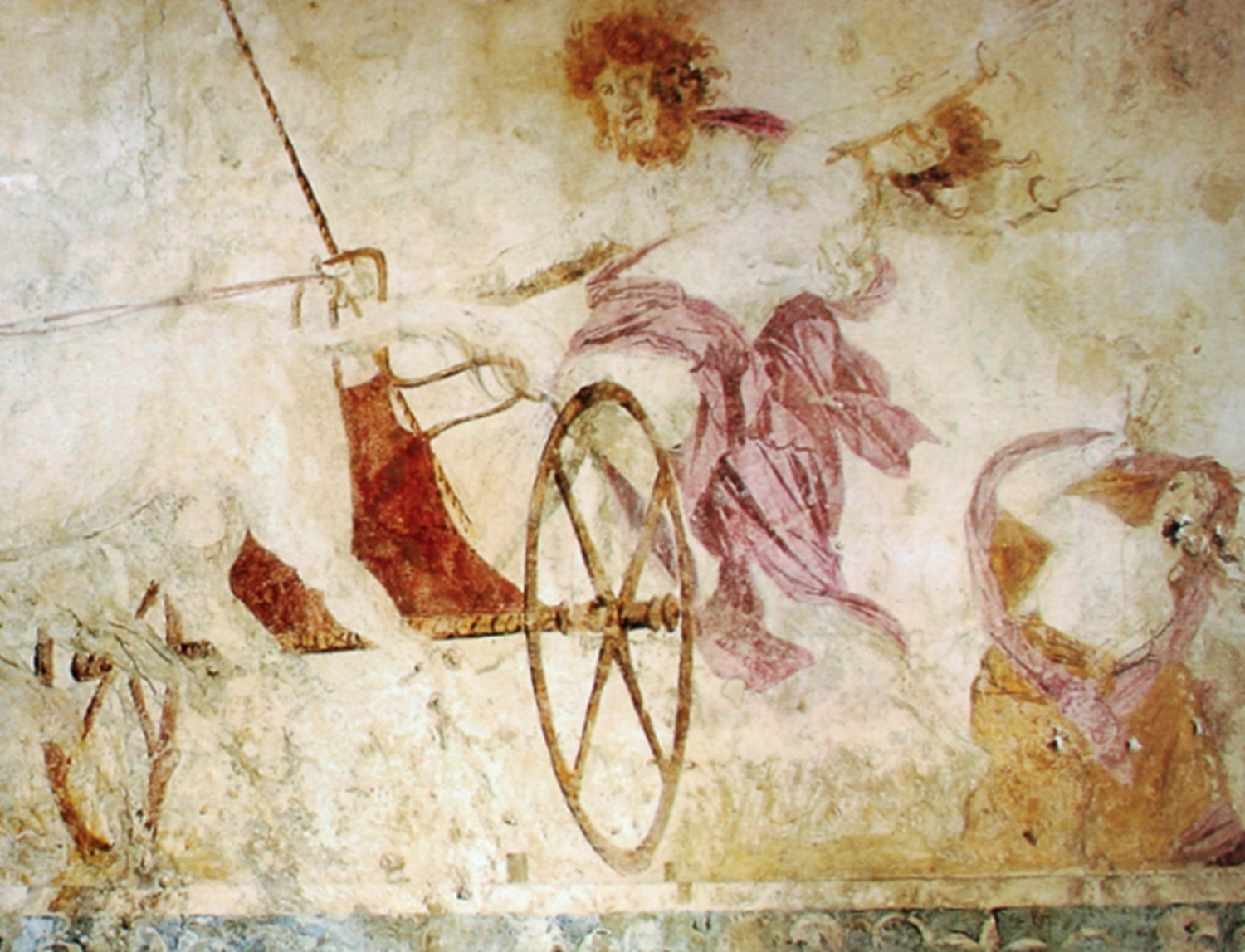
Abduction of Persephone (Kore) by Hades (Aidoneus) from tomb at Vergina
How is Eleusis prominent in the Hymn to Demeter?
Eleusis is given a special prominence in the hymn: site of end of Demeter’s wanderings
Mysteries concerned with both fertility on earth and life in the next world
What are possible ritual elements/aetiologies included in the hymn of demeter for the Eleusinian mysteries?
Possible ritual elements/aetiologies included in the hymn are:
Night time torch-lit rites
Ribals songs/Iambi
Mixed barley drink (Kykeon)
Mourning followed by celebration
Give a summary of the homeric hymn to demeter
1-4 Introduction
5-39 Rape of Persephone by Hades
40-90 Demeter searches for Persephone; Hecate and Helios reveal that she has been taken by Hades
91-230 Exile of Demeter on Earth; arrival at Eleusis and encounter with daughters of King Celeus; welcome by Metaneira who employs the disguised Demeter as a nurse for her baby son Demophoon.
231-304 Failed attempt to make Demophoon immortal; Demeter reveals her identity and commands the building of her temple and the institution of her rites.
305-374 Demeter refuses to send forth grain; embassies of the gods; Hermes fetches Persephone from Hades
375-489 Return of Persephone; two goddesses welcomed by Rhea at Eleusis; return to Olympus
490-5 Farewell
What is the ritual element in the Night time torch-lit rites?
Ritual elements/Aetiologies:
Torch lit search for Persephone
Then for nine days queenly Deo wandered over the earth with flaming torches in her hands, so grieved that she never tasted ambrosia and the sweet draught of nectar, nor sprinkled her body with water. (47-50)
In ritual? Probably end of ritual – search and discovery.

Identify this tablet:
Ninnion tablet 370 BC:
Votive plaque depicting elements of the Eleusinian Mysteries. National Archaeological Museum, Athens
Who is Ninnion?
Ninnion is the name of the person who dedicated it, believed to be a woman
What is the very top scene alike to?
Scene in the pediment at the top, alike to a temple
What do people suggest the tablet shows?
People suggest that this shows the whole mysteries, with the top showing the lesser mysteries and the bottom showing the greater mysteries
What is the white half circle at the bottom?
White half circle- potentially the mirthless rock which is where Demeter sat down to rest when she arrived at Eleusis or by some accounts graved about her daughter's abduction
What do the people holding torches show?
People are carrying torches so it is clear they are processing, holding sprigs (possibly of myrtle) and wearing crowns (of myrtle)
Where do we hear about this procession?
We hear about this procession in Aristophanes Frogs- where they are largely making fun of it: the chorus are singing about a night-time rite, myrtle and a procession, this is also taking place in the underworld
Who is Iambe?
The woman who made Demeter laugh in the Homeric Hymn to Demeter
There she sat, holding her veil before her face, and for a long time she remained there on the seat in silent sorrow. She greeted no one with word or movement, but sat there unsmiling, tasting neither food nor drink, pining for her deep-girt daughter, until at last dutiful Iambe with ribaldry and many a jest diverted the holy lady so that she smiled and laughed and became benevolent—Iambe who ever since has found favour with her moods (orgai). (194-205)
What is the equivalent ritual in the Eleusinian mysteries?
Equivalent in ritual? Gephyrismos- Also part of other Demeter festivals - Thesmophoria; Haloa
Write out CLEMENT OF ALEXANDRIA (ca. AD150 – 215)
Protrepticus (Exhortation to the Greeks) 2.18
Well, then (for I shall not refrain from the recital), Baubo having received Demeter hospitably, reaches to her a refreshing draught; and on her refusing it, not having any inclination to drink (for she was very sad), and Baubo having become annoyed, thinking herself slighted, uncovered her shame, and exhibited her nudity to the goddess. Demeter is delighted at the sight, and takes, though with difficulty, the draught — pleased, I repeat, at the spectacle. These are the secret mysteries of the Athenians; these Orpheus records. I shall produce the very words of Orpheus, that you may have the great authority on the mysteries himself, as evidence for this piece of turpitude:—
Having thus spoken, she drew aside her garments,
And showed all that shape of the body which it is improper to name,
And with her own hand Baubo stripped herself under the breasts.
Blandly then the goddess laughed and laughed in her mind,
And received the glancing cup in which was the draught.
What is kykeon?
Kykeon (from the Greek kykaō, "to stir" or "mix") was an ancient Greek beverage made primarily of water, barley, and herbs, often incorporating wine or goat cheese. It functioned as both a common peasant refreshment, a nourishing meal, and a ritualistic drink, most notably used to break the sacred fast during the Eleusinian Mysteries
Kykeon
So [Metaneira] made the kykeon and gave it to the goddess, as she requested, and the lady Deo took it for custom’s sake (210-11)
Question of if it was drugged and when it was drank
There was also a ritual mock battle that took place at some point:
in [Demophon’s] honour, at the due season of the revolving years, the sons of the Eleusinians shall evermore make battle and affray among themselves. (265-7)
Explain the night time ritual in the Eleusinian mysteries
“Now, let the whole people build me a great temple with an altar below it, under the citadel’s sheer wall, above Kallichoron, where the hill juts out. As to the rites (orgia), I myself will instruct you on how in future you can propitiate me with holy performance.” (270-4)
They then throughout the night tried to propitiate the glorious goddess, trembling with fear. (292-3)
Write the Establishment of the Mysteries at Eleusis:
Homeric Hymn to Demeter 470-83:
Establishment of the Mysteries at Eleusis:
Homeric Hymn to Demeter 470-83:
Fair-garlanded Demeter did not demur, but quickly made the produce of the loam-rich ploughlands come up; and the whole broad earth grew heavy with leafage and bloom.
She went to the lawgiver kings, Triptolemos and horse-goading Diocles, strong Eumolpos and Keleos leader of hosts, and taught them the sacred service, and showed the beautiful mysteries to Triptolemos, Polyxenos, and also Diocles—the solemn mysteries which one cannot depart from or enquire about or broadcast, for great awe of the gods restrains us from speaking.
Blessed is he of men on earth who has beheld them, whereas he that is uninitiated in the rites, or he that has had no part in them, never enjoys a similar lot down in the musty dark when he is dead.
Cf. Sophocles fr. 837 TrGF “Thrice blessed are those mortals who have seen the rites and enter into Hades; for them alone is life, for all other is misery”.
Identify this
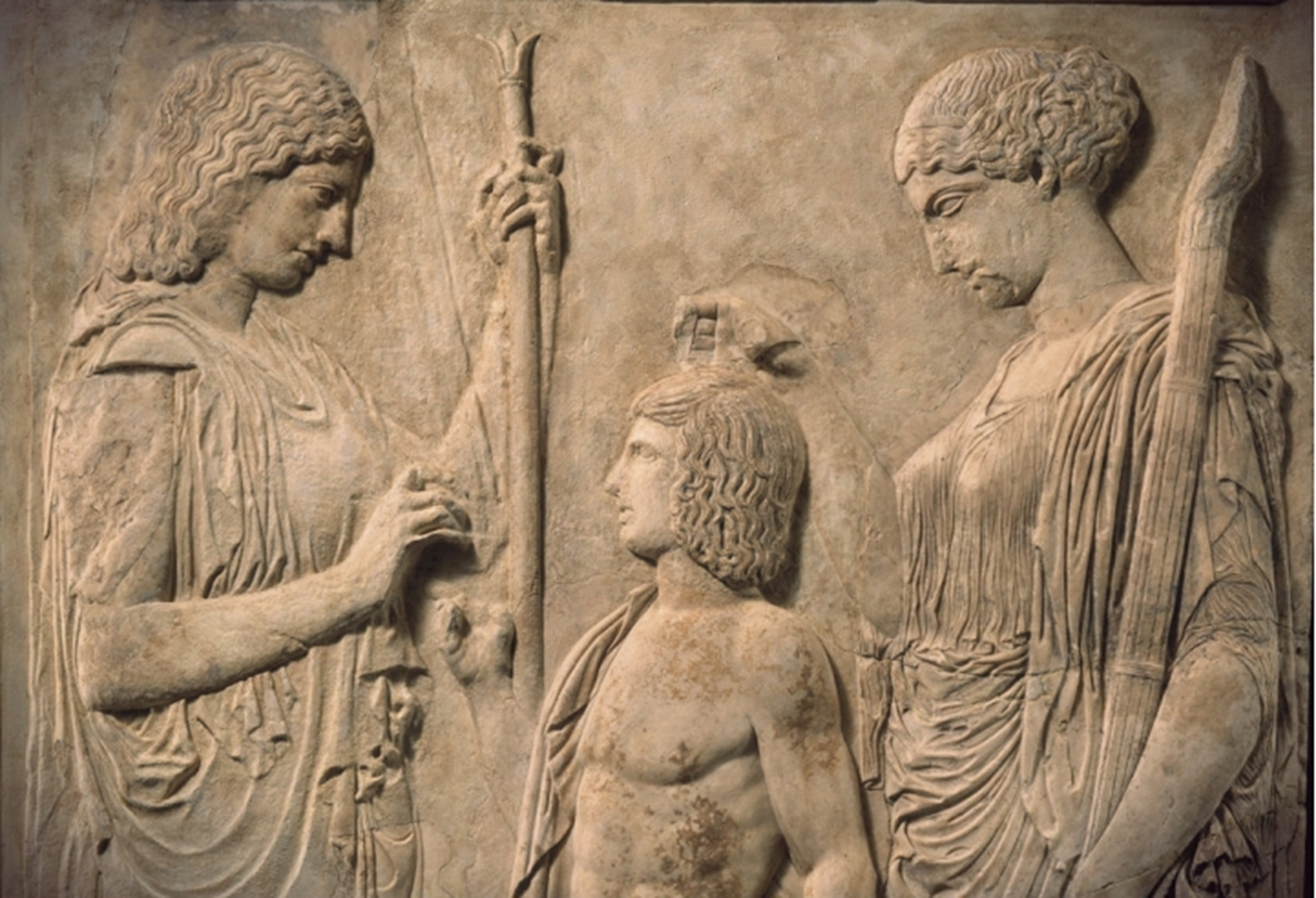
Votive relief from Eleusis, c. 440-420 BC
Demeter (left) offers Triptolemus (middle) grain; Persephone (right)
What is the Telestrion?
The Telesterion ("Initiation Hall") was a massive, sacred, square building located in Eleusis, Greece, dedicated to the mysteries of Demeter and Persephone
Describe the ritual that occurred at the Telesterion concerning Persephone
21st Boedromion: Rituals at the Telesterion:
[Perhaps] Dramatised version of story of Persephone enacted to encourage and ensure that fertility of agriculture continued. Ritual wanderings outside the Telesterion in darkness until hierophant opened doors
‘First there is wandering and wearisome running about, and uncertain fruitless journeys made in darkness. Then before the climax itself there is everything that is terrible . . . But after this an amazing light appears, and he is received into pure landscapes, full of voices and dancing and the solemnity of holy sounds and sacred visions’
Plutarch fr. 178 Sandbach (Kearns 6.4.4)
What else occurred at the Telestrion
21st and 22nd Dances and sacrifice followed:
‘I came out of the mystery hall feeling like a stranger to myself. Terror, anxiety and bewilderment turned to wonder and clarification.’
Plutarch Moralia 47a.
Clement of Alexandria
Clement of Alexandria:
Protrepticus (Exhortation to the Greeks) 2.21.2:
And the following is the token of the Eleusinian mysteries: I have fasted, I have drunk the cup; I have received from the box; having done, I put it into the basket, and out of the basket into the chest.
What are the suggested possibilities of what people may have seen in the Eleusinian mysteries?
Burket thinks that what they saw was the mortar and pestle (Kykeon). Others say it may be ears of wheat, something obscene
Possible that the reality is really mundane- it is the experience that counts
What did Aristotle state about the Eleusinian Mysteries?
Aristotle Fr 15 (Rose) (Synesios Dio. 8.1-6)
‘Aristotle believes that those who are being initiated have not a lesson to learn, but an experience to undergo and a condition into which they must be brought, once they have clearly become fit’.
Summarise the similarities between the Homeric Hymn to Demeter and the Eleusinian Mysteries
Journey to Eleusis mirrors the wanderings of Demeter
The Mysteries at Eleusis involved a re-enactment of the myth of Demeter and Persephone
Persephone returns from the underworld and is visible to initiates in the Telesterion
Initiation in the mysteries prepares initiates for the afterlife.
Describe another cult to Demeter in Sparta
Sparta- Pausanias 3.20.5:
‘Between Taletum and Euoras is a place they name Therae, where they say Leto from the Peaks of Taygetus ... is a sanctuary of Demeter surnamed Eleusinian. Here according to the Lacedaemonian story Heracles was hidden by Asclepius while he was being healed of a wound.’
Describe the mystery rites at Andania
Mystery rites at Andania (Messenia)- Pausanias 4.1.5:
The first rulers then in this country were Polycaon, the son of Lelex, and Messene his wife. It was to her that Caucon, the son of Celaenus, son of Phlyus, brought the rites of the Great Goddesses from Eleusis.
Describe the mystery rites at Thebes
Thebes: mystery rites at Kabeirion - Pausanias 9.25.5
Advancing from here twenty-five stades you come to a grove of Kabeirean Demeter and the Maid. The initiated are permitted to enter it. The sanctuary of the Kabeiri is some seven stades distant from this grove. I must ask the curious to forgive me if I keep silence as to who the Kabeiri are, and what is the nature of the ritual performed in honour of them and of the Mother.
Describe the mystery rites at Pheneos
Mystery rites at Pheneos (Northern Peloponnese)- Pausanias 8.15.1-4
The Pheneans have a sanctuary of Eleusinian Demeter, and hold a mystery of the goddess. Once a year they open two enormous stones fitted together, and take certain writings from them which has to do with the mystery, read it out to the initiated and then put it away the same night. Most Pheneans swear by the Rock about the most important things.
Describe the mystery rites at Lykosura
Mystery rites at Lykosura (Arcadia): For Despoina and Demeter - Pausanias 8.37
A little way up on the right past Despoina’s temple is the hall, as they call it, where the Arkadians perform the mystery and where they sacrifice generous and abundant offerings to the Mistress. This was for women as well as for men.
What is Orphism?
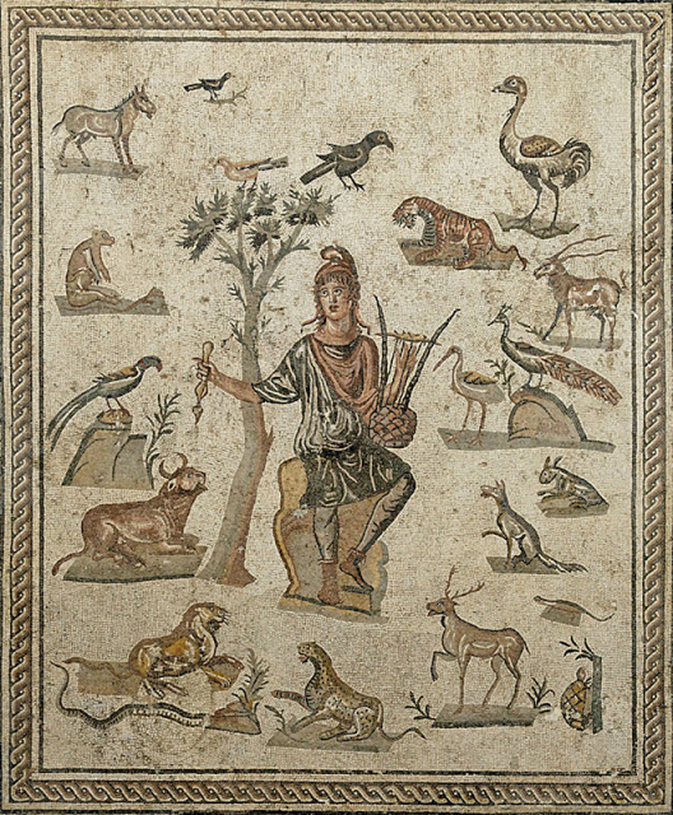
Orphism is the name given to a set of religious beliefs and practices originating in the ancient Greek and Hellenistic world, associated with literature ascribed to the mythical poet Orpheus, who descended into the Greek underworld and returned.
What does Plato say about wisdom for the afterlife?
Beggar priests and seers come to the doors… and they offer a bundle of books of Musaios and Orpheus… according to which they perform their sacrifices; they persuade not only individuals but whole cities that there is release and purification from misdeeds through sacrifices and playful pastimes, and indeed for both the living and the dead; they call these teletai, which deliver us from evil in the afterlife; anyone who declines to sacrifice, however, is told that terrible things are waiting for him
Plato, Republic, 364b-365a
What does Euripides write about Orphic practice?
Continue then your confident boasting, take up a diet of greens and play the showman with your food, make Orpheus your lord and engage in mystic rites, holding the vapourings of many books in honour.
Euripides, Hippolytus, 952-4
What are both of the above texts doing?
They’re both sort of mock Orpheus and the people who praise him
Identify this:

Orphic Texts- The Derveni Papyrus
What is the Derveni papyrus?
Papyrus from Macedonia in 266 fragments of 24 columns. Ca.340BC - oldest literary manuscript in Europe. Part of a funeral pyre.
What is it a commentary on?
Commentary on an Orphic poem concerning the generations of Night down to Zeus in Orphic cosmogony – sets up a rival theogony to Hesiod
Who is Orpheus mentioned as?
Orpheus is mentioned as the author of this poem.
What is the first line from the papyrus?
First line - ‘Close the doors, you uninitiated’
What are Orphic gold tablets?
A series of small gold tablets with writing on. Writing has many spelling mistakes. Over 30 found in graves, but only in a minority of graves in any place- just the Orphic members.
Where have these Orphic gold tablets been found?
Range from Hipponion (Calabria) 400BC down to Rome AD 260, but most 4th-3rd BC in Magna Graecia. Crete, Thessaly. None in Attica. Found open in hands of deceased or folded on chest or in mouth
What do these gold tablets contain?
Contain esoteric knowledge. These are revelation not literature. References to underworld- its geography, inhabitants, greetings, suggestions. So written from point of view of someone who has been to underworld- Orpheus.
Identify this

Gold foil tablet dating from the 4th century BC, Thessaly. Getty Museum.
Give a quick summary of the Bacchic mysteries
At night you clothed the initiates in fawnskins and held a mixing bowl over them and purified and cleansed them with mud and bran . . . By day you lead your fine bands of worshippers through the streets all crowned with fennel and white poplar . . .
Demosthenes 18.259-60
Pythagoreanism: give some base information on Pythagoras
Pythagoras was an historical figure
From Samos, born c. 570
Associated with Croton and Metapontum
Sage, prophet, miracle worker
Apparently had a golden thigh (Porph. V. Pyth. 28; Iambl. VP 92)
Give a summary of Pythagoreanism
Overlaps with Orphism: vegetarianism, esoteric knowledge, belief in the transmigration of souls, reincarnation, and escape from eternal cycle through purity
Didn’t eat beans
Both Orphism and Pythagoras associated particularly with the Greek West
What was the Pythagorean belief about Greek gods and numbers?
Greek gods were cosmic powers linked to numbers. Iamblichus in his work on Pythagoras’ The Sacred Discourse says Pythagoreans sacrifice to Aphrodite on 6th day, b/c 6 first number to share in odd + even (2x3=6). Marriage is unity of odd+ even. Odd = male, even = female.
What did the gods become more like in Pythagorean belief?
Gods lost ‘godly’ aura and became more ‘scientific’. A rational mythology not a mystical one like Hesiod or Orphic. Mathematics was fundamental to all. But can Greek religion be rationalised?
What was their belief in in Pythagorean belief?
Belief in afterlife and soul needing to be purified.
Revolutionary doctrine? Only select few achieve afterlife, and this was a private not public religion.
How was engagement with polis religion in Pythagorean belief viewed?
Engagement with polis religion? Problematic.
What are the Kabeiroi?
Mysterious chthonic deities associated with Mystery cults on the islands of Lemnos and Samothrace and at Thebes in Boeotia.
Who are the Kaberoi linked with?
Linked on Lemnos and Samothrace with Hephaestus.
What else can they be called and how many of them were there?
Not always named as Kabeiroi; sometimes korybantes; sometimes different sexes and between two and six individuals.
Kabeiroi and the sea
Great Gods linked to safety at Sea. Herodotus was an initiate. If you made it to Samothrace it was a place where you could be initiated for good luck at sea
Name a similarity between the Eleusinian and samothracen (blank)
Similarity of Eleusinian and Samothracen initiation:
Given the similarity of the Eleusinian and Samothracian stages of initiation (mystai/epoptai), the Samothracian preliminary ritual should, like Eleusinian myesis, involve purification. Here is seems to have been referred to as the Thronosis
What did Plato say about the Kabeiroi
‘Perhaps you do not perceive what sort of thing the two guests are doing around you. They are doing the same thing that those at the telete of the Korybantes do when they perform the thronosis around the person for whom they are going to perform the telete. For indeed there is dancing and playfulness there (i.e. in the thronosis), as you know if in fact you too have experienced the telete. And now these two are just performing a choral dance about you and as it were dancing playfully in order to perform the telete (for you) afterwards.’
Plato (Euthydem. 277d)
What were the Samothrace mysteries?
The Samothrace mysteries were a renowned ancient Greek mystery cult held at the Sanctuary of the Great Gods on Samothrace island (7th century BCE – 4th century CE). Unlike other cults, it was open to all—regardless of status or gender—offering personal safety, particularly at sea, and moral improvement to initiates.
What did Strabo write about the Corybantes?
Strabo (10.3.7):
But, roughly speaking and in general, they represent them all [Corybantes and similar figures] as a kind of inspired people and as subject to Bacchic frenzy, and, in the guise of ministers, as inspiring terror at the celebration of the sacred rites by means of war-dances, accompanied by uproar and noise and cymbals and drums and arms, and also by flute and outcry; and consequently these rites are in a way regarded as having a common relationship, I mean these and those of the Samothracians and those in Lemnos…
What did Pluyarch write about the initiation of the corybantes?
Plutarch, On the Soul, fr. 178 (Sandbach):
Then [at the point of death] it [i.e., the soul] suffers something like what those who participate in the great initiations suffer. Hence even the word “dying” is like the word “to be initiated”, and the act (of dying) is like the act (of being initiated).
First of all there are wanderings and wearisome rushings about and certain journeys fearful and unending through the darkness, and then before the very end all the terrors – fright and trembling and sweating and amazement.
But then one encounters an extraordinary light, and pure regions and meadows offer welcome, with voices and dances and majesties of sacred sounds and holy sights; in which now the completely initiated one becoming free and set loose…
Name a similarity between the Samothrace mystai and the Eleusinian mystai
At Samothrace too the mystai evidently wandered in the dark in search of a goddess. From a statement of Ephorus we learn that the goddess for whom the initiates searched was Harmonia:
Ephorus says that she (sc. Harmonia) was the child of Electra daughter of Atlas, that Cadmus carried her off when he sailed by Samothrace, and that she named the gates of Electra in honour of her mother. And even now in Samothrace they search for her in their festivals.
What did they celebrate by dancing in this festival?
Dance then celebrated marriage of Cadmus and Harmonia – was Harmonia lost by her bridegroom to be?
What is the Kabeirion?
The Kabeirion is a sanctuary on the outskirts of Thebes in Boeotia dedicated to the Kabeiroi, deities associated with fertility and the sea.
What did their cult include?
Their cult included mysteries whose introduction is ascribed to the goddess Demeter.
Pottery
A distinctive variety of pottery, known as Cabiric vases, was produced from the late fifth through the late fourth century B.C.

This example is characteristic in shape, subject, and technique. Such works may reflect farces performed in conjunction with the mysteries.
This image could possibly show Odysseus (left), woman on the right could possibly be Circe- stirring of the pot, could be a drugging thing
Write out what Pausanias wrote on the Kaberoi at Thebes
Kaberoi at Thebes:
Pausanias 9.25.5-6:
‘I must ask the curious to forgive me if I keep silence as to who the Kabeiri are, and what is the nature of the ritual performed in honour of them and of the Mother.
But there is nothing to prevent my declaring to all what the Thebans say was the origin of the ritual. They say that once there was in this place a city, with inhabitants called Kabeiri; and that Demeter came to know Prometheus, one of the Kabeiri, and Aetnaelis his son, and entrusted something to their keeping. What was entrusted to them, and what happened to it, seemed to me a sin to put into writing, but at any rate the rites are a gift of Demeter to the Kabeiri’
How is Thebes connected to Samothrace?
Thebes is connected to Samothrace in myth, primarily the wedding of Cadmus and Harmonia, which took place there.
Who are some of the votive dedications at Thebes dedicated to?
The votive dedications at Thebes are sometimes to a Kabeiros (Greek: Κάβειρος) in the singular, and childish toys like votive spinning tops for Pais suggest a manhood initiation.
Wine
Copious wine was drunk, out of characteristic cups that were ritually smashed. Fat, primitive dwarves (similar to the followers of Silenus) with prominent genitalia were painted on the cups.