A-Level Biology Enzymes: Action, Factors and Inhibition
 Call Kai
 Learn
Learn Practice Test
 Spaced Repetition
 Match
Match Flashcards
 Knowt Play
1/58

There's no tags or description
Looks like no tags are added yet.
Name | Mastery | Learn | Test | Matching | Spaced | Call with Kai | Chat |
|---|
No analytics yet
Send a link to your students to track their progress
59 Terms
Activation energy
Energy required to bring about a reaction.

Active Site
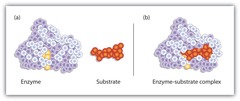
A group of amino acids that makes up the region of an enzyme into which the substrate fits to catalyse a reaction.
Competitive inhibitor
A form of inhibitor which binds to the active site of the enzyme preventing the binding of substrate.

Complimentary
Describes the relationship between the active site of an enzyme and the substrate molecule - the way in which they fit together.

Enzyme
A protein that acts as a catalyst and so lowers the activation energy needed for a reaction.
Enzyme-substrate (ES) complex
The intermediate formed when a substrate molecule interacts with the active site of an enzyme.

Induced fit model
A mechanism of interaction between an enzyme and a substrate where the active site changes shape to allow an enzyme-substrate complex to be formed.

Inhibitor
A substance which reduces the activity of an enzyme.
Kinetic Energy
The energy of motion, observable as the movement of an object, particle or set of particles.
Lock and key model
An analogy for how enzymes work - only the correctly sized key (substrate) fits into the keyhole (active site) of the lock (enzyme).
Metabolism
All the chemical processes that take place in living organisms.
Non-competitive inhibitor
A form of inhibitor which does not bind at the active site of the enzyme which prevents the binding of substrate.
pH
A figure expressing the acidity or alkalinity of a solution on a logarithmic scale on which 7 is neutral, lower values are more acidic and higher values are more alkaline.
Rate of reaction
The speed of a chemical reaction - can be worked out by looking at the decrease in concentration of a reactant over time or increase in concentration of a product over time.

Specific
Describes how each enzyme only catalyses a certain chemical reaction.
Substrate
A substance that is acted on or used by another substance or process. Fits into the active site of an enzyme.
Enzyme Concentration
Increasing enzyme concentration increases the number of active sites available for the substrate to collide with.
Substrate Concentration
Increasing the substrate concentration will increase the rate of reaction as there are more substrate molecules.
Temperature
As temperature increases so does the rate of reaction as there is more kinetic energy so the molecules move faster.

pH effect on enzymes
Above and below the optimum pH for each enzyme, the H+ ions and OH- ions disrupt the ionic and hydrogen bonds holding the enzyme's tertiary structure in place.

Competitive Inhibition
Have a similar shape to that of substrate molecules and compete with the substrate to bind to the active site of the enzyme.
Non-Competitive Inhibition
Do not bind to the active site as have different shape to the substrate and bind to a site away from the active site.
Denaturation
At high temperatures, the enzyme molecules vibrate too much, and bonds are broken which maintain the tertiary structure.
Saturation point
When all the enzyme active sites are occupied, increasing the substrate concentration will have no further effect on the rate.
Induced-fit Model
The updated model suggesting that the active site can change shape slightly to fit around the substrate and form an ES complex.
Enzyme-catalysed reaction
A reaction that is accelerated by the presence of an enzyme.

Temperature effect on enzyme reaction
The rate of an enzyme-controlled reaction can vary with temperature.
Controlled factor in enzyme experiments
One other factor the technician would have controlled.
Rate of reaction at 25 °C
The calculated speed of the enzyme reaction at this temperature.
Enzyme specificity
An enzyme catalyses only one reaction due to its specific active site.
Gout
A disease caused by the build-up of uric acid crystals in joints.
Xanthine oxidase
An enzyme that catalyses the production of uric acid from xanthine.
Allopurinol
A drug used to treat gout by inhibiting xanthine oxidase.
Protease
An enzyme that digests protein.
Effect of temperature on protease activity
The graph shows how protease activity varies with temperature.
Enzyme shape and function
The shape of an enzyme molecule is crucial for its specific function.
Vinegar's effect on bacterial enzymes
Vinegar, being acidic, can prevent the action of bacterial enzymes.
Temperature decrease and enzyme activity
A decrease in temperature decreases the kinetic energy of molecules.
Urea's effect on enzyme reactions
Urea breaks hydrogen bonds, affecting the rate of enzyme-controlled reactions.
Potassium ions in respiration
Concentrations of potassium ions are measured to study respiration.
Inhibitor in respiration
A substance that prevents respiration in plant roots.
Malonate
An inhibitor of respiration with a structure similar to the substrate.
Malonate's mechanism of inhibition
Malonate inhibits respiration by competing with the substrate for the enzyme.
Enzymes
Speed up the rate of chemical reactions in organisms by acting as catalysts.
Enzyme-Substrate Complex
Formed when an enzyme binds to a substrate.
Metabolic Reactions
Reactions that occur at a cellular level, such as respiration and digestion.
Optimum Temperature
The temperature at which an enzyme works best.
Optimum pH
The pH level at which most enzymes work best, typically around pH 7.
Enzyme Inhibitors
Molecules that bind to enzymes and slow or prevent their activity.
Hydrogen Bonds
Bonds that can be disrupted by changes in pH, affecting enzyme structure.
Ionic Bonds
Bonds that can be disrupted by changes in pH, affecting enzyme structure.
Enzyme Activity
Can be affected by factors such as temperature, pH, enzyme concentration, and substrate concentration.
ES-complex
The complex formed when an enzyme and substrate bind together.
Proton Tunneling
A phenomenon where protons can tunnel through energy barriers, allowing reactions to occur.
Specificity
The ability of an enzyme to only bind to a specific substrate due to its unique shape.
3D Structure
The three-dimensional shape of an enzyme that is crucial for its function.
Metabolic Rate
The speed at which metabolic reactions occur, influenced by enzyme activity.
Collisions
Interactions between molecules that lead to the formation of ES-complexes.
Limiting Factor
A condition that restricts the rate of a reaction, such as substrate or enzyme concentration.