VI. Analyzing Dynamic Systems in the Frequency-Domain
 Call Kai
 Learn
 Practice Test
 Spaced Repetition
 Match
 Flashcards
 Knowt Play
1/35

There's no tags or description
Looks like no tags are added yet.
36 Terms
Motivation for Analyzing Dynamic Systems in the Frequency-Domain
dynamic system models will now be analyzed in teh frequency-domain using the lapalce transform
What does the Laplace Transform allow? - Motivation
i. different equations to be conviently solved via algebra
ii. complicated systems to be decomposed into simpler functional blocks
iii. information system dynamic characterizations w/o the need to solve the differential equations
Unilateral LT of a Signal f(t)
the complex fcn: F(s) = integral from 0- to infinity (f(t) * e^(-st) dt where s is the complex frequency (s = sigma + jw)
LT converts a time-domain fcn to a frequency-domain fcn
bc the LT is an infinite integral, the LT DNE for all signals
What signals have LTs?
ones that grow no faster than an exponential
signals routinely used in dynamic systems analysis
Laplace Transform Tables

LT Properties
4 of them: linearity, time-differentiation, time interaction, and time-shifting
Linearity - LT Property
if f1(t) ←> F1(s) + f2(t) ←> F2(s), then af1(t) + bf2(t) ←> aF1(s) + bF2(s) where a/b are any constants
Time-differentiation - LT Property
if f(t) ←> F(s), then f.(t) ←> sF(s) - f(0-)
f..(t) ←> s²F(s) - sf(0-) - f.(0-)

Time Integration - LT Property
if f(t) ←> F(s0, then the running integral of 0- to infinity (f(tau)dtau) ←> (1/s)F(s)
differentiating/integrating in time corresponds to multiplying/dividing by s in frequency (LT converts calculus to algebra)

Time Shifting - LT Property
if f(t) ←> F(s), then f(t - to) ←> F(s) e^(-sto) to > 0

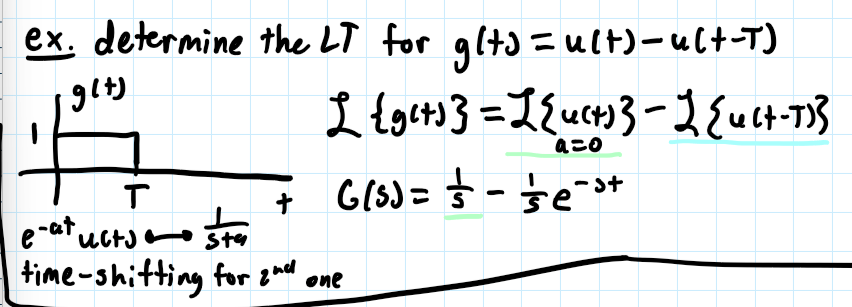
LT of g(t) = u9t) - u(t-T) Example
LT of y.(t) + ay(t) = 0 for some y(0) Example
1st-order, linear, time-invariant, autonomous equation


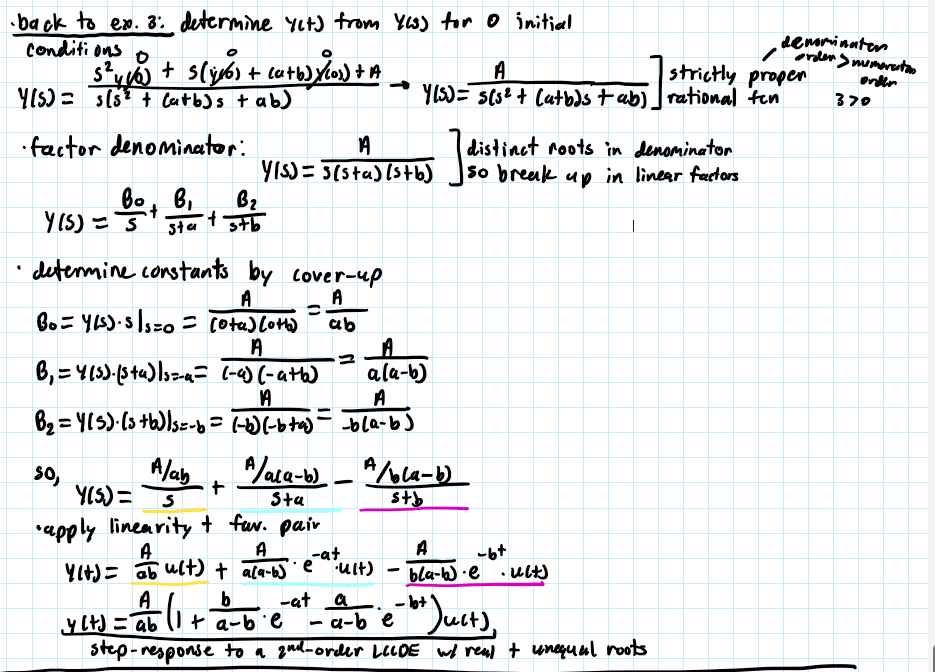
LT of y..(t) + (a+b)y.(t) + aby(t) = Ax(t) Example
Inverse LT Formula
f(t) = integral from c-jinfinity to c+jinfinity (F(s) e^(st) d(t)) → contour integral
Contour Integral is what?
more complicated to solve than the LCCDE in the time-domain
Alternative Method to Solving the Inverse LT
via partial fraction expansion (PFE) → applicable when Y(s) is a rational fcn (ratio of polynomials)
Partial Fraction Expansion (PFE) Steps
brea Y(s) up into simplier components
find inverse LT of each component using tabl elook-up
sum the inverse LTs to get y(t)
this works bc the LT is linear
Impulse Response
time-domain approach that was used to determine the impulse response of an LCCDE that only works when the right-hand side is bx(t) and doesn’t for more complicated right-hand sides (e.g., x(t) + x.(t))
LT may be applied to easily determine this of any LCCDE
Show that impulse(t) ←> 1 - Impulse Response Examples

Find the impulse response for y..(t) + (a+b)y.(t) + aby(t) = Ax(t)

System Impedance
the feature of the system that produces the opposition that the (generalized) flow encounters and the (generalized) effort that is needed to produce the flow
ex. systemic arterial circulation
Other BioE System Impedance Examples
electrical impedance when dealing w/ recording instruments
electrical impedance of biological tissues when dealing with electrical stimulation devices (pacemakers and neural stimulators)
mechano-impedance of the lung ventilatory system (pushing air into the lungs)
mechanical impedance of movement round joints and tissues
Impedance of a Network (Z(s))
the ratio of the LT of the efort at its entry point (E(s)) to the LT of the flow at this point (F(s))

What does Z(s) (impedance of a network) do?
allows an alternate analysis of networks w/o using node/loop laws
provides a single expression for all network elements as a kind of simplification of multiple elements and their arrangement
Impedance of Generalized Elements
resistance - Z(s) = R
PE storage/capacitance element - Z(s) = 1/sc
KE storage/inductance element - Z(s) = sL
Impendance of a Network of Elements
combine impednaces of individual components
Combining Series Impedances
loop law so Z(s) = Z1(s) + Z2(s) + …
just add them together
Combining Paralllel Impedances
node law so Z(s) = (Z1(s) * Z2(s)) / (Z1(s) + Z2(s))
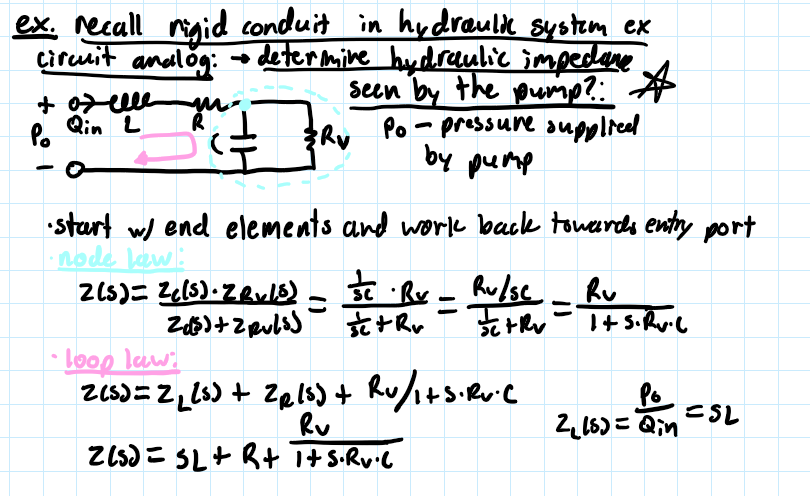
Combining Impedances Example
Impedance to Differentiation
the diff. eqn. relating e to f at the entry port can be easily determine
start with definition of Z(s) (= E(s) / F(s)), cross-multiply, then determine LCCDE by inspection based on LT properties
Impedance to Differentiation Examples

Transfer Function - Motivation
a transfer fcn is an s-domain fcn by which the LT of an input (X(s)) is multiplied by it to produce the LT of the output (Y(s)): Y9s) = H(s) * X(s) → H(s) = Y(s) / X(s) (transfer fcn)
system impedance (Z(s)) is a transfer fcn specifically relating the LT of the input flow (F(s)) to the LT of the output effort (E(s)) at the entry port of the system: E(s) = Z(s) * F(s)
transfer fcn is general and related any pair of input and output vars. of aystem
What are transfer functions useful for?
synthesis - combining subsystems to determine overall system behaviot
analysis - determing behavior of a asystem w/o having to solve the differential equations
Transfer System Definition

Comments about the Transfer Function (H(s))
can be determined from an LCCDE and vice versa by inspection (w/ si ←> di/dti)
if x(t) = impulse (t), then X(s) = 1 so therefore from earlier, the inverse LT of H(s) is the impulse response
completely characterizes the LCCDE in the sense that it can be used to determine the output to varioys inputs when the system is at zero ICs (rest) → therefore system block diagrams are often labeled with H(s)
