523: E2: Language Sampling, Literacy Models, and K–6 Interventions
 Call Kai
 Learn
 Practice Test
 Spaced Repetition
 Match
 Flashcards
 Knowt Play
1/43

There's no tags or description
Looks like no tags are added yet.
44 Terms
What are C-units and T-units?
C-units (communication units) are main clauses with modifiers that stand as complete conversational turns. T-units (terminable units) are main clauses plus any subordinating units, forming a complete grammatical sentence.
What signifies two C-units or T-units?
The presence of conjunctions such as 'and', 'but', 'or', 'so', and 'then'.
How is MLU calculated?
MLU (Mean Length of Utterance) is calculated by counting the number of different words in a sample.
What does the Subordination Index measure?
It measures sentence complexity by indicating how many clauses are present per C-unit or T-unit.
What should be done with repetitions or mazes in scoring?
They should not count towards the score and should be placed in parentheses.
What are subordinating conjunctions?
Words like 'because', 'if', 'when', 'until', 'as soon as', 'while', 'although', and 'whether' that introduce subordinate clauses.
What are coordinating conjunctions?
Words like 'and', 'so', 'but', and 'or' that can stand alone and connect clauses.
What is the Simple View of Reading?
It states that reading comprehension (RC) is the product of decoding (D) and language/listening comprehension (LC), expressed as D x LC = RC.
What does Scarborough's Rope illustrate?
It illustrates that skilled reading results from the coordination of language comprehension and word recognition.

What components make up language comprehension?
Background knowledge, vocabulary, language structure, verbal reasoning, and literacy knowledge.
What is the Simple View of Writing?
Writing is the product of text generation, transcription, and self-regulation.
What is narrative language development?
It is the account of experiences or events organized and sequenced to convey meaning, which can be oral or written.
What are the types of narrative accounts?
Recounts (prompted), accounts (unprompted), event casts (ongoing activities), scripts (routine descriptions), and stories (fictionalized accounts).
What is macrostructure analysis in narrative development?
It examines the organization and cohesion of narratives, including elements like setting, initiating events, and resolutions.
What is microstructure analysis?
It focuses on grammar, vocabulary, and literary devices within narratives.
What are the components of macrostructure according to Stein and Glenn?
Setting, initiating event/problem, internal response, internal plan, attempt, consequence, resolution or reaction, and ending.
What is the purpose of the High Point Analysis in personal narratives?
It identifies the introduction, orientation, complicating action, evaluation, resolution, and coda of a narrative.
What is Morphosyntax?
It refers to difficulties in complex syntax structures, often addressed in oral language interventions.
What is the Sentence Deconstruction method?
An intervention method that introduces definitions, provides examples, and includes guided and independent practice.
What does the Sentence Completion method involve?
It includes explicit instruction in combining sentences by adding relative pronouns and making relative clauses.
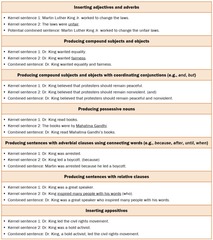
What is sentence combining?
A technique that teaches students to combine smaller kernel sentences into larger complex sentences.
What is the purpose of shape coding in sentence construction?
To use a visual coding system to show how components combine to create sentences.
What is semantic mapping?
An intervention method that strengthens connections among words through visual representation.
What does morphological awareness involve?
Teaching the meaning of bases and affixes, often using sticky notes to build words.
What is narrative language intervention?
An approach that teaches story grammar and elements of high point analysis, often using visuals and graphic organizers.
What is robust vocabulary intervention focused on?
Tier II vocabulary, which includes academic words critical for understanding text but not commonly used in conversation.
What are the types of inferences in reading comprehension?
Anaphoric, bridging, elaborative, and predicting inferences.
What is the goal of strategy instruction in reading?
To activate content/background knowledge, ask questions, summarize, retell, and predict during reading.
What does the SRSD model stand for?
Self-Regulated Strategy Development, which includes stages like developing background knowledge and independent performance.
What is the purpose of using graphic organizers in text structure awareness?
To support understanding of how passages are organized and to aid comprehension.
What are Elkonin boxes used for?
To help clients segment sounds in a word, where each box corresponds to a sound.
What is the focus of phonemic awareness interventions?
To enhance skills in segmenting and blending sounds critical for reading.
What does the acronym POW stand for in writing strategies?
Pick my ideas, Organize my notes, Write and say more.
What is the role of explicit instruction in pragmatics interventions?
To define social skills and rules, making students aware of them.
What is the purpose of using manipulatives in phonemic awareness?
To provide visual and tactile support for segmenting and blending sounds.
What does the term 'text structure' refer to?
How a passage is organized, including types like descriptive, sequence, cause/effect, problem/solution, and compare/contrast.
What is the importance of inference generation in reading?
It helps readers make connections and fill in gaps between pieces of information.
What is the purpose of using tier II vocabulary in interventions?
To enhance academic language that is critical for understanding various subjects.
What is the role of visuals in narrative language intervention?
To support understanding and sequencing of stories for younger clients.
What is a key component of written language intervention for K-6?
Focusing on decoding and encoding as part of early literacy.
What does 'self-regulation' in writing entail?
Planning, revising, and goal setting during the writing process.
What is the significance of repeated practice in vocabulary intervention?
To ensure high intensity exposure (36 times) to learn new words effectively.
What is the benefit of role-playing in pragmatics interventions?
To practice social skills in context, enhancing understanding and application.
How can SLPs support text structure awareness?
By explicitly teaching features of specific text structures and providing multiple examples.