4U Genetics
 Call Kai
 Learn
Learn Practice Test
 Spaced Repetition
 Match
Match Flashcards
 Knowt Play
1/34

There's no tags or description
Looks like no tags are added yet.
Name | Mastery | Learn | Test | Matching | Spaced | Call with Kai | Chat |
|---|
No analytics yet
Send a link to your students to track their progress
35 Terms
what is a nucleotide composed of?
a nitrogenous base
a sugar
one or more phosphates

Nitrogenous Bases are in heterocyclic rings. Explain the 2 types and say which base is in what category

Sugars are pentose. Explain the 2 types of sugars
• two types:
ribose
deoxyribose (missing O from #2 carbon

identifying nucleotides
add pic

Biological Importance of Nucleotides (2 things)
ATP (adenosine triphosphate)
• monomers of nucleic acids
Explain how nucleotides bond. What kinda linkage?
nucleotides are linked by phosphodiester linkages between the
phosphate of one to the sugar of the next (#3 carbon)
• these form long strands (millions nucleotides!)
• double strands joined across the nitrogenous bases by hydrogen bonding
• the two strands are antiparallel
• double helix; one complete turn every 10 base pairs
• four different nucleotides: A,T,C,G

Explain how the 4 nucleotides bond together

Similar to DNA, except:
• different sugar. ribose instead of deoxyribose
• one different nitrogenous base uracil instead of thymine
• it is shorter)
•single stranded
•found both inside and outside
the nucleus (DNA is only in the nucleus)

Semi‐conservative Replication
One DNA molecule strand is used as a template to produce two new, identical molecules
• Thus each new DNA molecule consists of 1 parent & 1 new synthesized strand

DNA replication occurs with the assistance of different enzymes (“‐ase”).
• Replication is an endergonic process driven by enzymes
• Complimentary base pairing (AT, CG) helps explain how DNA is replicated prior
to cell divison

In what phase of the cell cycle thingy does dna replication happen?
During S phase in interphase of mitosis or meiosis. complete set of an organisms' chromosomes must go to each daughter cell
do nucleotides bond in the 5’ to 3’ direction?
Yes


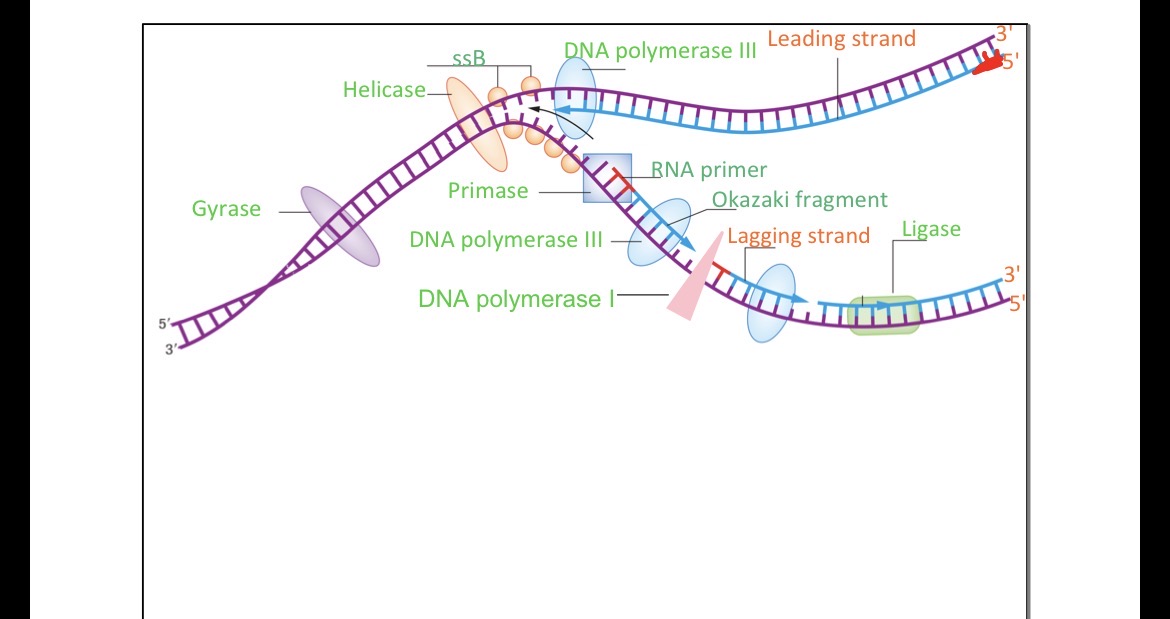
In dna replication, I bind to the single strands of DNA to prevent rezipping
Single stranded binding proteins
In dna replication, I Bind to the ss DNA and lay down RNA primers to build new complementary strands
• Free floating nucleotide triphosphates (dNTP) base pair with nucleotides along
the ss DNA strands
Primase
In dna replication, I Bind to the ss DNA and lay down RNA primers to build new complementary strands
• Free floating nucleotide triphosphates (dNTP) base pair with nucleotides along
the ss DNA strands
Primase. Primers are continuously added as the replication fork forms
Attaches nucleotides to one end of the growing complementary strand and
builds the DNA in the 5’ to 3’ direction
‐ Nucleotides lose 2 phosphates which generates the energy for this process
‐ Leading strand uses 3’ to 5’ template as a guide
‐ Lagging strand uses 5’ to 3’ template of original strand as a guide
• Therefore, new strand formation happens in opposite directions along the two
strands of a DNA molecule
DNA polymerase III.
Primase and Polymerase III continue to attach nucleotides on the lagging strands
in short segments (Okazaki fragments)
‐ Replication is continuous in one direction (leading strand) and
discontinuous in the other direction (lagging strand)
Replaces RNA primer segments with DNA nucleotides
DNA polymerase I
Joins the gaps in the lagging strand by building the sugar‐phosphate backbone
Ligase
Briefly explain the steps of dna replication
helicase unzips dna helix by breaking hydrogen bonds between complimentary base pairs.
Singe stranded binding proteins bind to single strands of DNA to prevent rezipping (they like door stops)
Primase binds to the single strands of DNA and lays down RNA primers to build new complimentary strands
DNA polymerase 3 Attaches nucleotides to one end of the growing complementary strand and
builds the DNA in the 5’ to 3’ direction. Primase and Polymerase III continue to attach nucleotides on the lagging strands
in short segments (Okazaki fragments)
DNA polymerase I Replaces RNA primer segments with DNA nucleotides
Ligase Joins the gaps in the lagging strand by building the sugar‐phosphate backbone
extra: DNA polymerase can only add nucleotides to the 3′ end of a growing strand, so DNA can only be built in the 5′ → 3′ direction.
The average human chromosome contains _ nucleotide pairs which are
copied at about _ base pairs per second
150 × 10^6, 50. The process would take a month (rather than the hour it actually takes)
• However, there are many places on the eukaryotic chromosome where
replication can begin
• As replication nears completion, bubbles of newly replicated DNA meet and
fuse, finally forming two new molecules

Tell 3 differences between the leading and lagging strands

a slow moving enzyme that recognizes mispaired nucleotides
• often repair damage that occurs between replication
• they cut out the chunk of new strand where the error occurs
• the gap is repaired by DNA polymerase I and DNA ligase
• but what if these are missed? On average, ten are missed every
time a cell divides!
DNA polymerase II
proof‐reads” as it replicates
• if it screws up, it can fix the error right then (but only then)
• once the next nucleotide is in place, it’s too late
• 99% accurate (but that’s still a lot of error)
DNA polymerase III


To prevent destruction of important genetic material, chromosomes have
several thousand repeating, non‐coding nucleotide sequences (TTAGGG) at their
ends called
Telomeres. These nucleotides are lost after a cell division
• After many cell divisions, when all of the telomeres are eroded, the nucleotides
that are removed representing important coding genes and the cell dies
Telomerase

Cancer cells don't follow the normal rules of cell function
• Normal cells that have mutated, causing unregulated cell division
• Two genes regulate mitosis:
Oncogenes (increase mitosis rate)
‐ Tumor suppressor genes (decrease mitosis rate)
Problems arise when there is an imbalance of these genes
• Changes that can possibly happen:
‐ Immortalization (cells don’t die)
‐ Transformation (cells don’t function normally)
‐ Metastasis (cells become mobile)
• Cancer cells also have large quantities of telomerase within them
Restriction Enzymes

DNA Fingerprinting
humans share over 99% of genome with each other
• so, we differ in less than 1% of our DNA, but these small differences are measurable
• we can gather a sample of DNA from someone
• the DNA is then cut up using restriction enzymes
• most of the resulting fragments will be the same as everyone else’s, BUT ...
• the 1% of DNA in which we differ will produce different sized fragments from those of other
people
• all we have to do is compare the resulting fragments
Gel Electrophoresis(Way of comparing DNA)

Polymerase Chain Reaction (PCR)

Uses of PCR (4)
-to massproduce genes for engineering;
• to massproduce base sequences for analyzing
• DNA fingerprinting
• fossil identification