3.4.3 Genetic diversity
 Call Kai
 Learn
 Practice Test
 Spaced Repetition
 Match
 Flashcards
 Knowt Play
1/13

There's no tags or description
Looks like no tags are added yet.
14 Terms
Gene and chromosome mutations:
-A gene mutation is a change in the DNA base sequence.
-Mutations occur spontaneously if DNA is misread during DNA replication. Ultraviolet or ionising radiation, chemicals and viruses can increase the rate of mutations. These are known as mutagens.
The three types of gene mutations are:
Substitution - One base is replaced by another.
Deletion - One base is removed from the sequence.
Insertion - One base is added into the sequence.
-These mutations may change the amino acid sequence coded for by the gene. This will lead to a different polypeptide and potentially a different tertiary structure.
Substitutions:
-Not all substitution mutations will result in a change to the amino acid sequence of a protein.
-In the example above, the base C has been substituted for a T. However, this triplet codes for the same amino acid so has no effect on the amino acid sequence.
-This is due to the degenerate nature of the genetic code. Many amino acids are coded for by more than one triplet.

Deletions:
-Deletions are much more likely to change the amino acid sequence because they cause a frameshift.
-In the example above, the base T has been deleted from the base sequence. This causes a frameshift where the entire sequence after the deletion shifts to the left by one base.
-This changes all the triplets after the deletion and so also changes the amino acid sequence.

Insertions:
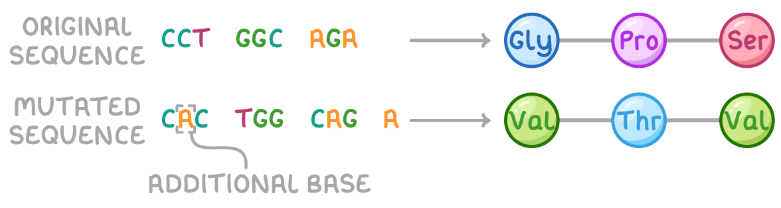
-Insertions are likely to change the amino acid sequence because they also cause a frameshift.
-In the example above, the base A has been inserted into the base sequence. This causes a frameshift where the entire sequence after the insertion shifts to the right by one base.
Chromosome mutations:
-Chromosome mutations involve changes to the structure or number of whole chromosomes. Mutations to chromosome number can arise spontaneously through errors in cell division.
-Two main types of mutations to the number of chromosomes exist:
Polyploidy - This is when organisms have more than two sets of chromosomes, and is mostly seen in plants.
Non-disjunction - This occurs when homologous chromosomes fail to separate in meiosis, resulting in gametes with extra or missing chromosomes, and leads to individuals with extra or missing chromosomes in all cells.
Meiosis:
-Meiosis is a type of cell division in which a parent cell divides to form four haploid cells, each genetically distinct from one another.
-The cell then undergoes 2 divisions:
Meiosis I - Homologous chromosomes are separated.
Meiosis II - Chromatids are separated.
-The two divisions of meiosis contain the same stages as mitosis:
Meiosis I - Prophase I, metaphase I, anaphase I, and telophase I.
Meiosis II - Prophase II, metaphase II, anaphase II, and telophase II.

Meiosis I
Prophase I:
The chromosomes condense, thicken and elongate and homologous chromosomes pair up.
Centrioles migrate to opposite poles of the cell where each centriole starts forming spindle fibres.
The nucleolus disappears and the nuclear envelope starts to break down, leaving the chromosomes free in the cytoplasm.
Metaphase I
Chromosomes line up along the equator of the cell in their homologous pairs (so in humans, 23 pairs line up).
Each chromosome attaches to the spindle by their centromere.
Anaphase I
Homologous chromosome pairs are separated and pulled to opposite poles of the cell (chromatids stay joined together).
Telophase I
The chromosomes reach the opposite poles of the cell where they uncoil.
A nuclear envelope forms around each set of chromosomes and the nucleolus starts to reform.
The cytoplasm divides to form two cells (cytokinesis).
Meiosis II:
Prophase II
The chromosomes condense and are now visible under a microscope.
Centrioles migrate to opposite poles of the cell where each centriole starts forming spindle fibres.
The nucleolus disappears and the nuclear envelope starts to break down
Metaphase II
The chromosomes line up at the equator of the cell (so in humans, 23 chromosomes line up).
Each chromosome attaches to the spindle by their centromere
Anaphase II
The centromeres divide and separate each pair of chromatids.
The spindle fibres contract and shorten to pull the chromatids to opposite poles of the cell.
Telophase II
The chromatids reach the opposite poles of the cell where they uncoil to become long and thin again.
A nuclear envelope forms around each set of chromosomes to form two nuclei and the nucleolus starts to reform.
The cytoplasm divides (cytokinesis) and 4 cells are produced.
Comparisons between mitosis and meiosis

Meiosis and genetic variation
This type of cell division serves two important roles:
Production of haploid gametes - This allows sexual reproduction to take place.
Creates genetic variation - This increases diversity, allowing natural selection to take place.
Two events within meiosis lead to genetic variation:
Crossing over (or recombination)
Independent segregation (or random assortment)
Random fertilisation of gametes
Crossing over
This occurs during prophase one of meiosis
During prophase one, the homologous chromosomes condense and pair up
The chromatids of each chromosome them wrist around one another, forming a chiasmata
When the chromosomes are separated during anaphase one, the chromatids break at the chiasmata and then reconnect to the chromatic from the homologous chromosome
-This swaps allele between the homologous chromosomes to produce different combinations of each chromosome

Bivalents and chiasmata
Bivalents
Definition: A pair of homologous chromosomes (one maternal and one paternal) that come together and align lengthwise during Prophase I of meiosis.
Structure: Each chromosome has already replicated in Interphase (S phase), meaning the bivalent is actually made of four chromatids (often called a tetrad).
Key role: Forming bivalents allows physical contact and pairing between homologous chromosomes so that genetic material can be exchanged.
Chiasmata:
The physical point or "cross-over" bridge where non-sister chromatids of the homologous chromosomes wrap around and attach to each other inside a bivalent.
What happens there:
Chromatids break at the chiasma.
Sections of DNA/alleles are swapped between the maternal and paternal non-sister chromatids.
This process is called crossing over or recombination.
Outcome: The genes stay the same, but the combination of alleles on the chromatids changes. This results in recombinant chromatids that make the resulting haploid gametes genetically unique.
Independent segregation
-During metaphase I, pairs of homologous chromosomes line up along the cell's equator.
-However, whether the paternal or maternal chromosomes appears on the left or right is completely random.
-As a result, which chromosomes end up in each daughter cell is also random. This principle is known as independent segregation or random assortment.

Calculating genetic variation due to independent segregation:
-To calculate this, we use the formula 2n where 'n' represents the number of chromosome pairs.
-You may also need to calculate the number of genetically different zygotes that are possible from two parents.
The formula for this is (2n)2.
