Neuropathic, Nociplastic & Mixed Pain
 Call Kai
 Learn
 Practice Test
 Spaced Repetition
 Match
 Flashcards
 Knowt Play
1/48

There's no tags or description
Looks like no tags are added yet.
49 Terms
Neuropathic Pain
Pain caused by lesion or disease of somatosensory NS
Central neuropathic
Peripheral
Peripheral NS Branching Logic
Somatic NS: sense organs and voluntary mm
Sensory NS (afferent): inputs
Motor MS (efferent): output
Autonomic → Sympathetic (arouse) and parasympathetic (calm)
Neuropathic Pain Diagnoses Classifications + E.g.
Peripheral: trigeminal, peripheral nerve damage, polyneuropathy, post herpetic neuralgia, radiculopathy
Amputations, surgery, trauma, diabetic polyneuropathy, chemo induced
Central: brain injury pain, central post-stroke pain, pain w/ MS, pain w/ SC injury
Traumatic, birth injury, tumor
Neuropathic pain prevalance
Higher in diabetic populations
More so in females
And ppl > 50 yrs old
Neuropathic pain in #1 transduction
Spontaneous activity/pain in primary afferents
From nociceptive neurons
i.e. Electric shock out of the blue
Neuropathic pain in #2 transduction/transmission
Excitatory signals ascending from periphery, SC, brain due to structural changes
Ion channel fxn
Larger receptor fields
1+2 order MN
Fxnl changes (Sensitization)
Neuropathic pain in MODULATION
IMPAIRED DESCENDING INHIBITION
Why opioids are ineffective
Peripheral Sensitization
More responsive and lower threshold of nociceptive neurons in periphery to stimulation of their receptive fields
More TRANSDUCTION of nociceptive signals from periphery to SC
Non-noxious causes pain
Central sensitization
More responsive nociceptive neurons in CNS compared to norm/sub-threshold afferent input.
More TRANSMISSION of signals from SC - brain
AP fire for longer = pain longer
Location of pain means….
Corresponds to location of innervation by injured structure
Postherpetic neuralgia pain location (peripheral)
Unilateral in 1+ spinal dermatome or trigeminal nerve territory
Peripheral nerve injury pain location
Follows peripheral nerve map distribution
Distal to trauma site
Painful polyneuropathy pain location (peripheral)
Feet, lower leg, thighs, hands
Painful radiculopathy pain location (peripheral)
Follows dermatome map (innervation of nerve root)
Neuropathic pain from SCI (central) location
@ or below spinal cord lesion
Central post stroke pain location
Affected limbs are OPPOSITE to stroke
Lateral medullary infarction: opposite limbs affected, facial pain distribution is ipsilateral
Central neuropathic pain from MS location
All over body
Combined distribution
Pain Quality Scale for neuropathic pain
PROMIS measure of neuropathic pain
Paresthesia
Abnormal sensation
Spontaneous or evoked
Dyesthesia
Unpleasant abnormal sensation
Spontaneous or evoked
Hyperesthesia
More sensitive to stimulation, excluding special senses
Hypoesthesia
Less sensitive to stimulation, excluding special senses
Hyperalgesia
More pain from noxious stimuli
Hypoalgesia
Less pain to noxious stimulus
Anesthesia
No sensation in response to a stimulus
Neuropathic pain considerations in practise
Touch aggravates pain (i.e. clothes, exam)
Stimulanenous numb or sensory gain
Sensory changes occur w/ other pain mechanisms
Location of sensory changes
Paradoxical pain
Numb and sensitive
Coexist
Temporal Features
Ectopic activity of nociceptors
Spontaneous pain.
Onset of pain not correlate w/ onset of nerve injury/disease.
Can be delayed; not happen at same time as injury.
Pain intensity
Doesn’t always correspond w/ degree of neuro damage
First line pain relief for neuropathic pain
Not always work
Treatment for neuropathic pain
Manage symptoms not underlying disease
Treat underlying disease not correlated w/ improvements in pain
Require specialists and unique interventions
Graded motor imagery
Mirror therapy
Sensory retraining
Nociplastic pain
Error in detecting danger + pain processing
Modulation impaired
Increased feedback loop. Altered nociception.
CNS is hyper excitable
Immune system release of cytokines - bad feelers
Affects CNS, brain, immune system
Pain w/o tissue damage
Pain from altered nociception w/o tissue damage
Examples of Nocicplastic pain
Chronic primary pain
Headache disorders
IBS
Non specific LBP
Cause of Nocicplastic pain
Unknown
Dysfxn of NS of peripheral and central NS
Structural + fxnl changes of nociceptive neurons
On a spectrum
Field is grey
Nocicplastic Physiological Changes in the periphery
Larger receptor fields in periphery
Peripheral sensitization (more responsive, lower threshold)
More inflammatory mediators - localized inflammation
Nociplastic changes in Spinal cord to 2nd order NN
Structural: larger receptor fields
Function: central sensitization (more responsive, lower threshold)
Spontaneous activity
Nociplastic changes in brain to 3rd order NN
Functional changes: central sensitization
Functional changes in modulation: lose descending inhibition. Increased descending facilitation [dampen pain response to everyday things]
Structural changes: organization of cortex. pain areas enlarged
Temporal Summation/wind up
Successive increase in AP due to rapid, repeated stimulation
Overall increased pain perception
Last pin prick rlly hurts bc more signals sent to brain
Wind up in SC: enhanced response of nociceptors (more nociceptive signals transmitted w/ repeated transduction)
Pain location in nociplastic pain
Widespread
No correlation w/ anatomical structures
Nociplastic pain co-morbid symptoms
Sensitivity to other sensations
i.e. lights, sounds, temp
All sensations heightened
Co-exist or a result of diff nociplastic pain
Provoking factors in nociplastic pain
Due to CS, many stimuli provoke pain (also non-noxious)
Quality in nociplastic pain
Many descriptors
Widespread non specific
Severity in nociplastic pain
High intensity ratings
Not correlated w/ tissue damage
Temporal in nociplastic pain
Pain @ rest
Evoked or spontaneous by move or touch
Treatment for nociplastic pain
Focus on NS bc pain itself is the disease
NOT tissues (pain not associated w/ tissue damage)
Educate, active/exercise based strategies, self management
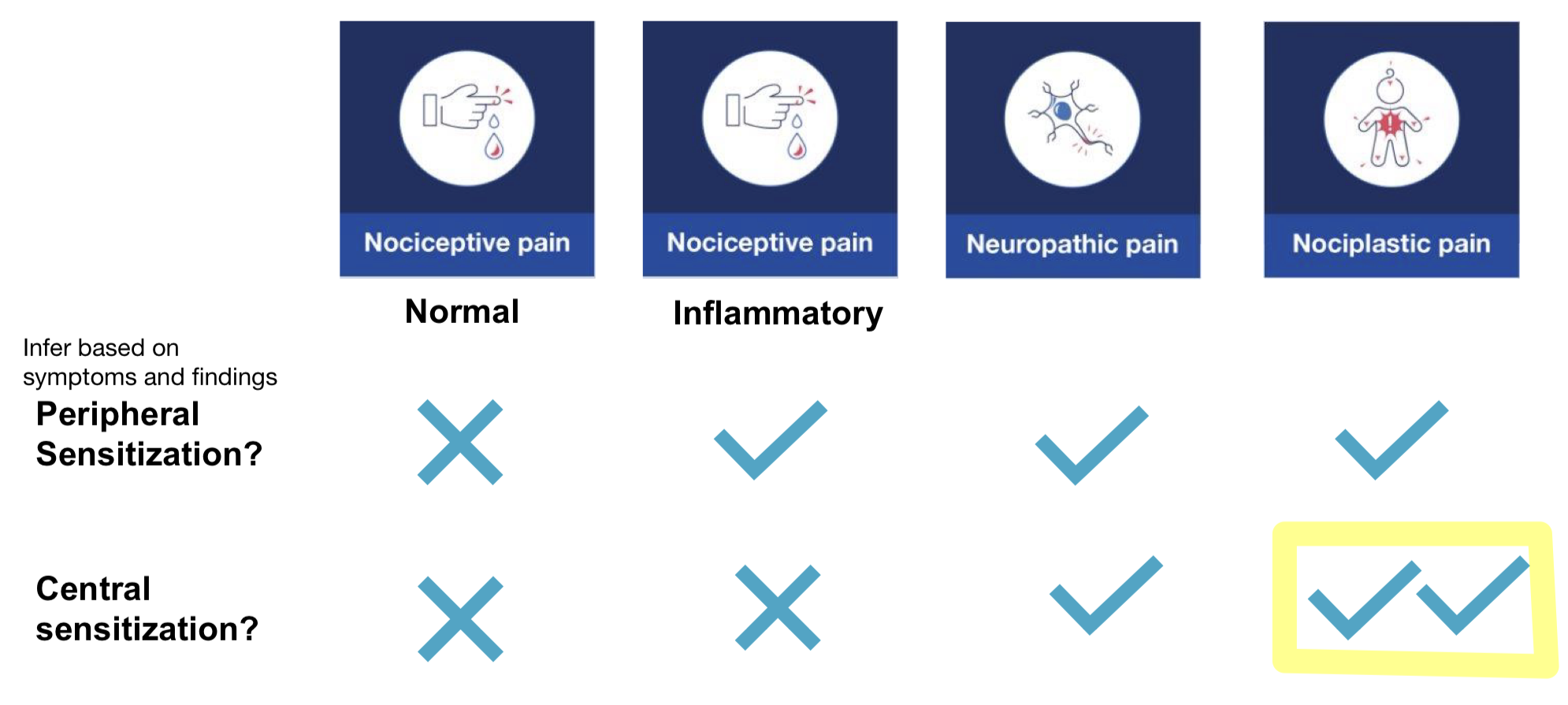
Sensitization based off mechanisms
Inflammatory pain: PS > due to inflammatory mediators
Short term
Neuropathic pain > PS + CS > due to nerve damage
Nociplastic pain > PS + CS
Long term lasting changes
Mixed pain definition
Pain starts as nociceptive/neuropathic → nociplastic over time
i.e. arthritis → nociplastic changes
OR
Pain w/ multiple pain mechanisms [combo] that co-occur
i.e. surgery > nociceptive from cut + neuropathic + inflammatory pain
i.e. sciatica, cancer, OA post surgical
Pain @ MANY body sites that each have distinct mechanisms contributing to persons overall pain experience
i.e. Person w/ TMJ, IBS, acute ankle sprain
For pain conditions that don’t fit
Mixed pain physiology
Co occur w/ existing mechanisms
OR
Unique mechanism
OA Pain
Mixed pain: signs of sensitization
Initially thought as Nociceptive
Evidence of low grad inflammation contributing to inflammatory pain
changed innervation of joint - neuroapthic pain
Increased innervation of osteochondral junction + cartilage (poorly innervated), loss of synovial lining