Memory Flashcards
 Call Kai
 Learn
 Practice Test
 Spaced Repetition
 Match
 Flashcards
 Knowt Play
1/77

There's no tags or description
Looks like no tags are added yet.
78 Terms
Memory
The persistence of learning overtime through the storage and retrieval of information
Encoding
Information going into the memory system
Storage
Retaining the information that has been stored
Retrieval
The process of getting the information back out at a later point in time
Automatic Processing
-Processing information without even thinking about it
-Ex) telling time
Effortful Processing
-Trying to process information so that you can have it in your memory later
-Ex) Studying
The Multi-Store Model
Includes sensory memory, short term memory, working memory, and long term memory

Sensory Memory
Immediate memory of sensory information
Short Term Memory
Works briefly; until it is either rehearsed or lost
Working Memory
focuses on conscious active processing, associating new and old information at the same time
Long Term Memory
Permanent Storehouse of the memory system
Iconic (Sensory Memory)
-Stores visual information for less than half a second
-Ex) If you see a car pass by on the highway, you might be able to picture it for a moment after it is already gone
Echoic (Sensory Memory)
-Stores auditory information for three to four seconds
-Ex) You might be able to recall the sound of a dog barking a few seconds after hearing it
The Working Memory Model
Includes working memory, central executive, visuospatial sketchpad, and the phonological loop
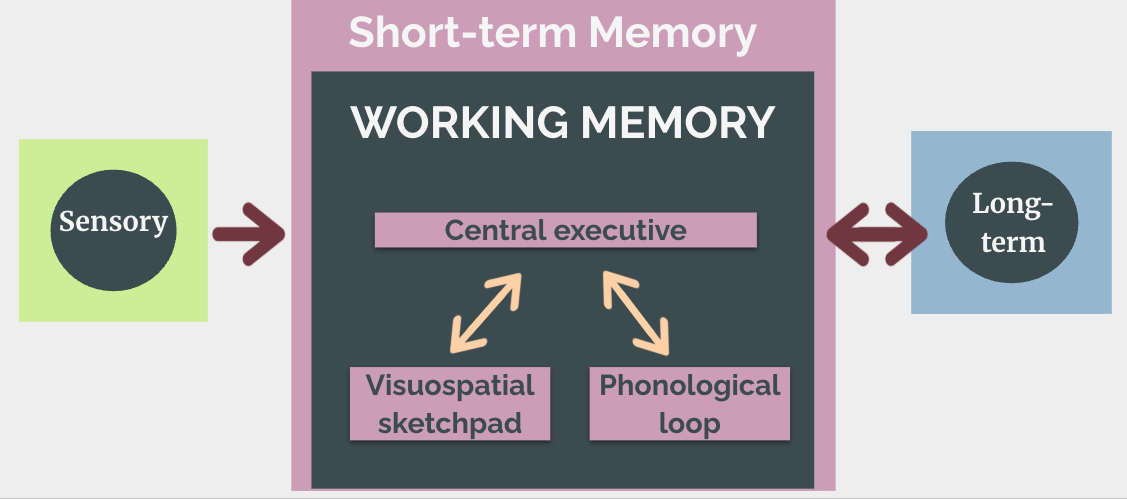
Working Memory (Model)
Active process of remembering
Central Executive
-Controls attention and coordinates phonological and visuospatial
Visuospatial Sketchpad
-Handles both visual and spatial information
-inner eye can visualize a mental picture
Phonological Loop
-Handles auditory information
-Stored in the inner ear
-The articulatory control system is your inner voice
Levels of Processing Model
Shallow: Structural and Phonemic
Deep: Semantic
Levels of Processing Theory
States that the longer and deeper information is processed the longer a memory will last and the easier it is to recall
Structural Processing (Shallow)
When we encode the physical qualities of something
Phonemic Processing (Intermediate)
When we encode the sound of something
Semantic Processing (Deep)
-When we encode the meaning of something
-giving something our own meaning
Long Term Potentiation
-An increase in a cells firing potential after brief, rapid stimulation
-Neural basis for learning and memory
-The more we use a pathway the clearer it becomes
Explicit Memory
-The conscious and intentional recollection of facts, ideas, and events that have occurred in a persons life
-Friends, family, events, past, etc.
Semantic Memory
-The conscious memory of facts and general knowledge
Episodic Memory
-Remembering personally experienced events
Implicit Memory
-Involves the unconscious storage and retrieval of information and events
-Ex) Riding a bike, writing, brushing teeth
Procedural Memory
-Remembering how to do things and preform certain actions and skills
Prospective Memory
-Remembering tasks to be preformed in the future
-Ex) get bandaids from CVS
Mnemonic Device
-A memory technique that helps people remember information by associating it with something easier to remember
-Ex) Never eat soggy waffles (North East South West)
Method of Loci
-Uses visualizations of familiar spaces to help recall information
-Visualize a physical space you are very familiar with, mentally place information in specific spots within the space, when you want to recall the information retrace your imaginary steps and encounter each piece of information in the order you placed it
Chunking
-Breaking down large amounts of information into smaller more manageable chunks to improve memory
Spacing Effect
Phenomenon that learning is more effective when study sessions are spaced out in time rather than presented in close succession
Massed Practice
-Practicing information all at once
Distributed Practice
-Practicing information spaced out
-Provides better quality memory consolidation
Serial Position Effect
-The tendency for people to remember the first and last items in a list most effectively, while recalling middle items with less accuracy
Primacy Effect
-Tendency to have enhanced memory for information presented in the beginning
Recency Effect
-The tendency to have enhanced memory for information learned most recently
Sensory Memory Stores
Capacity: High
Duration: Under 1 second (up to 3 for auditory)
Content: Raw sensory data, sight, smell, taste etc.
Short Term Memory Stores
Capacity: Limited
Duration: around 15-30 seconds without rehearsal
Content: temporary conscious information, words, numbers, sensations, etc.
Working Memory Stores
Capacity: Limited
Duration: Temporary (as long as actively processed)
Content: Active cognitive processing, problem solving, reasoning, etc.
Long Term Memory Stores
Capacity: Unlimited
Duration: long term
Content: All explicit memory
Maintenance Rehearsal
-Storage may be prolonged by rehearsing information overtime
Elaborative Rehearsal
-Rehearsing information over time in ways that promote meaning, helps with memory retention
-Semantic
Highly Superior Autobiographical Memory (Hyperthymesia)
-Has the superior ability to recall specific details of autobiographical events, tend to spend large amounts of time thinking about their pasts and have a detailed understanding of the calendar and its patterns
Autobiographical Memory
Memories about your own life
Flashbulb Memory
A clear memory of an emotionally significant moment or event
Anterograde Amnesia
-Inability to form new memories
-Ex) 50 First dates
Retrograde Amnesia
-Inability to retrieve memories from the past
Alzheimer’s Disease
-A brain disorder that gradually destroys memory and thinking skills
-Involves damage to the brain’s receptors for acetylcholine
Infantile Amnesia
-Version of amnesia that seems to be a side effect of your brains normal development process
-Almost all people have trouble remembering any biographical events before the age of four years old
Cortisol
-Stimulating Hormones that are released when excited or stressed to enhance memory
-Stronger emotional experiences make for stronger and more reliable memory
-Prolonged stress can corrode neural connections and shrink the hippocampus and block memories
Hippocampus
-Where memories are initially held
-Explicit memories
Cerebellum
-Holds muscle memories and balance needed for survival
-Implicit Memories
Recall
-Being able to retrieve information out of your brain on command
Recognition
-Being able to recall information from a set of options
Relearning
-Being able to understand and remember something more quickly when learning it for a second time
Context Effects
-The activation of memory when one returns to the setting of the original encoding, and it is not only affected by physical location but also conscious and mood
State Dependent Memory
-The tendency to recall experiences that are consistent with the state in which a person was at the time of encoding
Mood Congruent Memory
-The tendency to recall experiences that are consistent with ones current good or bad mood
Retrieval Practice
-Successful retrieval is more likely when using retrieval processes including testing effect and metacognition
Testing Effect
-Taking a test on previously studied material leads to better retention than does studying the material for an equivalent amount of time
-Testing and assessments cause knowledge to be more effectively stored in long term memory
Metacognition
-Awareness of ones own cognitive processes, often involving a conscious attempt to control them
Forgetting Curve
-A graph that represents how memory decreases over time when there is no attempt to retrieve or retain the information, it shows we tend to forget rapidly at first then the rate of forgetting slows down
Encoding Failure
-We can’t remember what we did not encode
-If we are not paying attention or entering the information into our LTM in the first place, we will not be able to retrieve it later because it does not exist
Proactive Interference
-Occurs when old knowledge interferes with the learning of new information
Retroactive Interference
-Refers to the conditions in which new learning interferes with old learning
Inadequate Retrieval
When a person is unable to access information that is stored in their long term memory
Tip of the Tongue Phenomenon
Feeling of confidence when you know the word and feeling as though the word is just within reach
Repression
-A defense mechanism in psychology that involves unconscious blocking or pushing away unwanted thoughts, feelings, or memories into the unconscious mind
Misinformation Effect
The tendency for the information you learned after an event to interfere with your original memory of what happened
Source Amnesia
The inability to recall the details of how, when, or where you learned information, while still remembering the information itself
Constructive Memory
-A psychological concept that describes how the brain creates memories, which can be influenced by new information, beliefs, perceptions, and attitudes
-Memories are not directly recalled as they happened, but are instead shaped by the brain as they are processed and retrieved from storage
Memory Consolidation
-Process in the brain that converts short term memories into long term ones
-The more we tell the same story the more it feels real and strengthens the version of the memory
Imagination Inflation
-A person’s confidence and belief than an event occurred that actually didn’t increases after repeatedly imagining the event actually happened
Deja Vu
A sense of having already seen something you are currently seeing or experiencing
Reconsolidation
The process of restricting memories and emotional learning to create healthier memories and behavioral changes