Classics 10 Final Prep
 Call Kai
 Learn
 Practice Test
 Spaced Repetition
 Match
 Flashcards
 Knowt Play
1/48

Earn XP
Description and Tags
pls help me get an A!!!
49 Terms

Polychrome (multi-colored) vase from Late Neolithic Dimini (abstract designs on surface), pottery,
Its abstract decoration illustrate that this vessel has been enhanced beyond its utilitarian use by this decoration (not strictly utilitarian)
Complicates common view that early civilizations were primitive—-they clearly cared about giving objects decorative flourish
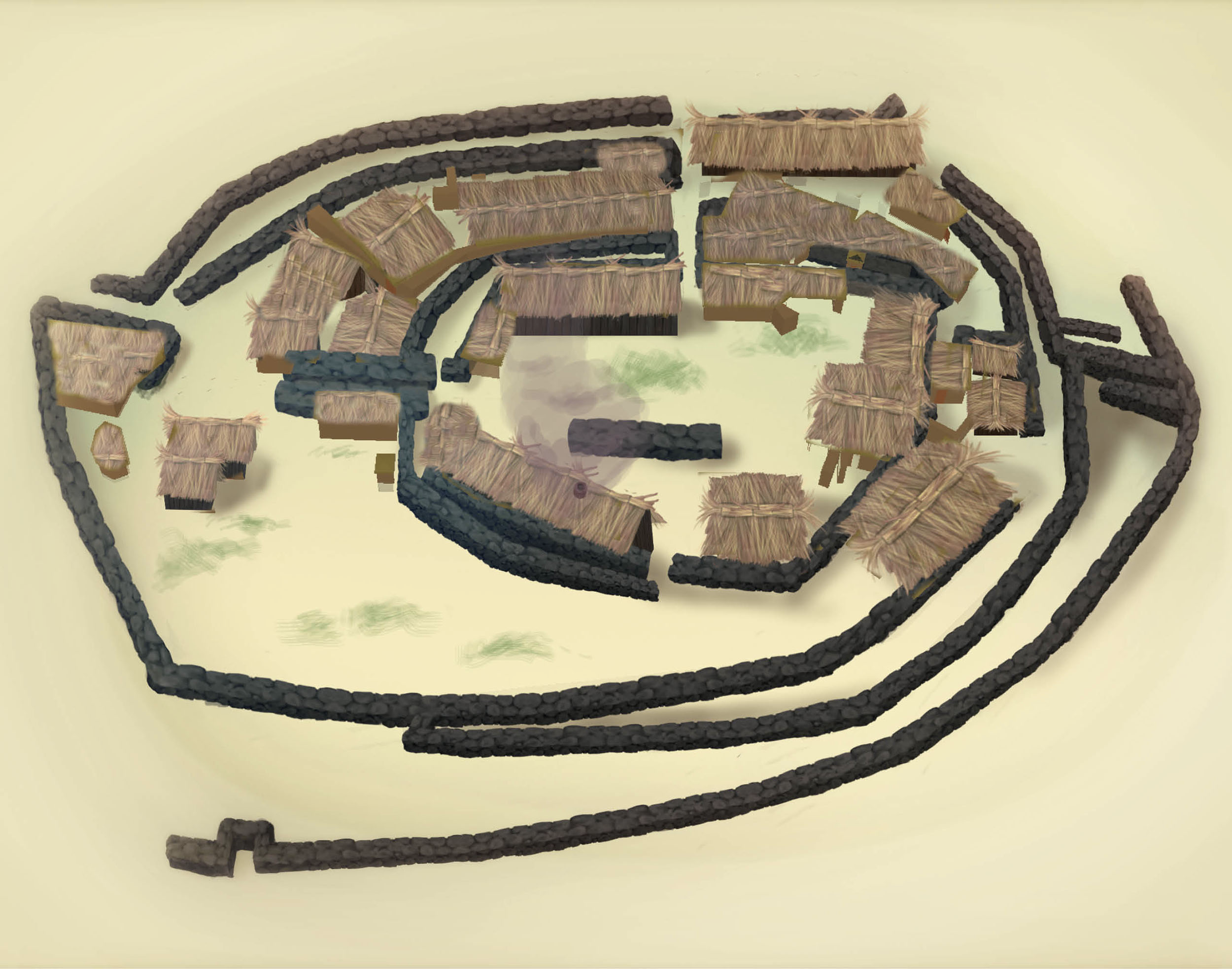
Site of Dimini, half a mile away from the sea on fertile plain, evidence of farming/herding (agropastoral)
Walls of site bring up many questions: are they defensive? Are they retaining the Earth? Why are they concentric?
A roof may have been built over these walls—-concentric circles have passageways cut in them
Central space = megaron—implies that something was conceived as being important enough to be protected by these concentric walls; evidence of complex, developed society
Does this megaron/site reflect central authority figure? Centralized site of stored goods/crops grown?
Bronze Age
widespread adoption of Bronze as metal
Technological advancement from previous Neolithic (Stone) age
Greater circulation of goods/ppl throughout Aegan Sea + Eastern Mediterranean
Megaron
Central Space
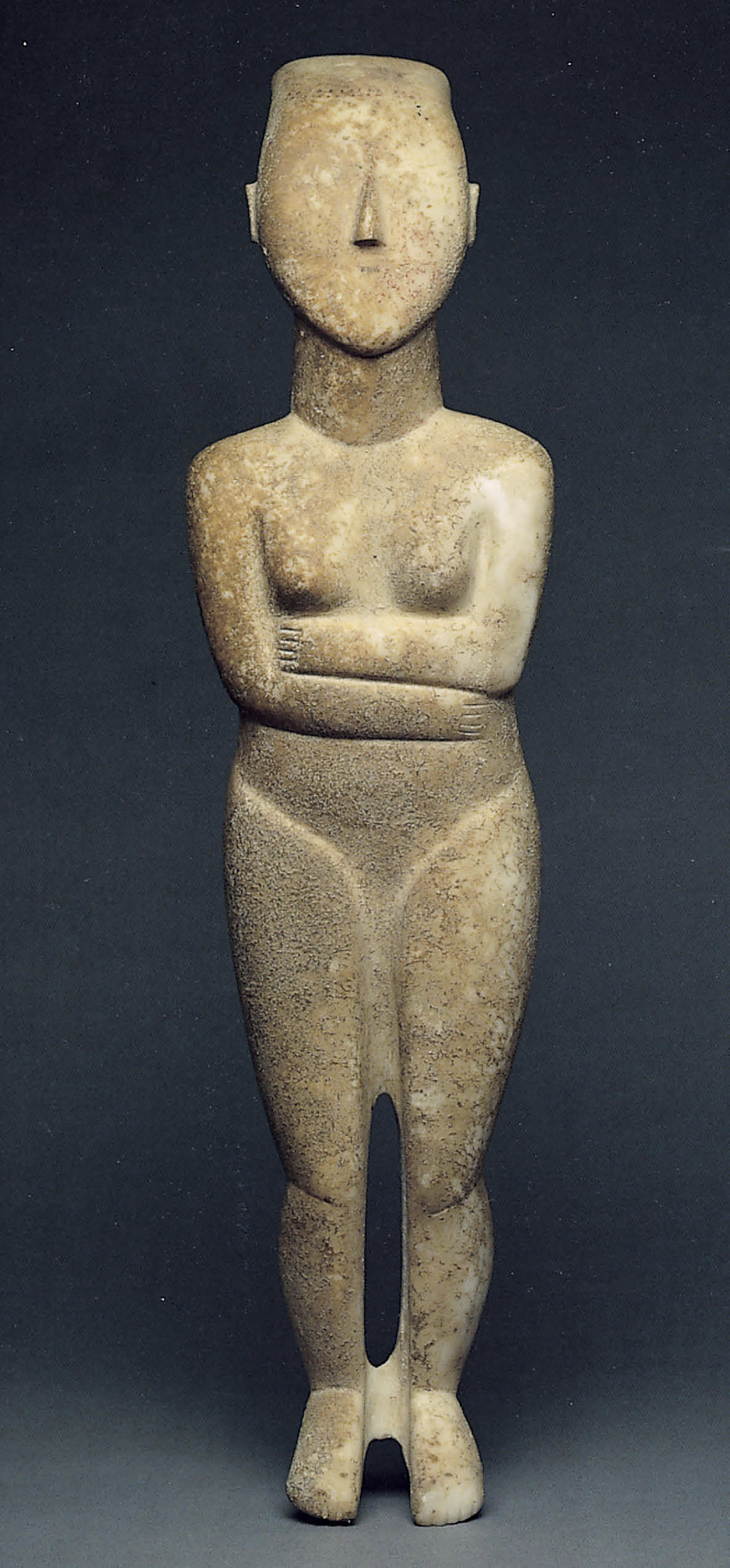
Cycladic figure
Named after string of islands (“Cyclades Islands”)
Marble, small
Usually found in burial sites
Anonymous, female bodies with typically folded arms (but can be in other positions)
Could it be religious idol?
Representation of person with whom it was buried?
Bronze Age
Found in multiple sites/islands across Aegan sea, evidence of trade!!

Minoan palace in Crete, AKA Palace at Knossos
Appears labyrinthine
Suggestive of sophisticated society that have ability/wealth/leisure to construct vast complex
Center contains megaron, leading to throne room—-similar to Dimini site, complex wall structures protecting inner room—why? Protect goods?
Evidence of settlements close to site, perhaps signs that this wasn’t a palace… ceremonial space? Uncertain.
May also suggest hierarchically complex society (someone important could’ve lived here) ←based on evidence from site in Syria, also had similar palatial/labyrinthine structure
Evidence of bathing rooms, lustral basins (hypothesized to be used for purification)
Most of these conclusions are projections/theories!!

Reconstruction of a rhyton (ritual libation vessel) —> smth you’d pour ritual liquid out of (most likely wine)
Large stone vessel, would not drink out of this
Bronze Age
Knossos (Minoans)
Presumably bull has some kind of symbolic importance bc used in this mysterious ritual
Ritually destroyed after used for pouring libation (wine)—found destroyed at certain sites
Perhaps smth abt conquering bull? Overcoming bull? Is bull symbol for person that’s powerful?
Rhyton
ritual libation vessel
pithos
A very large ancient Greek earthenware storage jar with a wide mouth and bulky body.
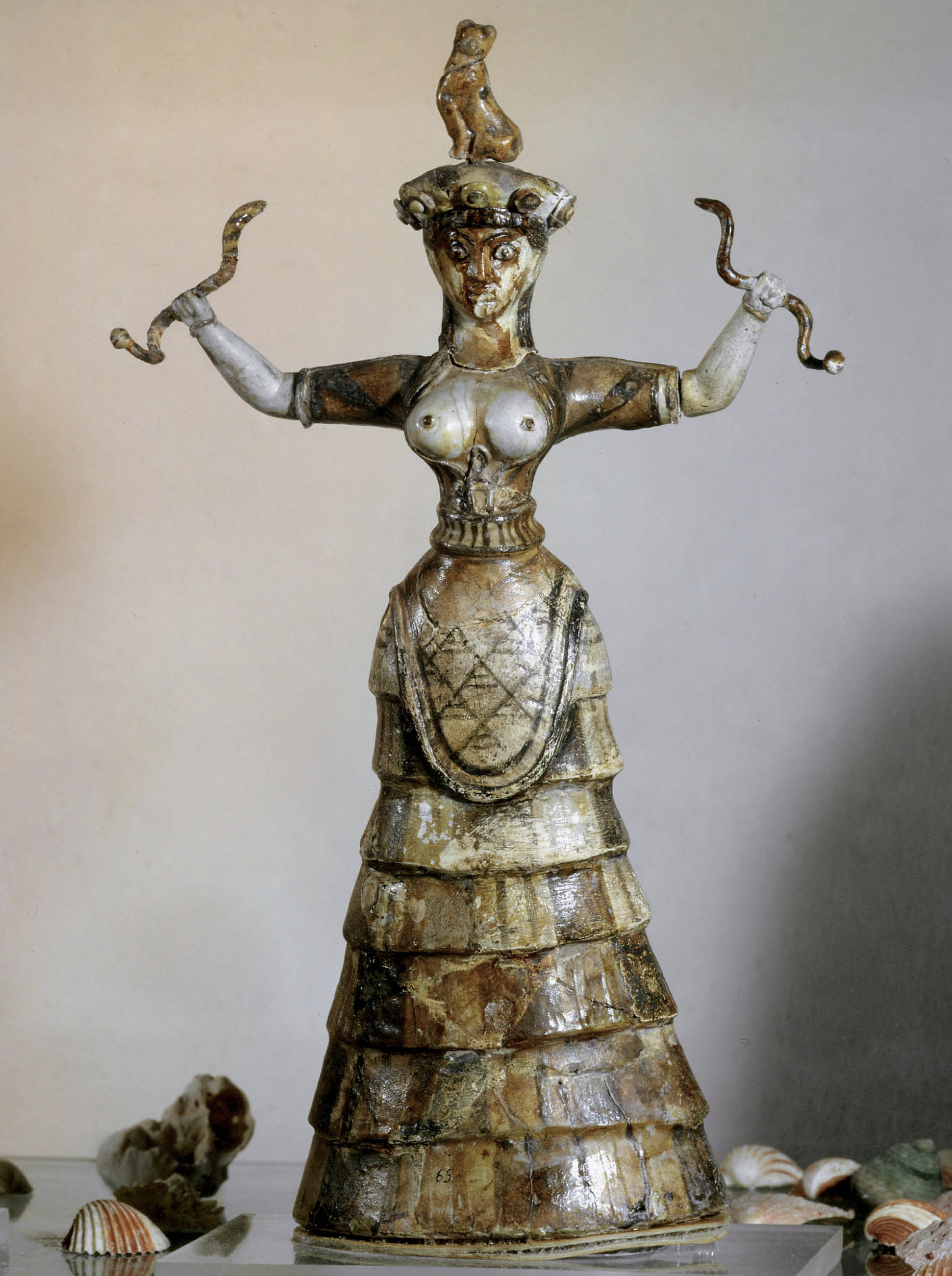
snake goddess
Bronze Age
Minoans don’t appear to have evidence of temples… did they not have belief system that required houses to gods?
Found at Knossos, glazed ceramic
Who is she? How did they worship their gods? Was she used in worship? Should we even think of this as religious since there’s an absence of temples?
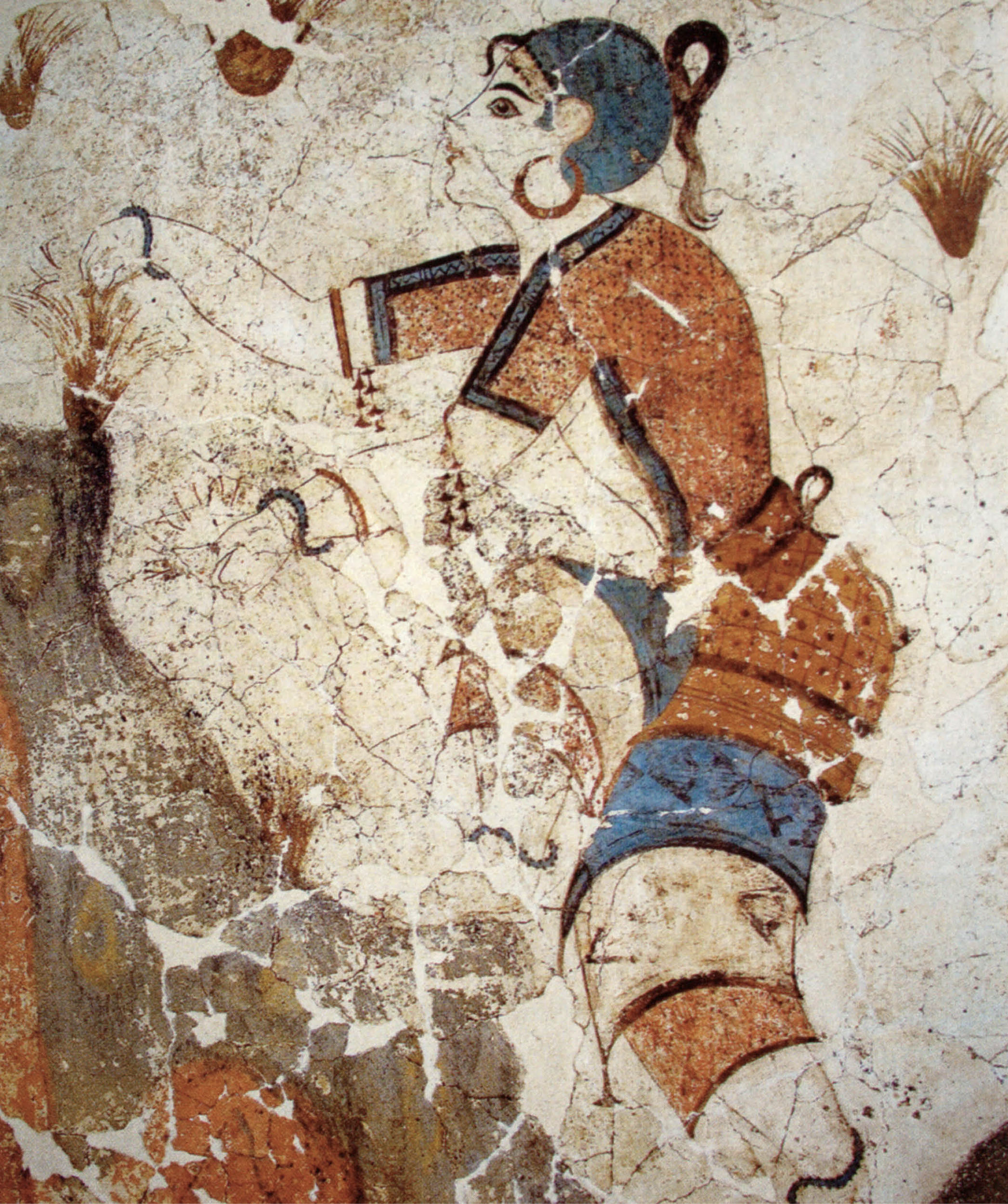
Bronze Age fresco from Akrotiri ←cosmopolitan merchant harbor/city
Saffron gatherer—is this meant to be an ordinary person? Is she divine?
Looking at someone else, not meeting viewer’s gaze
Abundant field of saffron
Vibrant colors, rich/opulent scene, figures have hair pulled back and large earrings
Sense of abundance—perhaps representation of wealth/success of city?

Fisherman fresco, Bronze Age, Akrotiri (merchant harbor/city)
Primarily ordinary ppl portrayed in art in Akrotiri
Awkward, lanky body
Who is this? Why is this image worthy of being depicted?
Image of abundance—perhaps painting was offering to Gods to wish for more fish?
The type of fish the fisherman is carrying was not type of fish found close to shore—indicates some kind of control of sea/strong enough boats to go out into deeper water ←suggests level of sophistication in culture
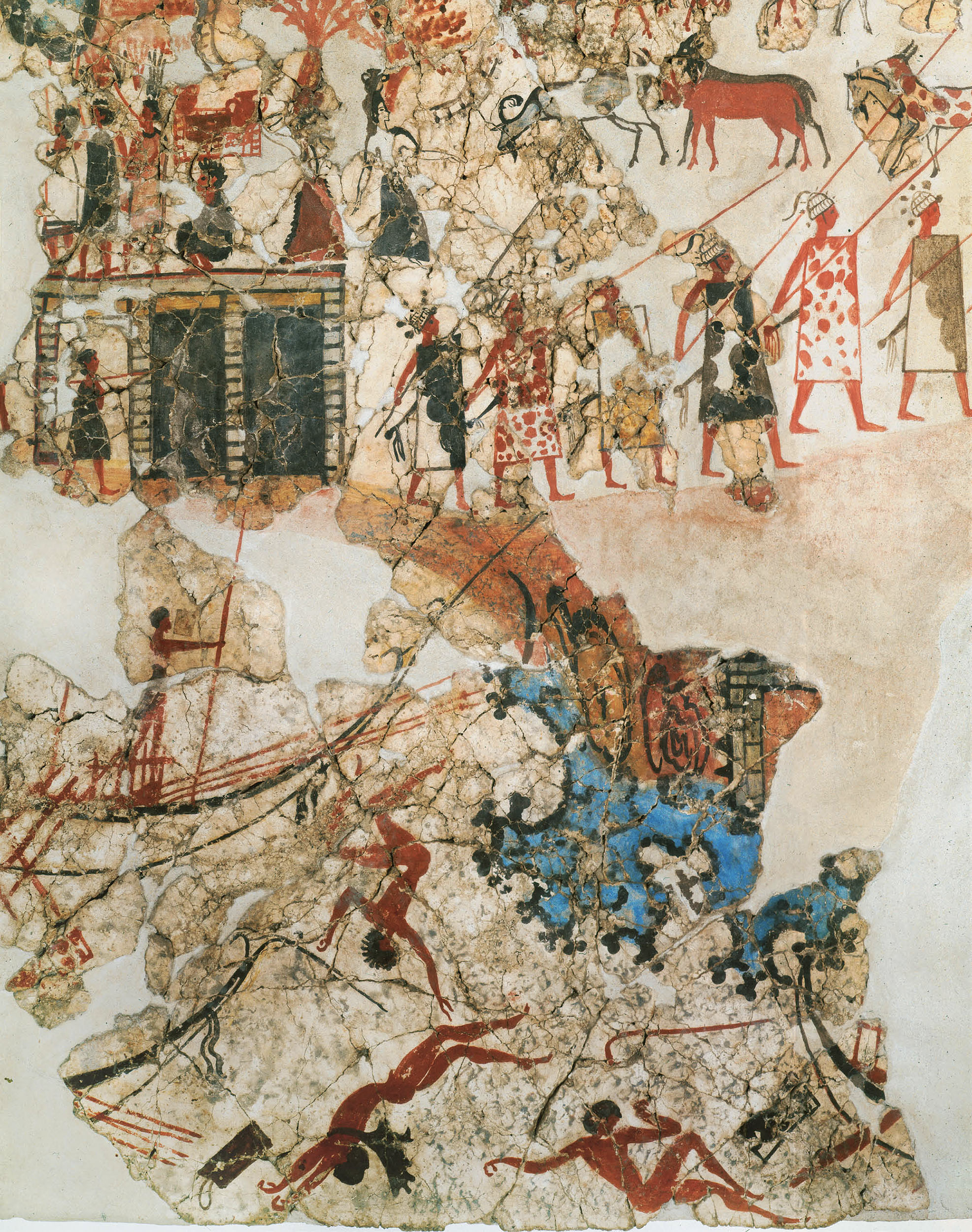
West House Fresco
Bronze Age fresco in Akrotiri (merchant harbor/city)
At top, ppl seemingly guarding cattle/armed in front of cattle
On the left, ppl on walls
Bottom of fresco—ship, ppl seen falling off of ship, perhaps defeated in some kind of battle (spears lying beside them)
Theory: perhaps this has smth to do with a cattle raid—danger of owning cattle, ppl might show up and take cattle (eg; in Odyssey, Odysseus’s companions are punished for destroying the Sun God’s cattle)

From Mycenaeans (late Bronze Age), found in Grave Circle A
Illustrates advancement of tech/manipulation of alloys since Neolithic Age (mixing multiple metals)
“Lion Hunt” dagger
Bronze w/ inlay of gold/silver/niello
Illustrates Mycenaean warrior culture
Figs with spears charging toward a lion that has his tongue out/is ready to fight
Towards end of blade, lion flees
May have been used/carried by someone, or made specifically for burial
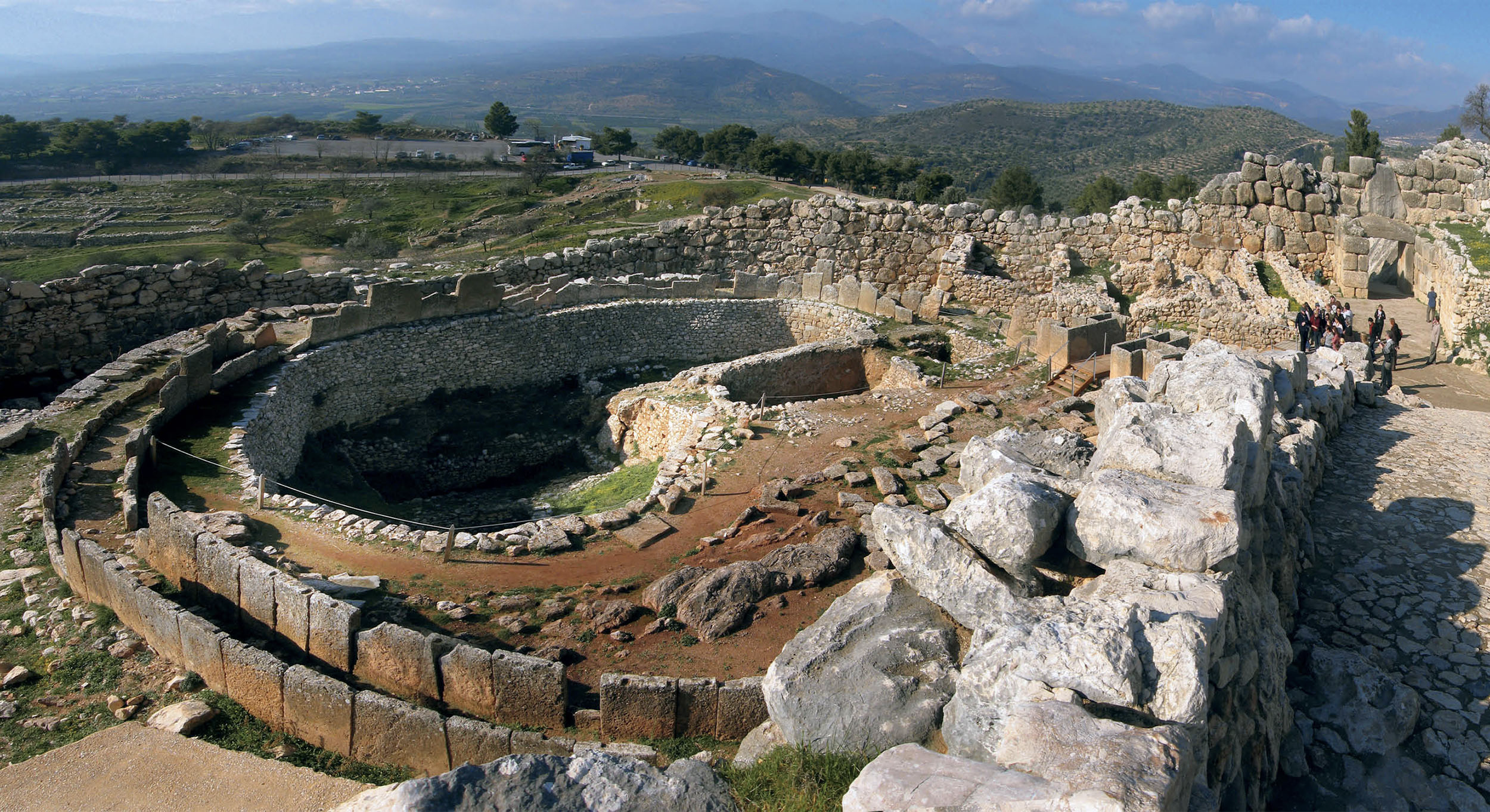
Grave circle A, found in city of Mycenae (Bronze Age)
Built into fortress wall —> may indicate pride, dead/glorious warriors still protect city
6 deep shafts inside with 19 burials, inside was copious amounts of golden items —> illustrates the wealth of the city (this region of Greece is not rich in gold—did this gold come from conquest? Trade? Both? ←sense of self-celebration/glorification
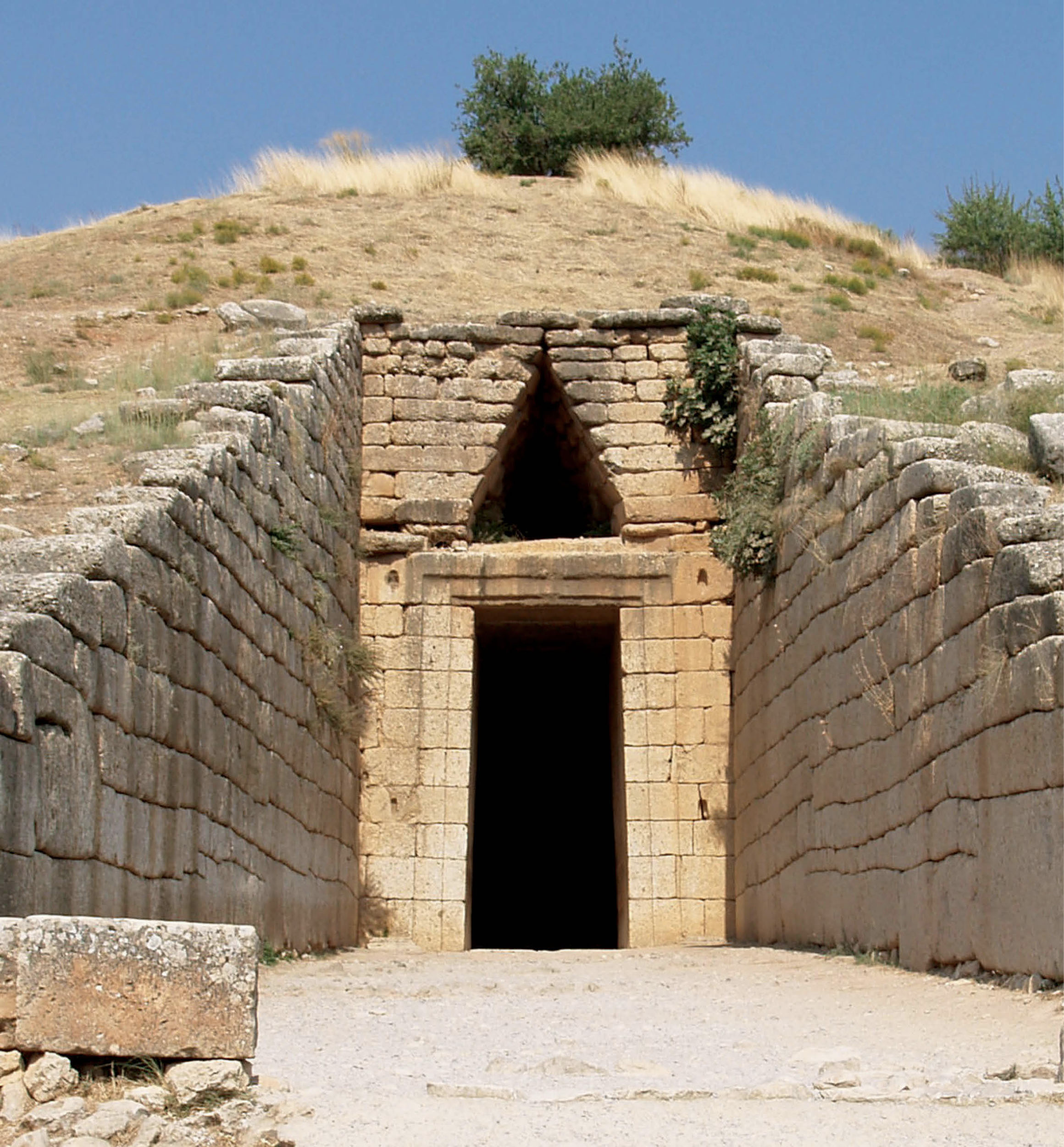
Bronze Age Mycenaean tholos (round structure w/ circular wall/roof)
Historian named it “"Treasury of Atreus” (not necessarily related to him)
Cyclopean (large) stones, cavern beneath hill (Earth)
Empty space (cavern) built over where body would be buried (along with treasures such as gold/lion dagger)—again, evidence of respect for dead, evidence of mighty culture, intimidate enemies by showing how well they can bury the dead—burials built into city
Path to walk to tholos is 118 ft long, already sense of grandeur, meant to intimidate with how much wealth Mycenaeans can pour into burials
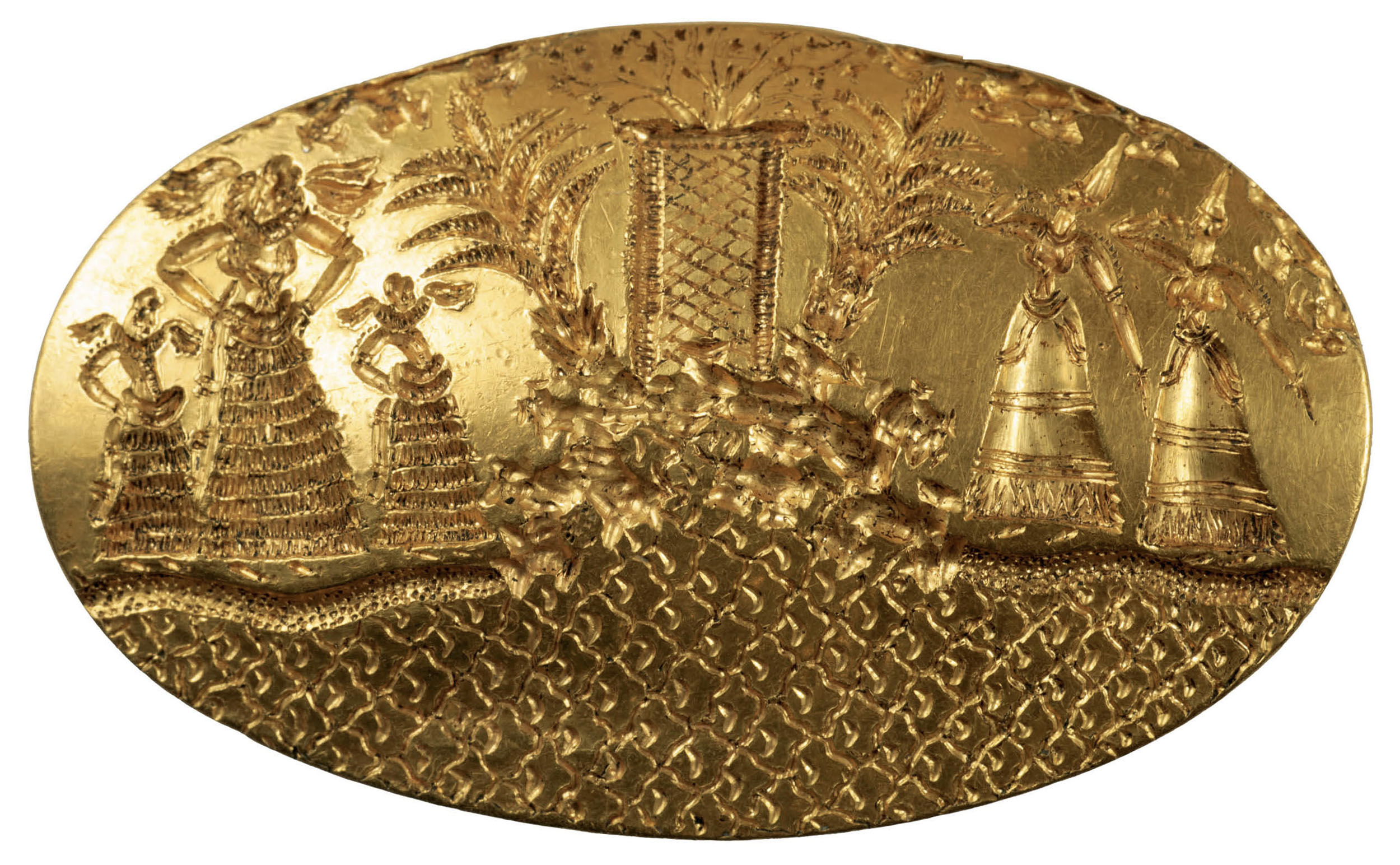
Found in shrine near Pylos (capital of Mycenaean city), Bronze Age
Evidence of Cretan manufacture (Minoans)
What does this evidence mean? Perhaps Mycenaeans, when taking over place such as Knossos (Minoan Crete), decided to take goods back to their territory
Perhaps also evidence that there was a friendly relationship between Mycenaeans + Minoans that fell apart
Mycenaeans liked aesthetics of Minoans
Golden ring, style of dress worn by engraved figures is similar to that of the snake goddess, women standing before a shrine
Iron Age
Technological advancement of using iron
Often characterized as a “dark age” bc of collapse of Mycenaean society, lack of written documentation, cultural migration, shrinking population, cultural decline/break, etc.
But now this view is complicated by historians!!
Movement from palace structures in Bronze Age to oikos (household) ←attaching self to oikos provided security, food, etc. especially if displaced by migration/war (oikos includes blood relations but also slaves)

Found on island of Lefkandi, Iron Age structure
Apsidal (semi-dome structure), large
Made of mud-brick walls with stone foundations
Also contains postholes, suggests that a porch was built onto it
Purpose is unknown, but contained deep burial shafts in central room
Theorized to be house of powerful figure, then became hero shrine/honorific burial site for this person + his spouse
Found cremated remains of a man, and bones of woman
Theorized that the woman was sacrificed at the time of the man’s death—this sacrifice often was a way of honoring/memorializing dead
Burial of 4 horses (ie; horse remains) also found in burial shaft ←indication of great amount of wealth
Similar to how in Iliad, Patroclus cremated and buried with the remain of horses by Achilles; perhaps this act called back this poem or poem called back this Iron Age tradition
Also found that man’s ashes were found inside bronze amphora from Cyprus (from a century before)—perhaps evidence of migration, cross-cultural connections, trade, sign of wealth (person was able to purchase smth from Cyprus)
In woman’s grave, lots of gold jewelry—again indication of wealth
ALL OF THIS suggests a kind of vitality/prosperity not commonly associated with Dark/Iron Age
thete
A person unattached to an oikos and/or owning no land (beggars, seasonal workers)

Found in Lefkandi, near Lefkandi burial site Iron Age
Figure of a centaur
Centaurs often shown in myths as lusty, bestial figures
First doctor in ancient Greek myth = Chiron, centaur
Uncertain which “tone” (we’ve conquered beasts, or learned/wealthy, honoring doctor) this centaur
When found, was ritually broken in half + placed in two diff graves
Suggests some kind of connection being made between these two graves/ppl
Geometric design (“dogtooth pattern”) ←intricate pattern of triangles
Crosshatch pattern running up centaur’s chest
Appears to have a sleeve tattoo running down arm
Forward looking glance
Interesting to note: horse burial at Lefkandi burial shafts, and centaur = hybrid of human + horse
Imaginative/playful object—more evidence of revisal of Iron Age as a dark age

Iron Age decoration on the side of a pithos (huge storage vessel/jar)
From island of Mykonos, found 150 years later than centaur figure
Trojan horse, heads inside, soldiers below horse, soldiers on top of horse (perhaps popping out of it—or Trojan guards waiting to see if this gift is truly a gift)
Evidence of Greeks looking back on cultural story/traditions, taking pride in it
No writing/captions, shows that viewer would automatically know what this image was (part of their cultural context)
The fact that this utilitarian object has decoration illustrates that civilization has enough time, leisure, and self-regard culturally to decorate this beyond its utilitarian purpose
Evidence against cultural break/decline during Iron Age (since often characterized as dark age)

Iron Age terra cotta clay cup “Nestor’s Cup” (not actually Nestor’s cup—character from Iliad who constantly discusses how wonderful the past was)
Found in Bay of Naples (one of the Greek colonies)
Not of great production value (bc terra cotta is not the hardest thing to produce, not luxury good)
Shows earliest evidence of Greek alphabet
Inscription playfully states: “Nestor’s cup I am, good to drink from. Whoever drinks this cup dry straightaway, the desire of beautiful-crowned Aphrodite will seize.”
Amusing contrast between humble craftsmanship + ridiculous idea that this belonged to one of the great warriors of Trojan War ←appears to be a joke!
Dactylic hexameter (meter of Homeric poetry)
Pseudo-vintage quality, trying to connect itself to “glorious past” via Nestor (Homeric world brought down to ordinary level)—evidence of Iron Age as vintage culture

Dipylon AMPHORA from Iron Age (handles/ears)
Funerary function, found outside gates of Athens, used as part of funerary ritual—holding cremated remains
Painting on Amphora represents two elements of funerary ritual:
Prothesis: movement/procession of the body from the home to burial/cremation site
Ekphora: Revealing/display of body before it is actually cremated or buried
Top row—corpse lying on side in state of Ekphora, people wailing beside it (arms above heads, pulling hair as part of ritual laments)
Lower row, image of ppl with shields and horses marching—perhaps evidence that person being buried/cremated was probably person of great wealth/warrior
Vast geometric decoration across whole amphora may have been indicative of wealth from person’s fam—how you represent yourself is shown thru how you honor dead!
Image of funeral recorded onto vessel that is used in funeral

Context: During the Iron Age, as society moves away from palace structures, more temples are built
Movement away from royal family, combining multiple oikos to communal space
Temple of Apollo, Thermon (in Peloponnese)
Building C = Temple, built over megaron B ←ruler’s apsidal residence (similar to apsidal structure at Lefkandi)
B + A = rooms/buildings connected to/by temple ← once again, archeological movement away from complex palatial structures to shared communal spaces—house not for a person but for a God
Progression away from individual to communal space

Amphora, Odysseus stabbing eye out of Cyclops
Found near Athens
Iron Age
Perhaps a visual reflection of the Greeks’ interactions with new peoples during Iron Age
eg; interactions during migration, colonization, immigration
Maybe connected to repeated motif in Greek literature/mythology of Greeks killing monsters (eg; cyclops + Medusa) ←using stories as a form of self-congratulation
Arguing that they have “civilized” spaces they’ve entered
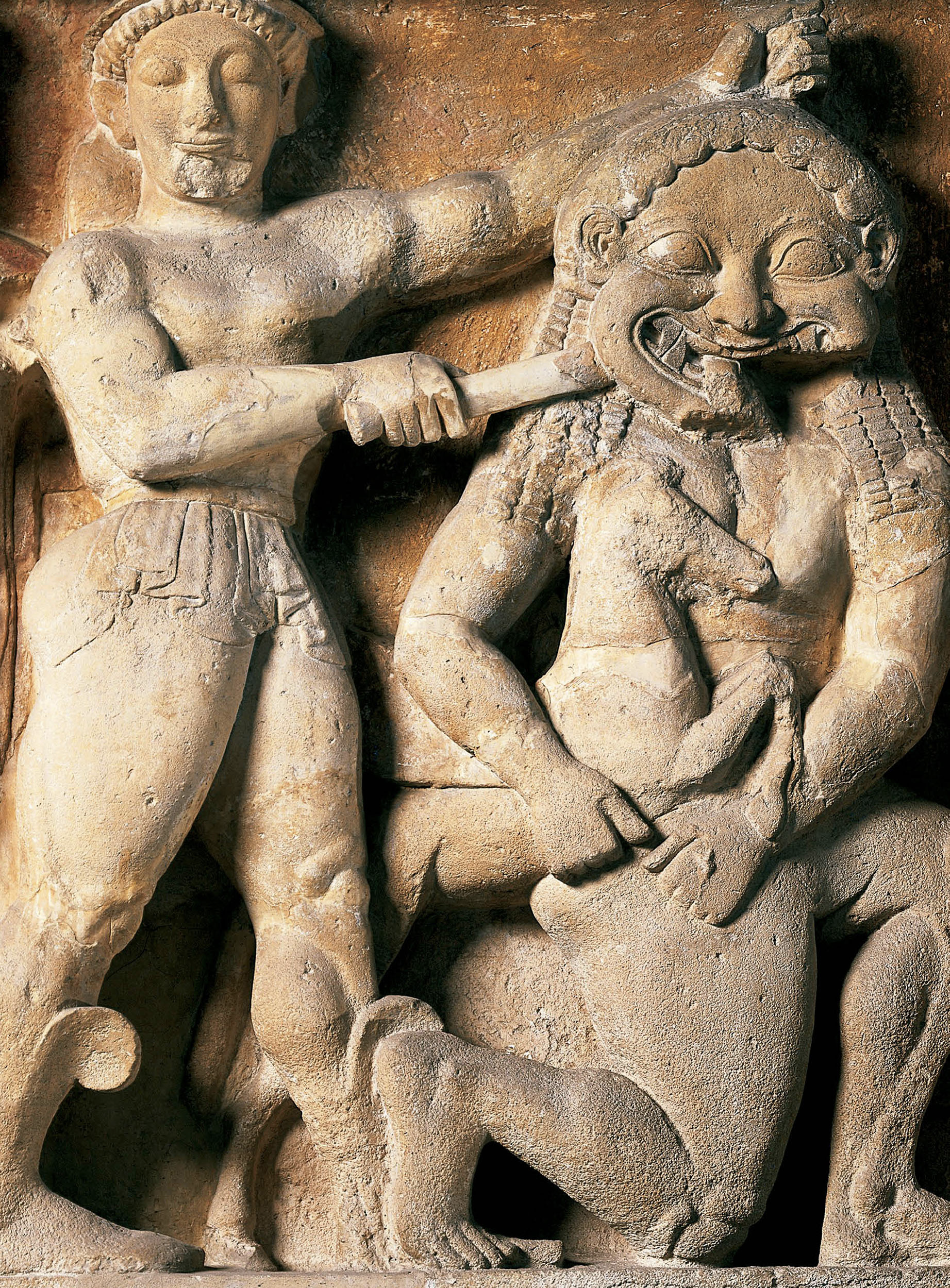
Decoration on Temple in Sicily
Iron Age
Perseus killing Medusa
Perhaps a visual reflection of the Greeks’ interactions with new peoples during Iron Age
eg; interactions during migration, colonization, immigration
Maybe connected to repeated motif in Greek literature/mythology of Greeks killing monsters (eg; cyclops + Medusa) ←using stories as a form of self-congratulation
Arguing that they have “civilized” spaces they’ve entered
Archaic Age
Characterized by political tension
Movement towards political reforms, especially in Athens (eg; Solon)
Movement away from investing power in aristocrats to greater distribution of power

Archaic Age
Laconian, not found directly in Sparta, but in nearby territory of Laconia (evidence of Spartan military might subduing neighboring nations)
Scholars also theorize that this may have been a token/sign of Spartan military presence in area, purposefully left behind as marker
Bronze statuette of a Spartan Hoplite Warrior (would’ve carried a big shield)
Scholars theorize that because Sparta was in a landlocked, resource scarce place (Lacedaemon, southeastern part of Peloponnese), used military might as a means of securing resources from neighboring nations
Impersonal—face obscured by helmet, reduces individual into military ideal/”dissolves person into Spartan military ethos”(relates to overarching Greek value of military culture)

Archaic Age, Spartan, ivory panel found in Sanctuary of Artemis Orthia
Artemis Orthia = the Upright lady
At sanctuary, evidence of ritual whippings of young boys—perhaps illustrating punishment for stealing/building endurance for military culture
Ivory difficult to find/obtain (especially in Sparta)—must mean that this was obtained through trade or military force
Relief carving of ship, 2 ppl raising mast, far left = female figure who’s bound by wrists + held left wrist by man—only figure in this carving facing outwards
Since this is Spartan, perhaps this is Helen? (Helen came from Sparta)
May also be an offering to Artemis Orthia—figure is standing in upright position, Spartans may be drawing connections to Helen + Artemis (don’t disrespect Sparta (ie; kidnap Helen) or you are disrespecting Artemis Orthia)
Illustrates how Spartan culture (although unusual) does have aspects that align with broader Grecian culture (ie; religion, religious worship)

Archaic Age, Spartan
Bronze statuette of Spartan woman running
Women in Sparta had multiple husbands (polyandry)
Often separated from husband
No obligation to engage in domestic/wage work, able to exercise outside, didn’t have to wear makeup, wrestled, participated in races, could be nude —> increased participation in society compared to women in other Grecian cultures
Figure potentially running in athletic competition, clothed ←illustrating the unique position/greater freedoms of women in Sparta
Perhaps bc men were constantly away at war, women may have had to take over duties
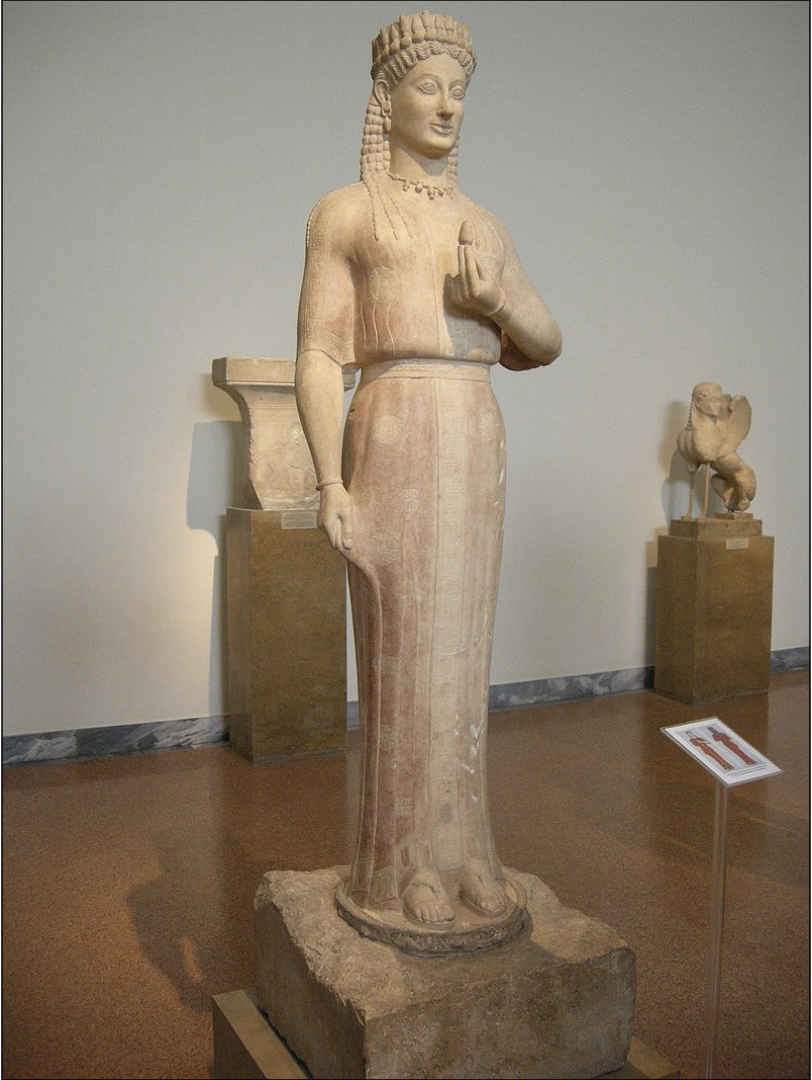
Korê figure, Archaic Age, made by man in Attica (where Athens is located)
Name of statue = “Phrasikleia,” meaning (roughly) “The woman who has great glory that is spoken about”)
Creator of statue is known (as aforementioned), and statue contains an inscription (“I, Phrasikleia’s grave marker, shall always be called maiden (korê), having received this name from the gods instead of marriage.” ←must mean this woman died before marriage, came from a wealthy family who was able to produce this statue
Through this inscription, woman who this statue is dedicated to is speaking through statue from afterlife, upholding virtue of maidenhood/virginity, despite being unmarried, she is still good, and any thought otherwise should be dismissed
Unknown what she was holding—perhaps a lotus (joy, sun, but also death + resurrection; also may enforce her intact virginity)
Woman in upright position, rigid, similar to Egyptian statues, archaic smile
Statues painted colorfully, represent person in death + wealth/social status of fam who could pay for this statue, tribute to gods and deceased loved one

Archaic Age
Painted on the side of a bell krater (held wine, used at symposium, wine was ladled out of this vessel into cups)
Symposium = private aristocratic parties, primarily for male aristocrats, where they would drink, listen to music/poetry
Men behind woman sitting and playing kottabos (common drinking game at symposia, flick dregs of cup at neighbor)
Appear to be entranced by woman playing flute
Women, slaves, and maker of vessels/furniture in which men are featured/lay on during symposia are absent from written record’s focus of these events, images such as this one (of woman playing flute) are only evidence that women were present (as performers or sex workers) during symposiatic events ←potentially providing more insight abt their roles during these events?
During symposia, men would stare at this vessel (as it was being used during the party) —> perhaps illustrating how these parties were meant to be sites of reflection—what are we doing? Why are we doing this?

Tablet, from Archaic period, showing prothesis of corpse (exposure of corpse)
During the Archaic Period in Athens, Solon made reforms stating that prothesis (laying out of body) of corpse must be done INDOORS—enacted several other reforms to limit “showing off” wealth
Aim was to avoid resentment between members of city
Other reforms include only doing procession of body at night, limiting number of cloaks women could wear, etc.

Ostraka (broken piece of pottery with name carved on it) from Classical Athens
Cleisthenes = guy who took over after tyrant rule of Athenians fell, made a bunch of reforms, attempted to connect with common ppl
Used for voting (if someone is becoming too wealthy, too privately endowed with separate military force (eg; had potential to become tyrant)), Cleisthene’s assembly (post tyrannical Athens) could vote to kick ppl out for 10 years (AKA, Ostracism)

Early Classical, bas relief carving decoration from Persepolis (Persia)
Representation of supreme god in Persian religion—rising above ppl and other structures on this wall
Equates Persian ruler with God, smth that Greeks didn’t do (ie; Persian rulers claimed to be appointed by God, Greeks didn’t share this tradition)

Classical red-figure wine jug
Depicting Greek fighting a Persian, Persian leaning away from Greek in a vulnerable position—slightly shorter than Greek, who is dressed in less garments (Persian wearing more clothes)
Bow is made to look visually less impressive than the Greek’s spear
“Odysseus was melting into tears; his cheeks were wet with weeping, as a woman weeps, as she falls to wrap her arms around her husband, fallen fighting for his home and children. She is watching as he gasps and dies. She shrieks, a clear high wail, collapsing upon his corpse. The men are right behind. They hit her shoulders with spears and lead her to slavery, hard labor, and a life of pain. Her face is marked with her despair.”
Odysseus Weeps… but why?
Context: Odysseus asks for Trojan war song among Phaeacians, starts crying
Odysseus compared to woman watching husband die → may be similar to Penelope, imagining her reaction to seeing his corpse (suffering creates sympathy) —> illustrating their likemindedness/strength of oikos (household)
MAJOR THEMES OF THE ODYSSEY
Nostos: homecoming, return to oikos (ideal household) ←several cases of deviation throughout novel, Odysseus deviates from his nostos, then is returned (eg; when he first sees Nausicaa and her slaves, compared to a lion, sexual violence but choosese #peace; and when with Calypso for years, Hermes sent to retrieve him lol)
Xenia (how to treat a stranger); shown in Cyclops scene, Odysseus tests the Cyclops to see if he will follow Xenia (treat guests with respect), instead Cyclops eats his men and gives gift of killing Odysseus last (subverts Xenia)—> shown as barbaric
Suitors test/break Xenia, over-stay their welcome in Ithaca, take all food/wealth of kingdom, must be killed for restoration of order
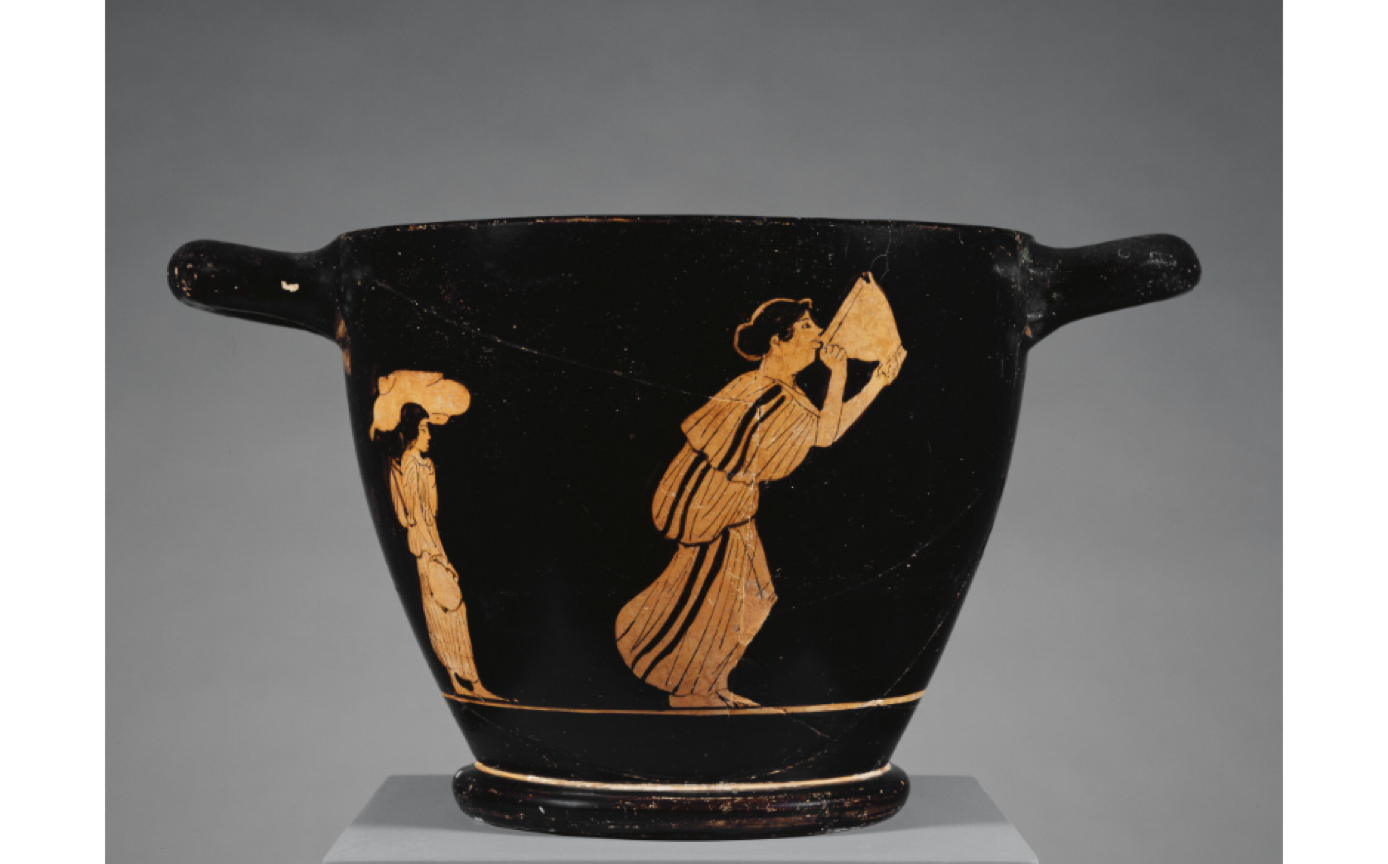
Attic (Athenian) Red-Figure skyphos (drinking cup), Classical Era
Provides glimpse of intimate relations between slave owner and slave
Woman on right drinking from large jug (another skyphos) ← scholars believe she is NOT enslaved, rather simply a woman in the household, wearing a nice peplos (garment woman would wear)
To woman’s left, an individual in a diminished position (notably smaller) stares at the woman ←most likely a slave
Carrying something—perhaps a new wineskin
The woman on the right is not facing the figure on the left, perhaps trying to conceal what she is doing
Significant amount of space between the two figures, distinguishes two classes (woman is “superior” to enslaved person, enslaved person is not allowed near woman)
On the opposite side of the cup is illustrations indicating that the figures are standing in a storage room
This could suggest that the woman has snuck into the pantry to secretly guzzle wine, yet the enslaved individual has seen her/is silently observing her
Perhaps glimpse into notion that enslaved ppl could see what slavers did not want them to notice, hence why slaves were brought into legal situations (court) and forced (most likely thru torture) to provide evidence

Illustration on side of cup, black figure, Archaic period
Depiction of a relationship between eromenos (young man) and erastus (older man)
Ancient Greek texts indicate that there was an unequal power balance in these relationships, perhaps older men (erastus) were to experience more pleasure/dominate younger men (eromenos)
This raises question: to what extent are these younger men being abused/pressured into doing smth against their own will/without their consent?
Older male (left) courts/touches younger male (right)

Archaic period
Oil flask
At top of flask, seated figure (may be a goddess) who is being approached by eight dancing maidens and four youths—appear to be celebrating the seated figure, presenting her with the cloth
Below the aforementioned image, illustration of women who appear to be engaged in cloth production
Elevates female domestic tasks (ie; making/weaving garments + cloths) for ritualistic purposes to honor goddess—> women’s “inscribed purpose” according to Greek customs is elevated thru its connection to divinity
This vessel indicates an ideology/set of values behind inscribed gender roles—could be considered “instruction manuals” for how to act

