IGCSE Physics: Waves
 Call Kai
 Learn
 Practice Test
 Spaced Repetition
 Match
 Flashcards
 Knowt Play
1/57

There's no tags or description
Looks like no tags are added yet.
58 Terms
longitudinal waves
the oscillation of particles are parallel to the direction of energy

longitudinal waves examples
Sound waves, shock waves

transverse waves examples
water wave light wave electromagnetic waves
tranverse waves
the oscillation of particles are perpendicular to the direction of energy

amplitude
the height of a wave's crest

wavelength
the distance in metres from the peak of one light or sound wave to the peak of the next.

time period
time taken for one complete cycle of oscillations

frequency
the number of complete wavelengths that pass a point in a given time

Doppler effect
The change in frequency of a wave as its source moves in relation to an observer

compressions
the regions of a longitudinal wave where the particles are closest together

rarefractions
the regions of a longitudinal wave where the particles are farthest apart

relationship between wave speed, frequency and wave length
wave speed= frequency x wavelength
v=f x λ

frequency
f=1/T
units for frequency
Hz (Hertz)
law of reflection
the angle of incidence is equal to the angle of reflection

normal
a line perpendicular to the surface where the light hits the surface
plane mirror
a mirror with a flat surface
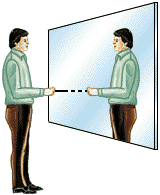
angle of reflection
The angle at which light rays are reflected, or bounced off, of a surface.

reflection
the bouncing back of a ray of light, sound, or heat when the ray hits a surface that it does not go through

refraction
change in direction of light ray when it encounters a boundry

angle of refraction
the angle between the normal and the refracted ray

relationship between refractive index, angle of incidence and angle of reflection
n = sin i / sin r
What happens to a wave's speed as they enter a new medium?
The wave slows down, bending toward the normal, and then the wave speeds up leaving the medium, bending away from the normal
refraction of water waves
water waves travel slower in shallow water and bend towards the normal
prism dispersion
Light travels through a prism, but because different colours have different wavelengths with different speeds than others causing a split of colors.

What colour has the shortest wavelength?
violet

What colour has the longest wavelength?
red

echo
a reflected sound wave
In what medium does sound travel the fastest?
solid
In what medium does sound travel the slowest?
gas
Why does sound travel fastest through solids?
particles in solids are close together therefore the vibrations pass quickly
Why can't sound travel in space?
Space is a vacuum - there is no air or medium for sound to travel through.
How does the height of the amplitude affect the volume of the sounds?
the greater the height, the louder the sound
How does the frequency of a sound affect the pitch?
the greater the frequency the higher the pitch of the sound
infrasound
Sound waves with frequencies below 20 Hz, the lower limit of human hearing.
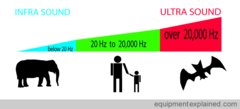
ultrasound
Sound waves with frequencies above 20,000 Hz.

Human range of hearing
20-20,000 Hz

electromagnetic spectrum in increasing frequency
radio, microwave, infrared, visible, ultraviolet, x-ray, gamma ray

What speed do all electromagnetic waves travel at?
speed of light (3 x 10^8 m/s)
How are radio waves used to transmit radio and television programmes?
A high frequency alternating electric current in the transmitting aerial produces radio waves of the same frequency that travels through the air at 300,000,000m/s. When the radio waves are absorbed by a receiving aerial, they make electrons in the aerial oscillate at the same frequency as the radio waves. This creates an alternating current that is amplified by the TV and decoded to make picture and sound.
Uses of radio waves
AM Radio, FM Radio, Television, Cell phones, Radar

How do microwaves cook food?
Water particles in food absorb the energy carried by microwaves. They vibrate more making the food hotter. Microwaves penetrates several centimetres.
Use of microwaves
Cooking, cell phones and satellite transmissions

Use of Infrared
TV Remote controls, Heaters and night vision equipment

Uses of visible light waves
Optical fibres and photography
Uses of ultraviolet
energy efficient lamps, sun tanning, security pens

Use of x-rays
observing the internal structure of bodies in medicine

Uses of gamma rays
killing bacteria, sterilising equipment, cancer treatment

Why are gamma rays and x-rays dangerous?
These are all ionizing so can alter the DNA in cells causing mutations and cancer
Why are infrared waves dangerous?
Infra-red radiation causes cells to heat up and too much can cause skin to burn.
Why is UV radiation particularly dangerous?
UV radiation can cause damage skin cells and cause skin cancer. It also damages the cells in your eyes causing blindness.
Why are microwaves dangerous?
They cause a heating effect on body tissue and skin because of their ability to penetrate several centimetres
1kHz
1000Hz
Investigation of refraction of light
Method:
Place the glass block on a sheet of paper, and carefully draw around the block using a pencil.
Take a ray box and carefully aim the box so that a single ray of light passes through the block.
Using a pencil, mark some points along the path of the ray:
Before it reaches the block;
Where it hits the block;
Where it leaves the block;
After it has left the block.
Now remove the block from the paper and, using a ruler and pencil, draw straight lines connecting points: a and b; b and c; c and d. The resulting line will show the path of the ray.
Replace the block within its outline and repeat the above process for a ray striking the block at a different angle.
Key things to remember include:
Naming the apparatus that you need (remember the ray box)
Explaining how to trace the rays.
Investigation of speed of sound in air
Two microphones are connected to an oscilloscope and placed about 5 m apart.
(This distance can be measured using a tape measure).
The oscilloscope is set up so that it triggers when the first microphone detects a sound, and the time base is adjusted so that the sound arriving at both microphones can be seen on the screen.
Two wooden blocks are used to make a large clap next to the first microphone.
The oscilloscope is then used to determine the times at which the clap reaches each microphone, and the time difference between the two claps is then determined.
This is repeated several times and an average time difference calculated.
The speed can then be calculated using the equation
speed=distance/time
Oscilloscope
A sound wave is displayed as though it were a transverse wave on the screen of the oscilloscope
The height of the wave (measured from the centre of the screen) is related to the amplitude of the sound.
The number of entire waves that appear on the screen is related to the frequency of the wave: If the frequency of the sound wave is increased, a greater number of waves will be displayed.
pitch of sound relating to frequency
The higher the frequency the higher the pitch
reducing risk of gamma radiation
stay in different room