ART201 Midterm
 Call Kai
 Learn
Learn Practice Test
 Spaced Repetition
 Match
Match Flashcards
 Knowt Play
1/8

Earn XP
Description and Tags
All of the testable images of artwork I have seen in class.
Name | Mastery | Learn | Test | Matching | Spaced | Call with Kai | Chat |
|---|
No analytics yet
Send a link to your students to track their progress
9 Terms

“Hall of the Bulls”
In Lascauz, France
Dated 16,000-14,000 BC
Displays bulls, horses, deer, boar (mega fauna)
Animals were glorified as a way to try and harness their power
“Make me more like this animal”
give me the speed of a horse, power of a steer
64 feet long
Largest bull is 11.5 feet long
50 feet inside the cave
caves were associated with the womb
Used scaffolding to paint higher up on the walls
Pigments used were charcoal and ochar
Lit up by torches of animal fat and the light made it seem like the figures were moving
collaboratively made by several artists overtime
Preserved footprints of adolecents mostly
coming of age ceremony

“Woman Holding a Bison Horn”
AKA Laussel Woman
Found in Laussel, France
Dated 25,000-20,000 BC
One of the erliest relief sculptures “Known”
1.5 Feet tall
Found in open air in front of a paleolithic rock shelter
contradicts the notion that all paleolithic humans lived in caves
Traces of red ocher is found on the relief
Ancient aritist painted sculptures
FIgure similar to the Venus of Willendorf
Emphasis on her belly, breasts, and hips
Her arm emphasises her belly and genital area.
13 Incisions on the horn
Perhaps referencing menstural cycles?

“White Temple”
In Uruk (modern Warka), Iraq
Ancient mesopotamia
Dated 3,300 BC
Made on top of a human made mountain
45 feet above street level
Made of bricks
put on top of this artificial mountain to be closer to the gods
Unclear if it had a roof
Deadicated to the god Anu presumeably
In the center of what was the city of Uruk
Most important building in the city

“Female Head (Inanna?)”
Found in the Inanna Temple in Uruk (Warka), Iraq
Dated 3,300 BC
Displayed in Baghdad, Iraq
In National Museum of Iraq
A fragmentary Marble Head
Assumed to protray the goddess Inanna
Goddess of sex, fertility, and warfare
Eyes once had inlays consisting of gems
As well as once having golden hair
Rest of the body being made of wood
A large hunk of marble would have been very expensive to import
Body would have been covered in intracate and espensive fabrics
Would have been decorated and painted with vibrant colors

“Warka Vase”
“Presentation of offerings to Innan(Warka Vase), From the Inanna temple complex”
From Uruk, Iraq
In Inanna Temple
Dated 3,300 BC
Displayed in the National Museum of Iraq, Baghdad
Displays Scenes in registers banding across the vase
Depicts a religious ceremony honoring Inanna
Registers starting at the bottom depict water, ewes and rams (fertility symbols), agriculture and husbandry
Naked men (slaves?)
Tells a story of how Inanna blessed the lands and the people show her thanks for her blessing
A votive left at her temple
Votive displaying people giving her votives
FIRST great work of narritve relief sculpture.
Common ground line
Figures and animals shown in profile
Hierearchy of scale
Depictions of pictographs with the symbols of Inanna adorning the top register
Displays a symbolic marriage

“Statuettes of Two Worshippers”
Found at the Square Temple at Eshnunna (modern Tell Asmar) in Iraq
Dated 3,900-2,750 BC
Male Figure is almost 2.5 Feet tall
Female Figure is almost 2 Feet tall
Votive statues made by worshippers to be sent to the temples because they couldnt
Held small cups to pour libations for the gods
Wide Large eyes to symbolize “perpetual wakefulness”
Heads tilted up to look and to wait for the god to arrive
Hierarchy of scale
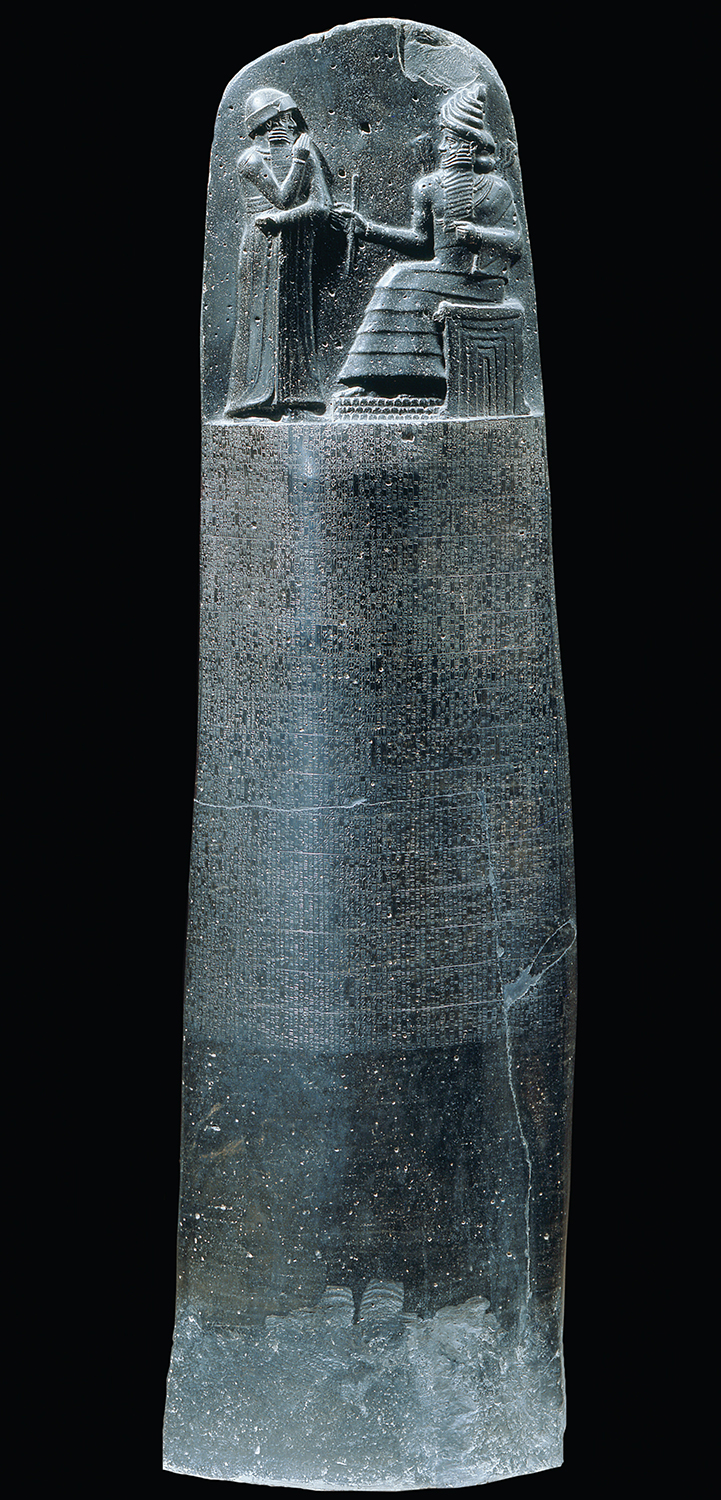
“Stele with the laws of Hammurabi”
Set up in Babylon, Iraq
Found in Susa, Iran
Dated 1780 BCE
Made of Basalt
Is 7 feet and 4 inches tall.
Can be viewed at the Musee du Luvre, Paris
Depicts Shamash giving Hammurabi symbols of power to rule and judge
A ruler because he was important in civic infastructure of Babylon
As well as a law giver and Judge as he will measure human behavior
Shows that his law is blessed/endorsed by the gods and his divine power as a leader.
Hierarchy of scale
Use of Foreshortening
Hammurabi and Shamash are shown at an angle
Groundline
Squiggles on Shamash’s shoulders represent heat

“Ishtar Gate (Restored)”
Originally found in Babylon, Iraq
Currently in the Near Eastern Museum in Berlin, Germany
Dated 575 BC
Built in honor of the goddess Ishtar
Built by the Priest Kind Nebuchanezzar II
who apparently built the gardens of Babylon
Marks the New Years Precession
Made of mud brick but glazed in cobalt to give the illusion of Lapis Lazuli
The blue represents Virility
Depicts Marduk and Nabu’s Dragon, Adad’s Bull, and Ishtar’s Lions.
Mushushu (Dragon)
Lions leading to the entrace symbolize Ishtar leading you to the gate