polymers
 Call Kai
 Learn
Learn Practice Test
 Spaced Repetition
 Match
Match Flashcards
 Knowt Play
1/11

There's no tags or description
Looks like no tags are added yet.
Name | Mastery | Learn | Test | Matching | Spaced | Call with Kai | Chat |
|---|
No analytics yet
Send a link to your students to track their progress
12 Terms
polymerisation
the joining together of short-chained molecules or subunits called monomers to form long chained molecules or macromolecules called polymers
addition polymerisation (propene example)
carbon-carbon double bond breaks in monomers, then the monomers have a free electron to form 2 new bonds with adjacent monomers
undergone by compounds with double bonds (e.g. alkenes)

plastics
addition polymers are sometimes called plastics
flexible, durable, waterproof, light-weight, strong
however carbon-carbon covalent bonds are strong and unreactive which is why they take so long to decompose, therefore disposal is a problem (nonbiodegradable)
condensation polymerisation
polymer forms and also a smaller molecule such as water, HCl or NH3
monomers in condensation polymers must have 2 functional groups per monomer
natural polymers
formed in condensation reactions, broken down in hydrolysis reactions
examples:
glucose → starch
amino acids → protein
nucleotides → DNA
polyester
example of a synthetic condensation polymer
one monomer is a diol w/ two -OH groups, the other is a dicarboxylic acid w/ two -COOH groups
OR
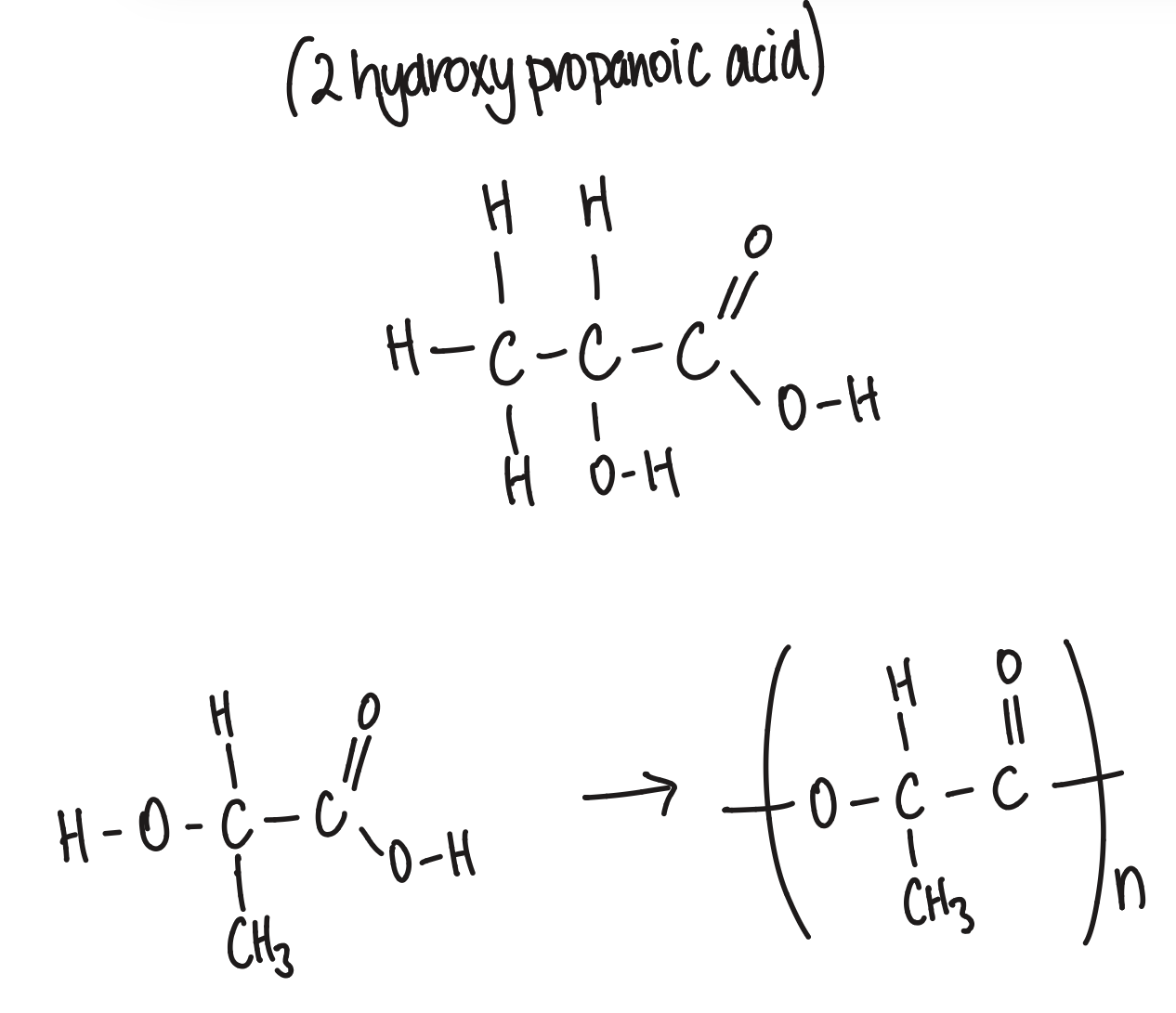
one monomer containing both a carboxyl group and a hydroxyl group (e.g. 2-hydroxypropanoic acid/lactic acid)
ester repeating unit
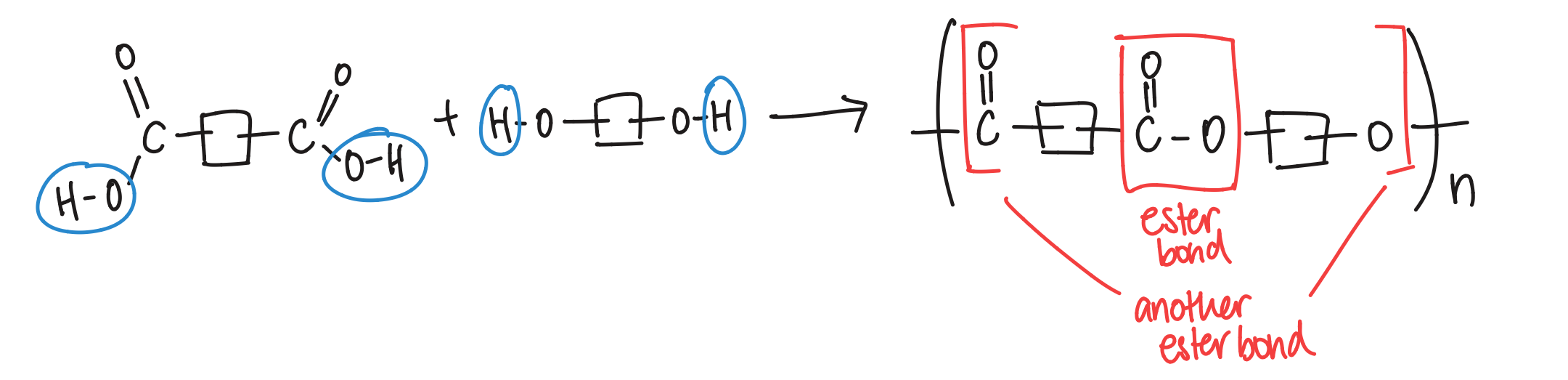
terylene/PET (draw)
an example of a polyester
formed from benzene-1,4-dicarboxylic acid and ethane-1,2-diol
used in food packaging and drinks bottles (clear, strong, lightweight)

polylactic acid/PLA
polyester
formed from 2 hydroxypropanoic acid
biodegradable (ester bonds can be hydrolysed), used in disposable nappies and surgical stitches
polyamides
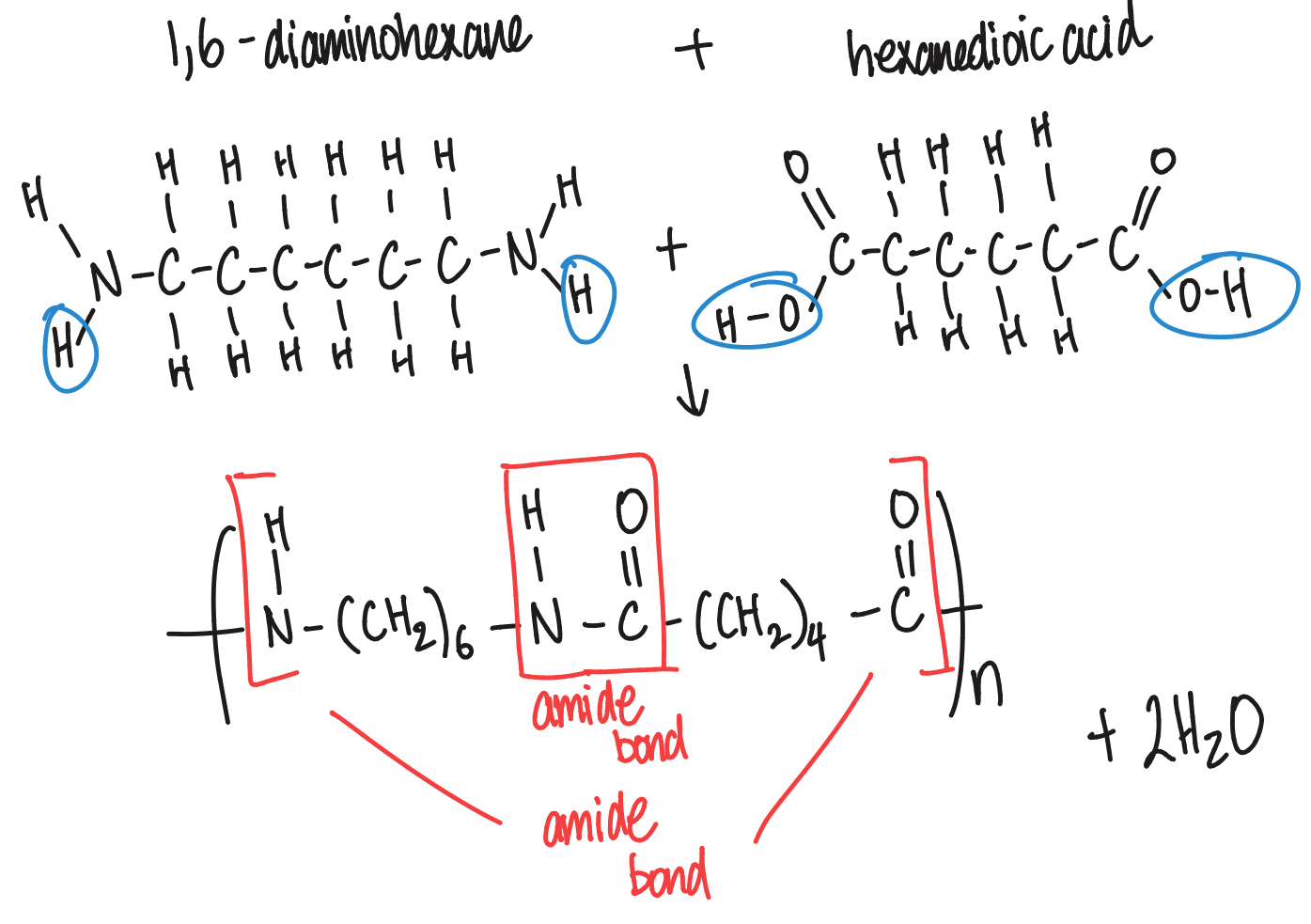
formed from a dicarboxylic acid (-COOH) and a diamine (-NH2)
examples include nylon and kevlar
contains amide bond (peptide bond)
nylon
formed from 1,6-diaminohexane (diamide) and hexanedioic acid (dicarboxylic acid)
used in ropes and clothes
kevlar
formed from 1,4-diaminobenzene (diamide) and benzene-1,4 dicarboxylic acid (dicarboxylic acid)
used in bulletproof vests
