faA
 Call Kai
 Learn
 Practice Test
 Spaced Repetition
 Match
 Flashcards
 Knowt Play
1/124

There's no tags or description
Looks like no tags are added yet.
125 Terms
Activities related to the primary purpose of the business, such as selling products/services, buying inventory, and paying expenses
Operating activities
Purchasing or disposing of assets used in the business, such as PPE and financial assets
Investing activities
Raising money through debt or equity, and repaying debt or distributing dividends
Financing activities
Raising funds by borrowing from creditors
Debt financing
Raising funds by selling ownership interests/stocks to investors
Equity financing
Coins, currency, money orders, checks, and bank deposits available to satisfy obligations.
Cash
Procedures designed to protect cash and ensure proper handling and accounting
Internal control
A reduction in the amount payable for paying within a specified discount period.
Purchases discount
Reductions in amounts owed because merchandise is returned or an allowance is granted.
Purchase returns and allowances
Document sent by the buyer to notify the seller of returned goods or request an allowance.
Debit memorandum (debit memo)
Payment made in advance for a future expense; initially recorded as an asset.
Prepaid expense
A special cash fund used for relatively small payments.
Petty cash fund
Deposits recorded by the company but not yet processed by the bank.
Deposits in transit
Checks recorded by the company but not yet cleared by the bank.
Outstanding checks
A check that cannot be collected because the payer's account has insufficient funds.
NSF check
Process of comparing bank and book balances and adjusting them for differences.
Bank reconciliation
Purchase discount formula
Purchase discount = Invoice amount × Discount rate
Payment after discount formula
Payment after discount = Invoice amount − Purchase discount
Discount amount formula
Discount amount = Eligible balance × Discount rate
Prepaid expense per period formula
Prepaid expense per period = Total prepaid amount ÷ Number of periods
Petty cash accounted for formula
Petty cash accounted for = Cash remaining + Receipts
Cash over/short formula
Cash over/short = Fund amount − (Cash remaining + Receipts)
Adjusted bank balance formula
Adjusted bank balance = Bank balance + Deposits in transit − Outstanding checks ± Bank errors
Adjusted book balance formula
Adjusted book balance = Book balance + Additions − Deductions ± Book errors
Accounts to add to bank balance
Deposits in transit
Bank errors that understated bank balance
Accounts to deduct from bank balance
Outstanding checks
Bank errors that overstated bank balance
Accounts to add to book balance
Interest earned
Direct deposits
Other bank collections for the company
Book errors that understated cash
Accounts to deduct from book balance
Service charges
NSF checks
Bank transfers/payments
Book errors tha overstated cash
A claim for money, goods, or services.
Receivable
Money owed to the company from goods sold or services performed on credit.
Accounts receivable (A/R)
A formal written credit instrument that promises payment, usually with interest.
Notes receivable
Principal amount written on a note.
Face amount
Date the note is issued.
Issuance date
Date payment of the note is due.
Due date / maturity date
Reduction in selling price given to customers for early payment.
Sales discount
Account that reduces revenue; includes Sales Discounts and Sales Returns and Allowances.
Contra-revenue account
Total sales recorded before deductions.
Gross sales
Gross sales less sales discounts and sales returns and allowances.
Net sales
Accounts receivable that cannot be collected.
Bad debts
Records bad debt expense only when a specific account is identified as uncollectible.
Direct write-off method
Estimates uncollectible receivables before actual accounts are written off.
Allowance method
Contra-asset account that reduces Accounts Receivable.
Allowance for Bad Debts
Expected amount of receivables to be collected after estimated bad debts.
Net realizable value (NRV)
Classifying A/R by how long it has been outstanding to estimate uncollectibles.
Aging of receivables
Note receivable that the debtor fails to pay at maturity.
Dishonored note
Gain or loss resulting from changes in exchange rates.
Exchange gain/loss
Derivative contract used to reduce foreign currency exchange risk.
Forward contract
Net sales formula
Net Sales = Gross Sales − Sales Discounts − Sales Returns & Allowances
Net Realizable Value of A/R formula
Net Realizable Value of A/R = Accounts Receivable − Allowance for Bad Debts
Estimated Bad Debts formula
Estimated Bad Debts = Accounts Receivable × Estimated Uncollectible %
Estimated collectible A/R formula
Estimated collectible A/R = Accounts Receivable × (1 − Uncollectible %)
Bad Debt Expense formula
Bad Debt Expense = Required Ending Allowance − Existing Allowance Balance (when existing credit balance)
Ending Allowance formula
Ending Allowance = Beginning Allowance + Bad Debt Expense − Write-offs
Accounts Receivable Turnover formula
Accounts Receivable Turnover = Net Credit Sales ÷ Average Accounts Receivable
Average A/R formula
Average A/R = (Beginning A/R + Ending A/R) ÷ 2
Average Collection Period formula
Average Collection Period = 365 ÷ A/R Turnover
Interest Revenue formula
Interest Revenue = Face Value × Annual Interest Rate × Time
Interest formula
Interest = Principal × Rate × Time
Time in months formula
Time in months = Months ÷ 12
Time in days formula
Time in days = Days ÷ 360 (when using a 360-day basis)
Transaction: Estimate bad debts
Debit: Bad Debt Expense
Credit: Allowance for Bad Debts
Transaction: Write off specific customer
Debit: Allowance for Bad Debts
Credit: Accounts Receivable
Transaction: Recover previously written-off account (restore)
Debit: Accounts Receivable
Credit: Allowance for Bad Debts
Transaction: Collect recovered account
Debit: Cash
Credit: Accounts Receivable
Recording an expenditure as an asset because it provides future economic benefits.
Capitalization
Expenditure whose benefits are obtained in the current period.
Expense
Process of matching the cost of capital assets with revenues obtained from their use
Amortization
Assets with physical substance.
Tangible assets
Tangible assets used in business operations.
Property, plant & equipment (PPE)
Assets with no physical substance, such as patents and copyrights.
Intangible assets
Systematic allocation of an asset's original cost over the periods it provides benefits.
Depreciation
Estimated value of an asset at the end of its service life.
Residual value
Period an asset is expected to be useful to the business.
Useful life / service life
Time until the asset physically wears out.
Physical life
Loss of usefulness because of technology or changing tastes.
Obsolescence
Physical wearing out of an asset.
Deterioration
Original cost less accumulated depreciation.
Book value / Net book value
Total depreciation recorded over the asset's life to date.
Accumulated depreciation
Improvement that makes the asset better than it was originally; capitalized.
Betterment
Reduction in the value of an asset when its remaining benefits are lower than its book value.
Impairment
Allocation of the cost of natural resources as resources are extracted.
Depletion
Excess of purchase price of a business over the fair value of its net assets.
Goodwill
Improvements made to leased property.
Leasehold improvements
Certain costs that may be expensed or capitalized and amortized over a short period.
Deferred charges
Costs incurred to develop new knowledge, products, or improve processes and services.
Research & development (R&D)
Increase in value arising from natural growth.
Accretion
Straight-line depreciation formula
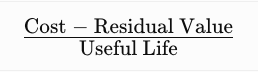
Net depreciable cost formula
Cost - Residual Value
Book value formula
Original Cost - Accumulated Depreciation
Declining balance depreciation formula
Book Value x Depreciation Rate
Double-declining balance rate formula
2 * Straight-line rate
Straight-line rate formula
1 / useful life
Double-declining depreciation formula
Book Value x 2 x straight-line rate
Sum-of-the-years'-digits (SYD)

SYD depreciation (Year 1) formula

SYD depreciation (Year 2) formula

Units of production depreciation formula

Book Value formula
Book Value = Cost − Accumulated Depreciation
Gain or Loss formula
Gain or Loss = Selling Price − Book Value
TRUE OR FALSE: Repairs & maintenance: Expensed
TRUE