Welfare at slaughter
 Call Kai
 Learn
 Practice Test
 Spaced Repetition
 Match
 Flashcards
 Knowt Play
1/48

There's no tags or description
Looks like no tags are added yet.
49 Terms
livestock at slaughter
must be humane
avoidable excitements, pain or suffering
effectively restrained and stunned, rendering it insensible to pain and finally bleed rapidly and profusely to ensure death before recovery occurs
Welfare at Slaughter
Transportation to abattoir
Lairage
Ante-mortem inspection (AMI)
Stunning and bleeding
stages of slaughter process
catching/ transportation
lairage and restraint
stunning and slaughter
slaughter methods
involve
inducing loss of consiousness
causing death of animal
loss of consciousness must last until death is caused by bleeding
process of inducing loss of conciousness = stunning
what will poor welfare practise result in
bruising and poor meat quality issues
what will poor stunning and bleeding cause
contribute to carcase quality problems such as burst blood vessels and broken bones
result in lower end-product
what 3 reasons mean its important to ensure humane slaughter
moral responsability
legistlation
economics
Basic criteria for transportation
A roof to protect the animals against rain or sun
No sharp or protruding objects in the animal compartment
No holes, gaps or cracks in the floor
Anti-slip flooring and sufficient bedding
Ramps and lateral protection for loading/unloading
Side openings to provide ventilation in hot weather
what other conditions must trucks transporting livestock for more than 8 hours fulfil
Access to the animals in order to water and feed them in the vehicle
Proper ventilation system - passive ventilation (side openings) or mechanically assisted ventilation
Partitions that allow animals to be separated into small groups
Drinking facilities (permanent access to water is required for pigs)
Space and equipment to store and deliver feed during the journey
transportation and handling - poultry
need to minimise stress during transportation
temperature
duration
noise
pver/understocking crates
minimise injuries( fractures of legs/wings, bruising) and deaths
what must abattoirs ensure in lairage
enough space to lie down
water ad lib
avoid mixing animals that may lead to increased stress and harm
control of temperature, light, noise
food if there longer than 12 hrs
welfare and meat quality
stress can affect meat quality - affects metabolism of glycogen in muscles
glycogen is energy source for muscle activity, following slaughter, glycogen converted to lactic acid
amount of glycogen pre-slaughter affects pH post-slaughter
chronic stress depletes glycogen
acute stress increases metabolic activity
meat quality issue - affected meat is safe but not desired by consumers
Pale, Soft, Exudative (PSE) meat
acute stress increases metabolic activity
denaturation of proteins because low pH, inability to keep fluids in cells
predominantely pigs
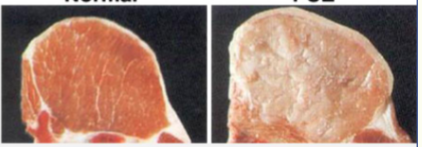
left = normal
right = PSE
Dark, Firm, Dry (DFD) meat
chronic stress depletes glycogen
no denaturation of proteins, fluid remains bound
commonly in cattle
pigs and sheep occasionally

left = DFD
right = normal
what is purpose of ante-mortem inspection
to determine whether there is any sign of any condition which might adversely affect human or animal health
to enable the Official Veterinarian (OV) to make the decision as to whether the animal can be slaughtered for human consumption
to determine whether any test should be carried out in relation to disease diagnosis or for residues of veterinary medical products
to determine whether welfare has been compromised
Particular attention should be given when zoonotic or notifiable diseases are a possible diagnosis
notifiable diseases
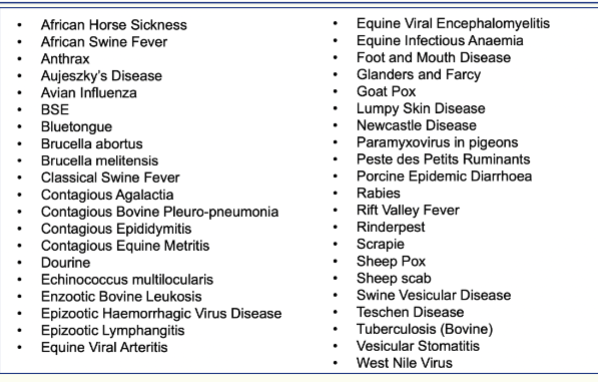
ante-mortem inspection tasks
The OV must carry out the ante-mortem inspection.
The Meat Hygiene inspector (MHI) may assist the OV with some pre-slaughter tasks.
The Food Business Operator (FBO) has several responsibilities that the Food Standards Agency (FSA) are required to verify are fulfilled.
Informal or formal enforcement action may be necessary where these responsibilities are not met
what if you don’t get an ante-mortem inspection
OV must declare meat from such animals unfit for human consumption
what must to OV varify for ant-mortem inspection
presenting animals don’t have hide, skin or fleece conditions that present an unacceptable risk of contamination of meat
BO must have procedures in place ensuring that each animal or batch of animals accepted into the slaughterhouse:
are properly identified
are accompanied by the relevant information from the holding of provenance
are not from areas under disease control with movement restrictions unless the Competent Authority so permits
are clean
are healthy, as far as the FBO can judge
are in a satisfactory state as regards to welfare
what must the inspection be able to identify
must observe each animal moving except poultry and at rest
identify animals showing neurological signs, respiratory signs, alimentary tract abnormalities, change in gait or external abnormalities
when must AMI take place
within 24hrs of arrival at slaughter and less than 24hrs before slaughter
Purpose of food chain information (FCI)
Food chain information (FCI) is used by slaughterhouse food business operators (FBOs) to assess any potential hazards presented by the animals intended for slaughter as part of their HACCP- based food safety management systems
FCI is required for every animal intended for human consumption. The producer must provide FCI to the FBO for all animals presented for slaughter
It is the FBO’s responsibility to evaluate the FCI and then make it available to the OV without delay.
The OV must review the FCI before ante-mortem inspection to determine the inspection procedures required
suspect animals include
animals showing clinical signs of illness, disease or disorder
animals showing clinical signs of a disease transmissible to man or animals, especially a notifiable disease (e.g., animals are found or suspected to have any form of clinical TB)
animals showing clinical signs of a disease or disorder likely to make fresh meat unfit for human consumption
animals showing signs of fatigue or stress
hygiene regulations
Following the application of the retained EU law 2006 EU Food Hygiene Regulations, the responsibility for the production of safe food lies with the food business operator (FBO)
All food business operators are required to put in place appropriate controls that demonstrate they are managing food safety within their business
This includes cleanliness of animals at slaughter
Clean Livestock Policy
The Clean Livestock Policy aims to ensure a consistent approach to categorisation of animals presented for slaughter and to minimise the risk foodborne disease caused by bacterial pathogens on dirty hides and fleeces
First published in September 1997 by the then Meat Hygiene Service (MHS) to improve hygiene standards following the fatal E.coli O157 outbreak in Scotland in 1996.
Faecal contamination and mud on hides/fleeces - especially wet hides/fleeces - can potentially contaminate carcasses when the hide/fleece is being removed.
The Clean Livestock Policy has improved cattle cleanliness - it has resulted in an improvement in the visible cleanliness of animals being slaughtered
Clean Livestock Policy – Inspection
Animals should be inspected by food business operators at slaughterhouses to ensure they are clean.
To prevent the contamination of carcasses and reduce risks to public health, reject any animal for slaughter that does not meet the required standard of cleanliness.
The criteria for identifying the cleanliness of cattle and sheep is separated into five categories, ranging from clean and dry - to filthy and wet.
Only livestock in categories one and two could proceed to slaughter for human consumption without further action being taken.
Categories one and two include: clean and dry, slightly dirty, dry or damp
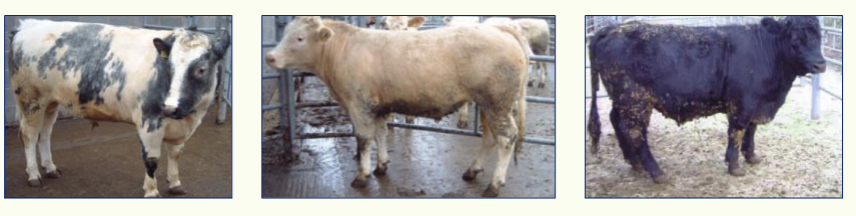
which one passes inspection
left
purpose of stunning
renders animal immediately insensible to pain
killed by exsanguination - sticking
methods of stunning
mechanical - percussive
electical
chemical - gaseous
Percussive Stunning – Captive Bolt
The primary objective of captive‐bolt stunning is to induce immediate insensibility by administering a severe blow to the skull of the animal.
Produces a rapid acceleration of the head, causing the brain to impact against the inside of the skull.
Disruption of normal electrical activity resulting from sudden, massive increase in intra‐cranial pressure, followed by an equally sudden drop in pressure. Causes brain dysfunction and/or destruction, and impaired blood circulation
The animal must then remain unconscious until it dies from bleeding or pithing. The term ‘percussive’ describes the principal action of the captive‐bolt.
Although the captive‐bolt is used mainly for stunning cattle, sheep and goats, it is also utilised to a lesser extent for pigs, horses and farmed deer
stunning
The initial effect on the animal is immediate unconsciousness accompanied by ‘tonic’ activity - animal collapses, stops breathing and becomes rigid, with its head extended and its hind legs flexed towards the abdomen
This period of rigidity normally lasts for 10 - 20 seconds following stunning. The forelegs may be flexed initially and then gradually straighten out.
This tonic activity is followed by a period of involuntary kicking movements (clonic seizures) which gradually subsides.
An effective stun is dependent on the blow being administered to the correct part of the skull. To ensure maximum impact on the brain, the best position is where the brain is closest to the surface of the head and where the skull is at its thinnest
signs of effective mechanical stun
animal collapses - tonic phases
no rhythmic breathing
fixed, glazing expression
no corneal reflex
relaxed jaw, possible with tongue hanging out
Cattle - Stunning
The ideal stunning position is in the middle of the forehead – at the crossing point of two imaginary lines drawn between the eyes and the centre of the base of the opposite horns .
The muzzle of the stunner should be held at a right angle to the skull, so that the bolt is directed through the upper brain towards the brainstem

Sheep - Stunning
The correct position for stunning sheep depends on whether the animal is polled (hornless) or horned.
For polled sheep, the muzzle of the stunner should be placed on the highest point of the head, and on the mid‐line, aiming straight down.
For horned sheep, the muzzle of the stunner should be placed on the mid‐line, behind the ridge between the horns, and aimed towards the base of the tongue

Pigs - Stunning
Pigs are the most difficult animals to stun with captive‐bolt equipment.
The target area is very small, and this problem can be exacerbated by the ‘dish‐face’ characteristic found in certain breeds and in aged pigs.
In addition, relative to other species, the brain lies deep in the head with a mass of sinuses lying between the frontal bone and the brain cavity

electrical stunning
The principle of electric stunning is to pass sufficient current through the brain to interrupt its normal activity, so that the animal becomes immediately unconscious and unable to feel pain.
When electrodes are applied to the head, the amount of current that flows will depend on the voltage difference between the electrodes, and the electrical resistance of the animal.
To increase the current flowing in a circuit, the voltage must be increased, or the resistance decreased
Animals contain a high proportion of liquid that will conduct electricity well. However, skin, fat, bone and hair are poor conductors.
Stunning with electricity is known as electronarcosis. Electronarcosis is a fully reversible procedure, disrupting normal brain function for a short period.
When electrical stunning is carried out effectively, the result is essentially the same as an epileptic seizure in humans, during which the brain is severely stimulated, the body exhibits tonic/clonic activity, and there is complete loss of consciousness
Slaughter - Poultry - Stunning - Electrical Stunning
Electrical stunning must make the bird immediately unconscious and insensible to pain until death occurs. Death is usually achieved by cutting the major blood vessels in the neck.
The general principle of electrical stunning is to pass sufficient current through the brain to disrupt the normal electrical activity. The duration of insensibility depends on the size of the current that passes through the brain and the length of time for which the current is applied
The initial effect on poultry is immediate insensibility, accompanied by arching of the neck, no rhythmic breathing, rigidly extended legs, constant rapid body tremors and the wings held close to the body

Signs of an Effective Electrical Stun
Neck arched with eyes fully open.
No rhythmic breathing immediately after the stun.
Rigidly extended legs.
Constant rapid body tremors.
Wings held close to the body (following initial uncontrolled bursts of flapping)
Immediately after electrical stunning, within a maximum of 15 seconds, the bird must be killed by either neck-cutting or neck dislocation
Controlled Atmospheric Stunning - Gas Stunning
Carbon dioxide
Heavier than air
Cheap
May induce unpleasant effects
Inert gases (e.g. argon)
More expensive
No physiological effects
Vacuum or Nitrogen (poultry only)
Cattle - Bleeding
Animals must be bled as soon as possible after stunning, ideally whilst still in the tonic (rigid) phase. Bleeding involves severing the carotid arteries and jugular veins, or the blood vessels from which they arise.
Bleeding should be carried out by an incision made with a sharp knife in the jugular furrow at the base of the neck, the knife being directed towards the entrance of the chest to sever all the major blood vessels arising from the heart
Good hygiene: two knives should be used. The first to open the skin and the second to sever the blood vessels
On most cattle lines, where the carcase must be hoisted to a bleed area, maximum stun‐to‐stick intervals of 60 seconds for the captive‐bolt.
Sheep - Bleeding
Bleeding may be carried out in a similar way as for cattle (position 1) or by an incision made close to the head using a blade at least 120mm long to sever both carotid arteries and both jugular veins (position 2).
In the EU, the trachea and oesophagus of animals intended for human consumption must remain intact during bleeding, except in the case of slaughter according to a religious custom. An incision at the entrance to the chest must therefore be used
All pigs, sheep and goats should also be stuck within 15 seconds
Pigs - Bleeding
A knife at least 120mm long should be inserted in the mid‐line of the neck at the depression before the breastbone.
Pushed upward to sever all the major blood vessels which arise from the heart
In the abattoir, all pigs, sheep and goats should also be stuck within 15 seconds.
Poultry - Bleeding
Birds should be bled without delay and always within 15 seconds of stunning. Neck cutting must sever both carotid arteries or the vessels from which they arise.
When slaughtering birds for consumption birds should be kept suspended after neck- cutting to allow time for the blood to drain from the carcase
Turkeys and geese must be allowed to bleed for a minimum of two minutes, and other birds for one and a half minutes, before plucking and evisceration can begin
Exemptions for Religious Slaughter

Cattle – Kosher Slaughter
Must be kept upright in an approved restraining pen
A head restraint is required
Support to the animal is required during and after slaughter
Sharp knife
Rapid uninterrupted movement of the knife
Severe both carotid arteries and both jugular veins
Slaughter without stunning (2024):
0% of pigs
2% of cattle and 6% of calves
29% of sheep (increase from 23% in 2022)
11% of goats (decrease from 25% in 2022)
3% of broiler chickens (2% in 2022)