BIOL 1510 Chapter 10
 Call Kai
 Learn
 Practice Test
 Spaced Repetition
 Match
 Flashcards
 Knowt Play
1/58

There's no tags or description
Looks like no tags are added yet.
59 Terms
Functions of lipids
highly reduced sources of fuel
important for biological membranes
participate in signaling
General structure of lipids
hydrocarbons with COOH on the end
Charge of lipids at physiological pH
Negatively charged due to deprotonated COOH group
Effect of increasing carbon chain length on solubility
Increased length=decreased solubility
Nomenclature of hydrocarbons
24:2(delta 9,12)
first number represents the number of carbons
second number represents the number of double bonds
the numbers after the delta represent the position of the double bonds, specifically the first carbon involved in the double bond(s)
What’s more common: even or odd numbered fatty acids
Even numbered
Most common positions of double bonds in fatty acids
9, 12, 15→in that order
What’s the most common type of unsaturation: cis or trans?
Cis
Effect of cis double bonds on fatty acid properties
cause kinks in the tail
prevents close packing
leads to more fluid membranes and a melting point depression
What are triacylglycerol molecules used for?
Storage
Types of lipids found in cells
triacylglycerides
glycerolipids
sphingolipids
Structure of triacylglycerols
glycerol molecule linked to three fatty acids via ester linkages
Glycerophospholipid
glycerol backbone
2 fatty acids linked via ester linkages
a PO4-X head group

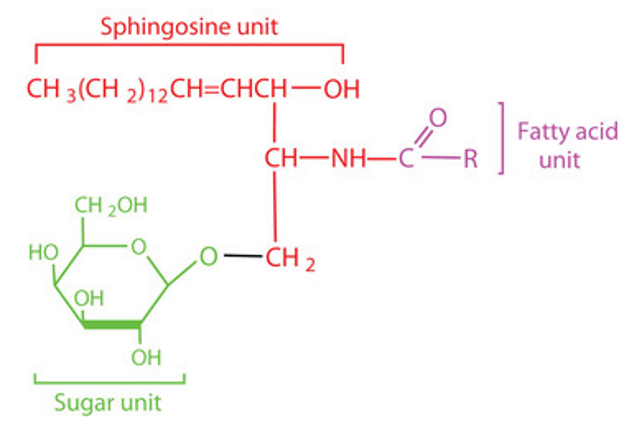
Sphingolipids
long-chain sphingosine backbone
fatty acid substituent linked via an AMIDE linkage
head group

Gangliosides
sphingolipids with complex oligosaccharide head groups

Glycosphingolipids
monosaccharide head group
Sphingomyelin
A type of sphingophospholipid with a phosphocholine head group found in myelin sheaths
Ceramides
A type of sphingolipid where the head group is just a hydrogen
Phosphotidyl___ lipids
A type of glycerophospholipid with the head group is PO4+whatever the suffix molecule is
Archaelipids
Special lipids found in the membranes of thermophilic archaea
glycerol backbone
two alcohol chains linked via an ETHER linkage
PO4 substituent
What is the purpose of the ether linkage in archaealipids
makes the lipids not susceptible to hydrolysis and nucleophilic attack, which helps the archaea withstand high temperatures
Phospholipases
enzymes responsible for degrading lipids
How often are membranes remodeled?
All the time!
What can the inability to breakdown membrane lipids lead to?
disease
Structure of cholesterol
steroid
rigid and planar
4 rings

Functions of cholesterol
controls membrane fluidity→increases it
precursor for many signaling molecules
Bacteria version of steroids
hopanoyds→similar planar ring structure
Evolutionary history of hopanoyds and what that reveals about their likely function
Thought to have arisen in ancient marine bacteria and confer resistance to high salinity environments
Staphyloxanthin
Pigment produced by some strains of S. aureus that acts as a virulence factor
Staphyloxanthin precursor
Squalenes
Functions of squalanes
membrane stabilization
remedies bacterial oxidative stress
Lipids as signaling molecules
Phospholipase C cleaves PIP2 into IP3 and DAG
eicosanoid molecules
steroid hormones
Precursor to eicosanoid molecules
Arachidonic acid
Examples of eicosanoids
Prostaglandins, TXA2, etc
What blocks eicosanoid synthesis?
NSAIDs
Water soluble vitamins
excess can be excreted
B and C
Fat soluble vitamins
excess stored in fat and liver tissue
A, D, E, K
Where do we get our vitamins from?
Diet! Don’t synthesize them
Purpose of fat soluble vitamins
Signaling
Function of vitamin E
antioxidant
Function of vitamin K
blood clotting
Where does ubiquinone come from?
Derivative of fat soluble vitamins
Function of vitamin D
Bone maturation
Function of vitamin A
Vision→makes retinal, a pigment of rhodopsin
Rhodopsin
Turns light into electrical impulses
Do phospholipids contain sphingosine?
Some do?
Do sphingolipids contain phosphate groups?
Some do
Are ceramides part of membranes?
Yes
Are gangliosides part of membranes?
Yes
Can a lipid with a small number of unsaturations have a low melting point?
Contains mostly short-chain fatty acids
What is the polar part of sphingolipids?
Polar head group and/or phosphate
What is the polar part of glycophospholipids?
Sugar
How do trans fatty acids compare to cis fatty acids with respect to melting point?
Have a higher melting point because they pack closer together and have increased interactions
What is “better” for lipids, higher or lower melting point?
Higher melting point because they stay in the solid phase longer
What is the most common cause of melting point decrease?
Cis double bonds
How do branched chain fatty acids affect the fluidity of the plasma membrane?
Increase fluidity and decrease melting point because the lipids can’t pack as closely together
What is the polar part of a phosphatidyl___
The phospho___ head group
if phosphatidylethanol amine, then phosphoethanolamine is the polar head group
How do steroids decrease inflammation?
The inhibit the actions of phospholipase A, which prevents the synthesis of certain eicosanoids such as prostaglandins since arachidonic acid (precursor for eicosanoids) release is prohibited. This decreases inflammation
Functions of phospholipase A
releases arachidonic acid→precursor for many important signaling molecules
breaks down dietary glycerophospholipids