Learn: Anatomy and physiology chapter 3 (energy, chemical reactions, and cellular respiration)
 Call Kai
 Learn
Learn Practice Test
 Spaced Repetition
 Match
Match Flashcards
 Knowt Play
1/77

There's no tags or description
Looks like no tags are added yet.
Name | Mastery | Learn | Test | Matching | Spaced | Call with Kai | Chat |
|---|
No analytics yet
Send a link to your students to track their progress
78 Terms
What is Energy
the capacity to do work
How many classes of energy are there?
2
What is potential energy?
energy of position or stored energy
What is kinetic energy?
energy of motion
Ex: when an arrow is pulled back in the bow it has ________
Potential energy
Ex: When the arrow is released it now has _____
Kinetic Energy
first law of thermodynamics
Energy can be transferred and transformed, but it cannot be created or destroyed.
second law of thermodynamics
when energy is changed from one form to another, some useful energy is always degraded into lower quality energy (usually heat)
What is a chemical reaction?
a process that changes, or transforms, one set of chemicals into another
What are the components of chemical reactions?
reactants and products
Reactant are _____
Substrates or substances that are found prior to the start of chemical reactions
Products are ____
substances formed at the end of the chemical reaction
Categories of chemical reactions are based on
Changes in chemical structure
Decomposition reaction is
breakdown of a molecule into smaller components
AB->A+B
decomposition reaction
sythesis reaction is
Two or more atoms, ions, or molecules that are combined to form a larger chemical structure
A+B->AB
synthesis reaction
exchange reaction is
Atom, molecules, electrons or ions are exchanged between two chemical structures
AB+C-->A+BC
exchange reaction
Catabolism is
breakdown of substances
Anabolism
Builds up
Metabolism
All of the chemical reactions that occur within an organism
oxidation-reduction (redox) reactions
a reaction that involves the transfer of electrons between reactants
Oxidation
loss of electrons
Reduction
gain of electrons
exergonic reaction
A chemical reaction that releases energy
endogonic reaction
absorbs energy and will not occur spontaneously
Reaction rate is measured by
How quickly the reaction takes place
activation energy (Ea)
the initial energy needed to start a chemical reaction
What does a catalyst do to a reaction?
A catalyst lowers the activation energy needed to start the reaction
What are enzymes?
Proteins that speed up chemical reactions
What is the relationship between enzymes and activation energy?
Enzymes lower the activation energy required for a chemical reaction to occur.
Most enzymes are
globular proteins
What is an active site?
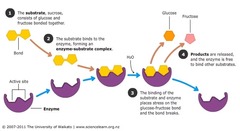
a region on an enzyme that binds to a protein or other substance during a reaction.
enzyme-substrate complex
A temporary complex formed when an enzyme binds to its substrate molecule(s).
Active site's speciffity
Only permits 1 single subrates to bind and helps catalyze one specific reaction
enzymes are located
Within some cells (ex: dna polymerase), plasma membrane (lactase) or secreting through cells
Change in enzyme shape
Permits new bonds to be formed
What is this a picture of?
Mechanism of action for an enzyme in a synthesis reaction
What are coenzymes?
Organic carrier molecules
What are effects of enzyme and substrate concentration
Rate of chemical reaction may be accelerated
Saturation is
so much substrate is present that all enzyme molecules are engaged in reaction
enzymes reaction rates are affected by
shape, temperature, pH
How are enzymes named?
An enzyme's name is created by adding '-ase' to the first part of the name of the substance on which it works
What is the pH for enzymes
Between pH of 6 and 8
Denaturation of enzymes
enzyme reactions are affected by temperature, pH, and the concentration of the substrate
True or False: Enzymes can be turned on
True
What turns off enzymes by binding to them
Inhibitors (competitive or noncompetitive)
competitive inhibition
Inhibitor competes with substrate for active site.
noncompetitive inhibitor (allosteric inhibitor)
bind to another part of an enzyme, causing the enzyme to change shape and making the active site less effective
metabolic pathways are composed of
Numerous enzymes to convert specific substrate to final product
How are metabolic processes regulated?
Negative feedback that involves product that serves as an allosteric inhibitor that binds to an enzyme early in the pathway
Cellular respiration makes
ATP
What process is used to synthesize ATP
Endergonic process
potential energy
stored energy
What is required for maximum atp production
Oxygen
What is glucose oxidation
-step by step breakdown of glucose with energy release
-carbon dioxide and water formed
Net reaction of glucose (CELLULAR RESPIRATION)
C6H12O6 + 6 O2 → 6 CO2 + 6 H2O +ENERGY
phosphorylation and dephosphorylation
addition/removal of phosphate groups through the action of protein kinases/phosphatases
Cellular structures required for cellular respiration are
Glycolysis, intermediate stag, citric acid cycle, electron transport system
What is aerobic cellular respiration?
Series of oxygen-requiring reactions in mitochondria
Where does glycolysis occur?
cytoplasm of the cell (does not require oxygen)
Where does the electron transport chain occur?
inner membrane of mitochondria (requires oxygen)
Glycolysis
first step in releasing the energy of glucose, in which glucose is broken into two molecules of pyruvic molecules, net production of 2 ATP
substrate-level phosphorylation
The enzyme-catalyzed formation of ATP by direct transfer of a phosphate group to ADP from an intermediate substrate in catabolism.
What steps are happening
Steps 1-5 glycolysis

What is the final product of glycolysis?
Pyruvate, which removes both phosphates producing 2ATP.
Intermediate stage is
the link between glycolysis and the citric acid cycle
What is intermediate stage catalyzed by
pyruvate dehydrogenase
during decarboxylation,
a carboxyl group is released from pyruvate as CO2
Citric Acid Cycle (Krebs Cycle)
A chemical cycle involving eight steps that completes the metabolic breakdown of glucose molecules begun in glycolysis by oxidizing acetyl CoA (derived from pyruvate) to carbon dioxide; occurs within the mitochondrion in eukaryotic cells and in the cytosol of prokaryotes; together with pyruvate oxidation, the second major stage in cellular respiration.
What is the function of the electron transport system
Transfer of electrons from NADH and FADH2 to produce ATP.
Where is the electron transport chain located?
inner mitochondrial membrane (cristae)
H+ pump
A transporter that actively moves H+ across a cell membrane, thereby generating a gradient that can be used by the cell, for example, to import other solutes.
3 major steps of electron transport system
1. electrons are transferred from coenzymes to O2 , 2. H+ GRADIENT is established, 3. H+ gradient is harnessed to form ATP
The process of forming ATP is
Oxidation phosphorylation
What process is this?
Stages of cellular respiration

How many ATP molecules are produced from glucose during cellular respiration
34 atp