Finance Webcasts (2B, 4B, 5A)
 Call Kai
 Learn
 Practice Test
 Spaced Repetition
 Match
 Flashcards
 Knowt Play
1/20

There's no tags or description
Looks like no tags are added yet.
21 Terms
What is the formula for duration of a bond?
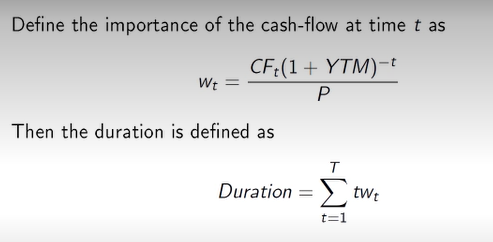
What is the formula for the importance of a cash flow?
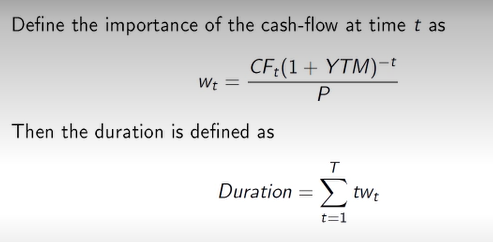
What is the duration of a bond a measure for?
Duration measures the effect of maturity of the bond by computing the time weighted average of discounted cashflows
Is the interest risk higher for a coupon paying bond or a zero bond?
The interest risk is higher for a zero bond. With a coupon paying bond, you alrady have some money in the pocket.
What does it mean if the weight of the risk free asset is negative?
We are borrowing money at the risk free rate to invest more than our wealth (1) in the risky assets
What does it mean if you say that you are financing a portfolio at 50% margin?
50% of what we are investing is borrowed funds
What does taking leverage do to a portfolio’s return and risk?
By taking leverage we can increase a portfolio’s return. Importantly, this increase always comes at the expense of an increase in the portfolio’s risk.
Does leveraging up a portfolio make it better?
Leveraging up a portfolio does not alter its risk-return trade-off!

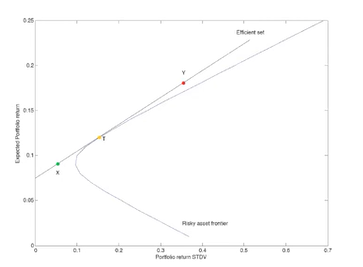
Which one is a levered portfolio, X or Y?
Y
How to balance the bias-variance trade-off in determining the covariance matrix of assets when managing a portfolio?
Shrinkage estimators. We take a linear combination of the unbiased but noisy sample covariation matrix with the biased but more precisely estimated target covariance matrix.
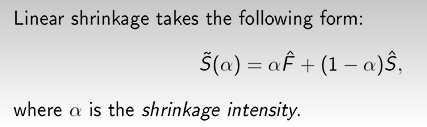
What form does linear shrinkage take?
What are common shrinkage targets?
1 The identity matrix
2 A one-factor model
3 Equicorrelation
What assumptions do you need for an event study?
Markets are efficient and therefore reflect all available information.
The event is unanticipated. If it were anticipated, market prices would have already started to adjust before the event actually happens.
There are no confounding effects; there is no other event that may have systematically caused returns across your sample. (?)
Abnormal returns are defined as AR_i,t = R_i,t - E[R_i,t]. How to find the E[R_i,t] ?
It may come from CAPM, estimated on the clean window. E[R_i,t] = alphahat + betahat * R_m,t
When doing an event study, what is the distribution of the abnormal returns under the null hypothesis?
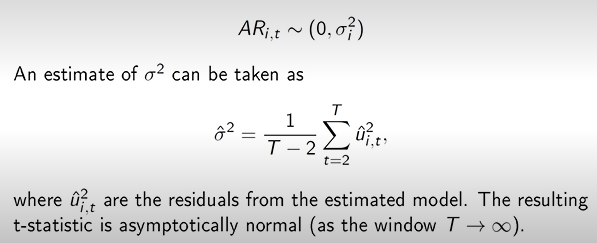
If we aggregate abnormal returns over time, what do we get? What is the formula?
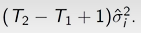
Cumulative Abnormal Returns (CAR)

What is the variance of CAR?
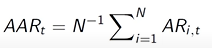
We may obtain less noisy estimates of abnormal returns by using a cross-section of firms that are all affected by the news. How do we call this and what is the formula?
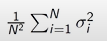
Average Abnormal Returns (AAR)
What is the variance of AAR?
What is it called when, in order to see how abnormal returns are affected, we take both a cross-section of affected firms and we aggregate over time? What is the formula?
Cumulative Average Abnormal Returns (AAR)

What is the variance of CAAR?
