Criminal offending - Part 2
 Call Kai
 Learn
Learn Practice Test
 Spaced Repetition
 Match
Match Flashcards
 Knowt Play
1/50

There's no tags or description
Looks like no tags are added yet.
Name | Mastery | Learn | Test | Matching | Spaced | Call with Kai | Chat |
|---|
No analytics yet
Send a link to your students to track their progress
51 Terms
What is the impact of sexual abuse? (4, one main one, 2 more specific ones, 1 sort of repeat)
General, non-specific risk for psychopathology - includes significant risk of wide range medical, psychological, behavioural, and sexual disorders.
PTSD, depression, suicide, sexual promiscuity, victim-perpetrator cycle, poor academic performance
Impacts on adult interpersonal functioning
Long-term trauma symptoms
Psychologically meaningful risk factors involve what two things?
Strong evidence of prediction AND a plausible rationale that is a cause
What are psychologically meaningful risk factors? What can they be likened to? How do behaviours of interest arise?
Individual propensities that may or may not manifest;
Can be likened to traits (i.e., long-term, enduring characteristics that lead to predictable expressions of thoughts, feelings, or behaviours)
Behaviour of interest arises only through interactions with the environment - opportunities or facilitation
What does a psychologically meaningful risk factor have to demonstrate to be considered “supported”?
Effect has to be more than trivial - .15
What are “supported” psychologically meaningful risk factors? (5/11)
Sexual preoccupation
Any deviant sexual interest
Offence-supportive attitudes
Emotional congruence with children
Lack of adult relationships
Impulsivity
General self-regulation problems
Poor problem solving
Resistance to rules/superiority
Grievance/hostility
Negative social influences
Hostility towards women
Sexualised coping
Externalised coping
What are “promising” risk factors? What are examples?
Risk factors that, in the future, may be “supported”
Machiavellianism
Callousness
Hostility towards women, sexualised coping, and externalised coping are now supported
What are single-factor theories for sexual offending?
Deviant sexual preferences
Intimacy deficits
Cognitive distortions
Deficient victim empathy
What is the deviant sexual preferences theory of sexual offending? How is it proposed these are acquired?
Deviant sexual behaviour is a direct product of deviant sexual preference.
Basic learning principles and neurobiology
How do basic learning principles relate to the acquisition of deviant sexual preferences? However, the majority of people what?
Conditioning and reinforcement: Idea that repeated pairing of pleasurable state + a condition stimulus may lead to conditioning (deliberate or circumstantial)
This is maintained by fantasy
Can also be acting out things that were seen (modelling)
Majority of people exposed to these kinds of experiences in childhood do not go on to develop deviant sexual preferences
What ideas followed the concept of deviant sexual preferences in intervention?
If it was learnt, it can be ‘unlearned’ — now, treatment has a wider range of targets than purely behavioural
What are examples of reconditioning techniques for deviant sexual preferences theory?
Aversive conditioning - pairing the deviant fantasy w/ aversive stimulus
Covert sensitization - pairing imagined target behaviour with imagined unpleasant outcome
Masturbatory reconditioning - thematic shift, where client masturbates to deviant theme then switches to non-deviant theme just prior to orgasm
Directed masturbation - directed masturbation solely to non-deviant themes
Verbal satiation - repeated verbalisation of deviant fantasies in absense of reinforcement
What is the intimacy deficits theory of sexual offending? What are the 2 dichotomies of models involved? How does this relate to attachment styles?
Attachment styles from childhood endure and are reflected in adult attachment style
Model of self + model of others
Each style is proposed to relate to a distinct type of sexual offending
(Except secure)
Dismissive/avoidant - hostility, violence against adult women
Preoccupied/ambivalent - tend to seek approval from others, sexualise attachment relationships, leading to sexual contact w/ children
Unresolved/disorganised - Tend to choose to seek intimacy through impersonal sexual encounters. Sexual offending one of many different strategies of externally based control in response to intense emotional states
What is the clinical utility of the intimacy deficits theory of sexual offending?
W/ disorganised + preoccupied associated with emotional loneliness, this could be important to work on clinically.
Dismissive is linked w/ high fear of intimacy
Some programs involve teaching clients about styles, assisting them in self-identification, and discussing how it has influenced their relationship exp
What are multifactorial theories for sexual offending?
Finkelhor’s Preconditions
Ward & Siegert’s Pathways
Ward & Beech’s ITSO-R
Seto’s Motivation-Facilitation
What was Finkelhor’s Precondition Model the first to do?
Acknowledge the complexity of the phenomenon of sexual offending
Incorporate situational/contextual variables
Informs individualised treatment - If different people have different contexts, pathways, motivations, and trajectories, of course treatment will be different
Finkelhor’s Precondition model proposed what consistent underlying factors are apparent across different accounts of deviant sexual behaviour?
3 Motivational Factors
Emotional satisfaction
Sexually aroused by children
Unable to meet sexual needs appropriately
1 Factor associated with translation of motivational factors into action
Disinhibition
These factors combine with contextual factors. Can operate in coordination or separately.
What are Finkelhor’s Four Preconditions? How do they relate to the occurrence of offending?
Motivation to sexually abuse (for instance, the consistent underlying factors of emotional satisfaction, sexual arousal, & blockage)
Overcoming internal inhibitors (which can stop even those with the motivation; to do with self-control)
Overcoming external inhibitors (for ex., accessibility)
Overcoming victim resistance
All four are necessary for offending — aka, each one is necessary but not sufficient on their own without the others. Thus, each can be targeted.
What are the three basic motivations to sexually abuse, according to Finkelhor’s Precondition Model?
Emotional congruence — emotional/intimacy/connection needs that are sought to be met, that the offender thinks can be met by children (safer, maybe on same level of development/maturity, or easier to control)
Sexual arousal - usually includes powerful learning mechanisms with repeated reinforcement. Around ½ of convicted offenders are motivated by some element of arousal.
Blockage - sexual needs sought being met that are not otherwise met except through the sexual offending. Blockage could be fear of rejection, social skills, relationship dysfunction, & guilt. Does not require that sexual need to be of children
According to Finkelhor’s Precondition Model, without _________, we ____________.
A motivation of some kind, which does not have to be a paraphilia or attraction, we don’t have a sexual offense
What are ways that one might overcome internal inhibitors in Finkelhor’s Precondition Model?
Intoxication (particularly alcohol)
Poor impulse control
Senility
Psychosis
Severe stress
Cognitive distortions — i.e., not seeing it as wrong, seeing it as “good” for both parties
How do offenders overcome external inhibitors, according to Finkelhor’s Precondition Model?
Garnering caregiver trust
Getting the child alone
Limited/poor supervision
Lack of social supports
How do offenders overcome victim resistance, according to Finkelhor’s Precondition Model?
Gifts
Gradual sexual desensitisation
Encouraging emotional dependence
Threats/violence
Ward & Siegert’s Pathways model takes a ______ approach, and proposes what
A “theory-knitting approach”
A # of distinct etiological pathways (w/ distinct risk/vulnerability factors), each w/ own set of core dysfunctional mechanisms
What should be noted about the pathways proposed by Ward & Siegert?
Each category can be broken down further—’pathways’ are merely clusters of clinical phenomena, and some can fall into multiple pathways
What are Ward & Siegert’s Pathways? (5)
Intimacy deficits
Deviant sexual scripts
Emotional dysreguation
Antisocial cognitions
Multiple dysfunctional mechanisms
According to Ward & Siegert’s Pathways Model, each pathway is associated with different _____ and ____ profiles, each reflecting separate _____.
psychological; behavioural; etiologies
According to Ward & Seigert’s Pathways theory, how do causal mechanisms relate to symptoms?
The relevant primary causal mechanism will result in a unique set of symptoms
What contributes to vulnerability in Ward & Siegert’s Pathways Model?
Common clusters
Deviant sexual arousal
Intimacy deficits
Inappropriate emotions
Cognitive distortions
Other contextual factors
Family environment
Biological factors
Learning history
Cultural issues
Describe Ward & Siegert’s Pathway 1 - Intimacy Deficits (5)
Normal sexual scripts
Insecure attachments resulting in problems w/ adult relationships
Develops maladaptive strategies to avoid unsuccessful adult relationships
Intimacy deficits + feelings of loneliness
Substitutes child as a surrogate partner
Describe Ward & Siegert’s Pathway 2: Deviant Sexual Scripts
Distorted sexual scripts interacting w/ dysfunctional relationship schema
Premature sexualisation (early learning experiences incl exposure to sexual matters or abuse)
Sex/intimacy confusion (merging/fusing of sex and intimacy)
Vulnerability translates to sexual need
Relationships, even friendships, perceived in sexual terms
Relationships ultimately unsatisfying and non-lasting, equalling periods of rejection
Describe Ward & Siegert’s Pathway 3: Emotional Dysregulation
Normal sexual scripts
Problems with emotional regulation
Emotional structures unidentified + uncontrolled
Early established link between sex + emotional wellbeing
Sex used as soothing strategy
Unable to mobilise social support when stressed
increased anger and emotional dysregulation
Child used to satisfy sexual need and punish partner
Describe Ward & Siegert’s Pathway 4: Antisocial cognitions
Normal sexual scripts
Antisociality and procriminal attitudes and beliefs
“I can do what I want and I can get my needs met”, disregard of social norms
Patriarchal attitudes and sense of own superiority
Exploits opportunities to self gratify
Describe Ward & Siegert’s Pathway 5: Multiple Dysfunctional Mechanisms
Distorted sexual scripts
Idealised relationships
Dysfunctional ideas about children’s sexuality
Deviant sexual arousal generated by sexual scripts
Increased self esteem based on perceived legitimacy of action — i.e., feel good about themselves because don’t see it as a problem (“We both feel good”)
What should be noted about Ward & Siegert’s Pathways Model?
Model is more descriptive than etiological
How does Ward & Beech’s ITSO model differ from previous models (Finkelhor, Ward & Siegert)
Attempts to advance etiological explanation with regard to implicated factors as opposed to simply description
More broad, incorporating research relation to human behaviour more generally
What does Ward & Beech’s ITSO theory incorporate?
The impact of
biological factors
Ecological factors
and their interaction
on individual’s (neuro)psychological functioning
and subsequent clinical symptomology pertaining to risk (i.e., deviant arousal, cognitive distortions, emotional & social difficulties)
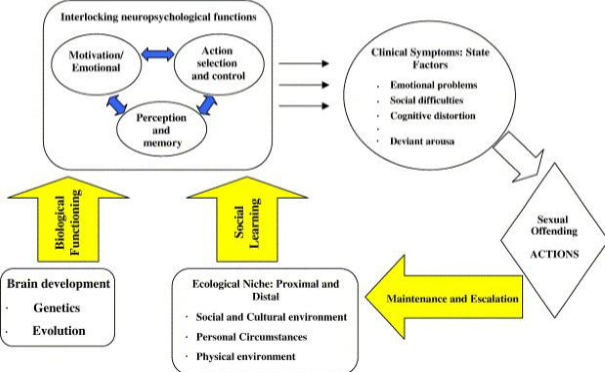
Describe Ward & Beech’s ITSO model
Biological Functioning and Social learning contribute to Interlocking neuropsychological functions (motivation/emotional, action selection and control, perception and memory) to result in clinical symptoms.
This results in sexual offending, which is maintained and escalated through social learning in a feedback loop.
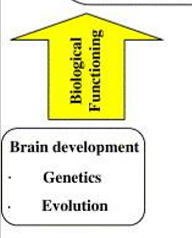
What biological functioning influences contribute to neuropsychological functions, according to Ward & Beech’s ITSO?
Brain development
Genetics
Evolution
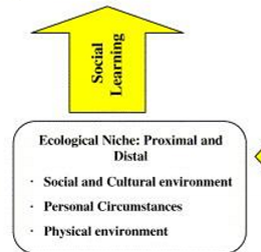
What social learning influences contribute to neuropsychological functions, according to Ward & Beech’s ITSO?
Ecological niche: proximal and distal factors
Social & Cultural environment
Personal circumstances
Physical environment
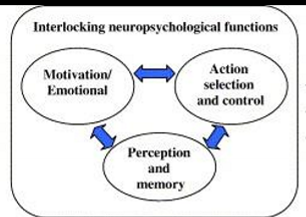
What are interlocking neuropsychological functions, according to Ward & Beech’s ITSO model?
Motivation/Emotional → Action selection and control → perception and memory → repeat
What are clinical symptoms/state factors, according to Ward & Beech’s ITSO?
Emotional problems
Social difficulties
Cognitive distortion
Deviant arousal
What is a summary of Ward & Beech’s ITSO theory?
Brain development and social learning interact to establish an individual’s level of psychological functioning
Such functioning may be compromised in some way, causing difficulties w/ adaptive functioning, leading to problematic psychological functioning and clinical symptomology
Sexual offending can result
Consequences can, in turn, serve to maintain and/or escalate further harmful sexual behaviours
What is Seto’s Motivation-Facilitation Model?
Identifies primary motivations for sexual offences, as well as trait + state factors that facilitate acting on these when there are opportunities
What is Seto’s Motivation-Facilitation Model influenced by?
Finkelhor’s model, and self-control based general theory of crime
What are Seto’s M-F Model’s three primary sexual motivations?
Paraphilias (i.e., intense, recurrent, and unusual sexual interest in atypical sexual activities or objects) - Compare to Finkelhor’s deviant sexual preferences
High sex drive (relative to norms and clinically problematic)
Intense mating effort (novelty seeking in mates due to evolutionary biology)
What are facilitation factors, according to Seto?
Those factors that overcome any trait or state inhibitions against acting upon motivations
What are examples of trait facilitation factors, according to Seto?
Self-regulation problems, such as impulsivity or recklessness
Hostile masculinity (misogynistic attitudes and beliefs, suspicion and hostility to women, view women as adversaries)
What are examples of state facilitation factors, according to Seto?
Negative affect (anger, stress, low mood)
Alcohol use (disinhibiting effect, increased opportunity)
High sexual arousal
What is the person-environment interaction in Seto’s Motivation-Facilitation model?
Strongly motivated individuals more likely to seek out or create opportunities
What are situational factors, according to Seto’s Motivation-Facilitation Model?
State facilitation factors that exist outside the person and interact w/ personal facilitation factors
What are examples of situational-factors, according to Seto’s M-F model?
Vulnerable victims (father absence/blended families, lower income/family stressors, social isolation)
Lack of presence of guardians who could intervene
Time and place factors (afternoon/evening, homes)