Microlab Exam #1
 Call Kai
 Learn
Learn Practice Test
 Spaced Repetition
 Match
Match Flashcards
 Knowt Play
1/32

Earn XP
Description and Tags
(didn't finish pigments)
Name | Mastery | Learn | Test | Matching | Spaced | Call with Kai | Chat |
|---|
No analytics yet
Send a link to your students to track their progress
33 Terms
1 stage micrometer (SU) is equal to how many mm? um?
0.01 mm
10um
What color is Gram-positive bacteria?
Purple
What color is Gram-negative bacteria?
Pink
Is the peptidoglycan layer thicker in Gram-positive or Gram-negative bacteria?
Gram-positive
What does monotrichous mean?
Has a single flagellum
What does amphitrichous mean?
Has flagella at both ends
What does lophotrichous mean?
Has tuft of flagella at one or both ends
What does peritrichous mean?
Has flagella surrounding the cell
Can the capsule be stained?
No, not directly
What is an endospore?
A dormant, extremely heat-resistant structure produced by only a few bacterial genera (ex: Bacillus, Clostridium)
These structures found in cytoplasm
Resistant to certain chemicals, making difficult to stain
Spores extremely dehydrated
Water-soluble dyes we use will not penetrate the spore
Will be clear areas in Gram stain
Purpose: to protect cell’s genome from harsh condition
Capable of being revived after long period of time
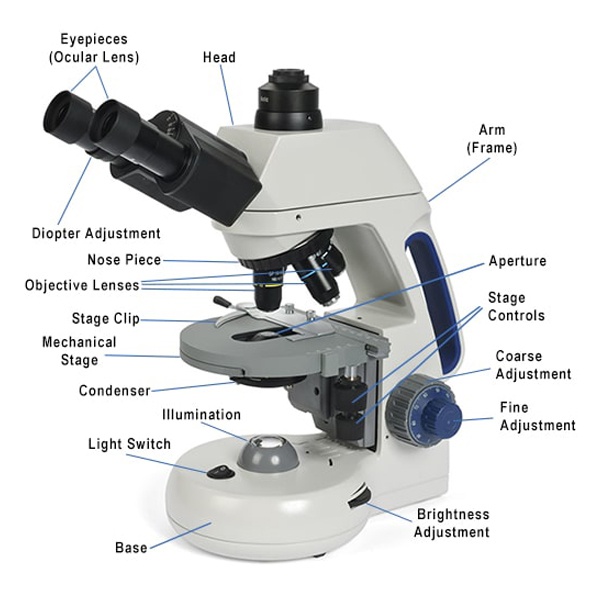
Identify the major parts of the compound light microscope & their function
Eyepiece (ocular lens)
Camera
Objective lens
Stage (slide) clips
Stage
Condenser/diaphragm — controls the amount of light that reaches condenser
Light (source)
Stage controls
Course focus
Fine focus
What is sanitization?
Reduces the number of microbes on a surface to a level that is considered safe according to public health standards
What is disinfection?
Aims to target all microbes on a surface (viruses & bacteria)
What is sterilization?
The complete elimination of all viable microorganisms, including highly resistant forms such as bacterial endospores & viruses
What is subculturing?
Transferring bacteria from an old culture to fresh broth or agar
Used to maintain pure stocks of bacteria over long periods of time
What is inoculation?
To transfer bacteria to fresh media
What should be included on your labels for plates & tubes?
Your name
Section number
Date
Organism name (or number)
Temperature
What does it mean if a molecule is amphipathic? Is soap amphipathic?
Each molecule has a hydrophilic polar head region & a hydrophobic nonpolar tail region
Tail repelled by water but attracted to oils
Soap is effective bc amphipathic
What are micelles?
Spherical structures that trap oil, dirt, & microbes inside
Created by soap molecules when in aqueous environment
So, soap doesn’t lyse/kill bacteria but simply removes them from skin surface
Hand sanitizers with concentrations of alcohol higher than __ have decreased efficacy, but they must have at least __ alcohol to be effective.
90%
60%
What are fastidious bacteria?
Bacteria that require additional growth factors or specific nutrients to support growth & therefore require supplemented media
What is chemically defined media?
All chemical components & their exact concentrations are known
What is complex media?
Some ingredients are naturally derived (ex: extracts & digests) & their precise chemical composition is unknown
Ex: TSA, NA
What are the steps of Gram staining & what is used for each step?
(1) Primary stain (crystal violet) — all cells look purple
(2) Mordant (iodine) — all cells remain purple
(3) Decolorizer (ethanol) — only Gram-positive cells remain purple; Gram-negative cells become colorless
(4) Secondary stain (safranin) — Gram-positive remain purple; Gram-negative cells become pink
Crystal violet → iodine → ethanol → safranin (CIES)
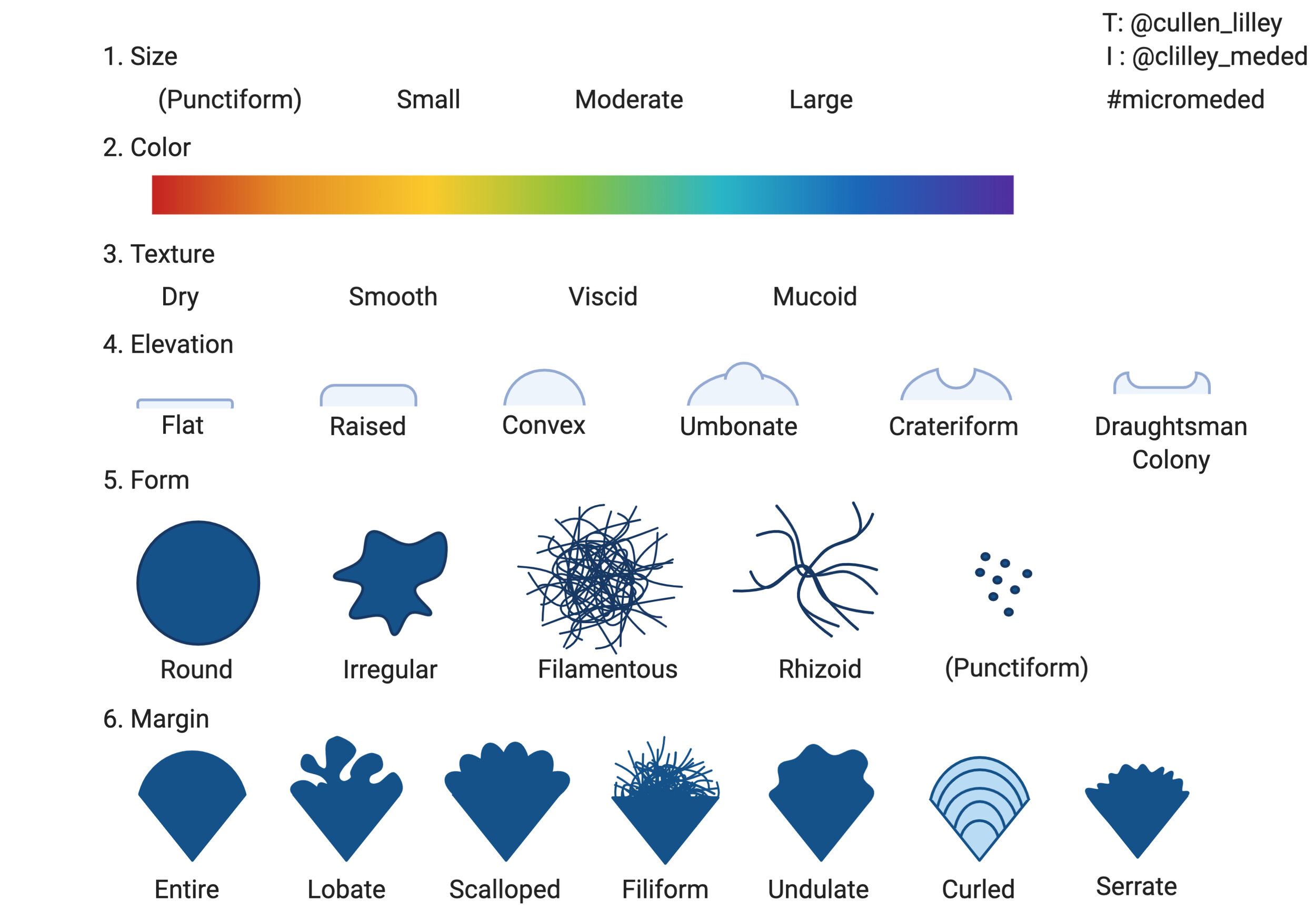
What are the different forms for bacterial morphology?
Punctiform
Circular
Rhizoid (root-like)
Filamentous (thread-like)
Irregular
Spindle

What are the different margins for bacterial morphology?
Entire
Undulate (wavy)
Lobate (finger-like)
Curled (concentric circles)
Filamentous (thread-like)
Erose (serrated)
**if a colony’s margin does not fit into one of these classifications it can be considered irregular

What are the different elevations for bacterial morphology?
Flat
Raised
Convex
Umbonate
Pulvinate
Crateriform
Mesophiles grow best at temperatures between __ & __
20 degrees C & 45 degrees C
Psychrophiles cannot grow above __ but can survive in environments below __
20 degrees C
0 degrees C
Thermophiles grow best at temperatures between __ & __
45 degrees C & 80 degrees C
What is optical density?
The light waves are scattered as they pass through the culture sample, with more scattering as density increases
What bacteria is prodigiosin associated with & what are the characteristics of this pigment?
Serratia marcescens
Red in color
Opt. temp: room temp. (30 degrees C)
Has potential antibiotic & cancer-fighting properties
Source of natural coloring for food industry
Increases effectiveness of sunscreen
What bacteria is pyocyanin associated with & what are the characteristics of this pigment?
Pseudomonas aeruginosa
Responsible for chronic & persistent infections in cystic fibrosis & cancer patients, skin infections in burn patients, hot tub rash, & swimmer’s ear
Blue-green phenazine pigment
Below pH of 5 will turn red