Astronomy midterm 2
 Call Kai
 Learn
 Practice Test
 Spaced Repetition
 Match
 Flashcards
 Knowt Play
1/39

Earn XP
Description and Tags
me making Vyvanse
40 Terms
Define the terms speed, velocity, acceleration, force, momentum, and angular momentu
Speed: How fast something moves
Velocity: describe speed and direction of motion
Acceleration: The rate of change in an objects velocity
—>you can change acceleration by changing your speed or direction or both
Force: Proportional to acceleration, push or pull on an object defined by the objects change in speed/direction as it is applied
Momentum: Mass x velocity
Angular Momentum:A measure of the rotation of a body as it revolves around some fixed point: the product of its mass, velocity, and distance from the fixed point around which it revolves
—> mass x velocity x distance
State Newton's three laws of motion and apply them in the case of objects moving under gravity
Newtons Law 1:
An object in motion remains in motion unless acted upon by an outside force
The object is slowed down by friction
Newtons Law 2:
Acceleration is proportional to force and inversely proportional to mass
the change of motion of a body is proportional to and in the direction of the force acting on it
Newtons Law 3:
For every force, there is always an equal and opposite reaction force
Ex: the shuttle is propelled upwards by a force equal and opposite to the force with which gas is propelled downwards
Whenever something pushes on something, the thing pushes back
It is an equal and opposite force
Describe how the force of gravity between two objects depends on their masses and the distance between them
The gravitational attraction between two bodies must be proportional to their masses
→ the more mass an object has, the stronger the pull of its gravitational force
The magnitude of the force of gravity must decrease with increasing distance between the sun and a planet in proportion to the inverse square of their separation
Define free-fall
The force required to make him go in a circle is the same as gravity
→ when the only force acting upon an object is gravity, you are in freefall
why do astronauts float in space?
When astronauts are in freefall they are accelerating downwards at the same speed as every other object, because gravity is the only external force acting upon them and everything (their space station, their lip combo) is falling around the earth at the same speed
Explain why there are two high tides and low tides within 24 hours at any given location on Earth
The moon exerts gravitational forces on the earth, which causes a tidal bulge to form that is drawn towards the moon. The moons gravitational pull is stronger ton the side facing the moon and the side opposite the moon. As the moon is the highest in the sky, the side closest to the moon experiences a a high tide, and the earth’s rotation lags behind this bulge and carries the coastal location through it.
Correctly describe how tides arise from differences in the force of gravity between two points
The moon exerts a gravitational force on the earth that causes that water to pull towards it. This creates friction between landmasses, and the tidal bulge causes an actual flow of water to the side of earth opposite and below the moon. The centre of the earth pulls towards the moon, causing the water to bulge out on the other side as well.
Spring tides —> when the gravitiaonal forces of the sun re also acting upon tides in conjunction with the effects of the moon
Explain why we can never see the far side of the moon from earth
The moons rotation period around the earth matches that of its own orbital period, because of gravitational forces exerted by the earth that slowed down the moons rotational period from 14 hours to 27 days because of tidal locking. The gravitational forces exerted on the moon by earth eventually slowed its rotation period gradually.
Describe the major parts of the Sun, such as the core, photosphere, and corona
The core:
The hottest part of the sun
where nuclear fusion occurs
is 15 million kelvin hot
The photosphere:
The last part of the sun that is opaque and visible
where sunspots form
we can only observe photons that are emitted into the photosphere
The corona
The suns atmosphere and the coolest part of the sun, extends past earth so technically we are in the suns atmosphere
emits half as much light as the full moon
the corona thins out rapidly at great lengths
Apply the concept of hydrostatic equilibrium to the Sun
The sun maintains temperature, pressure and density in an equilibrium. Hydrostatic equilibrium is what a star needs in order to maintain equilibrium. The masses in the regions of the sun have gravitational attraction towards each other which creates a tremendous force inwards, causing the sun to collapse in on itself. However, this full collapse is prevented by opposing gravitational forces exerted by the thermal & radiative forces of the sun (come with nuclear fusion)
If pressure is too low—> the star collapses and builds up internal pressure and returns to equilibrium
If pressure is too high—> it expands and the pressure decreases, putting it back into equilibrium
Explain how the Sun produces energy from matter
The sun produces energy from nuclear fusion
4 hydrogen nuclei are turned into 1 helium nucleus
These 4 protons create:
2 positrons
2 neutrinos
2 gamma rays
1 helium ray
—> this has less mass than what it started with, which releases a lot of energy
Distinguish between nuclear and chemical reactions
Nuclear reactions is when energy is released from a mass by changing the nucleus of an atoms
Chemical reactions are when electrons in the molecules react with each other and change each other (by forming or breaking chemical bonds) but the atoms stay the same
Distinguish between fission and fusion
Fission: When 235 Uranium (w 92 protons and 143 neutrons) gets hit by a slow neutron and absorbs it, which makes it 236 uranium and makes it unstable. The nucleus of the atom will split into tiny pieces because the forces cannot keep it together. the mass of these tiny pieces will be smaller than the original atom, which will release energy
This is used in nuclear plants and not the sun
Fusion: When multiple light nuclei collide at a very very high speed and form a new nuclei, with a mass smaller than the 2, which releases energy. In the sun, it is 4 hydrogen nuclei turning into 1 helium nucleus. (also releases 2 neutrinos, 2 gamma rays, 1 helium ray & 2 positrons)
Describe the main nuclear reaction by which the Sun generates energy
Nuclear fission occurs in the core of the sun where hydrogen isotopes collide with each other at high speeds.
When you combine 4 protons (hydrogens) you get:
→ 2 positrons (+ charged electrons)
→ 2 neutrinos
→ 2 gamma rays
→ 1 helium nucleus
Describe the origins of sunspots; describe the solar cycle and its effects on Earth
Origins of sunspots: Sunspots are cooler regions on the surface (photosphere) of the sun that are formed when magnetic field lines pushes to the surface of the sun and disrupts the convection process that allows hot plasma to escape, which leaves a cooler spot.
The solar cycle is the activity of the Suns change in magnetic field and radioactivity. During it, it switches its magnetic north and south poles
There are less sunspots at the beginning of the solar cycle
There are the most in the middle
This causes phenomena such as the Aurora borealis on earth and cause geomagnetic storms (?)
Define the terms emission, absorption, transmission, and reflection
Emission: When an object is emitting light, when it is the source of light
Reflection: When light bounces off something (the angle of incidence is equal to the angle of reflection)—> scattering is reflecting in all directions
Absorption: When light is absorbed by something (can be partial or in full, results in a change in color)
Transmission: light comes along a solid and goes through it, coming out of the other side
Interpret the Sun's spectrum as having both continuous (i.e. “full rainbow”) and line features
Continuous spectrum is an array of all wavelengths or colours of the rainbow (which gases that have a lower density can absorb light from) —> this comes from the core of the sun
The sun has a continuous spectrum but there are some colours missing in the range, as certain colours in the spectrum go with certain elements (which absorb different sets of colours)
This is because specific low density gases lie above the suns hot interior and these gases will absorb this light according to their atomic composition
Spectrometers revealed that when these gases were heated, they produced lines instead of a continuous spectrum, which indicates that at different temperatures, different gases emit light at specific wavelengths or temperatures
Apply the concept of a blackbody spectrum to explain the continuous portion of the Sun's spectrum
A blackbody is an idealized model of a dense, hot opaque gases in the suns interior that absorbs all electromagnetic energy that falls on it, allowing it to emit radiation at all wavelengths at each temperature. This allows for the sun to have a continuous spectrum that emits all wavelengths at its core.
Describe light in terms of its wavelength, frequency, energy, and colour; explain how these terms are related
Light is an electromagnetic disturbance that moves through air in waves, but behaves more like particles, which are described as photons.
Light always moves at the same speed in a vacuum, and its speed is always measured by its wavelength x frequency. Because of this, they have an inverse relationship, where as the wavelength (distance between two peaks) gets shorter, the frequency gets higher
From our eyes, different wavelengths are perceived as different colours. Higher, shorter wavelengths present as blue light to us, whereas lower, longer wavelengths register to us as red.
Wavelength and frequency are related because all wavelengths travel at the same speed.
The energy of a wavelength is also related to its frequency, where higher frequency wavelengths have more energy
Explain the line features in the solar spectrum as absorption lines
The line features in the solar spectrum are lower-density gases that absorb different wavelengths of light depending on their temperature (which is significantly lower than the hot gases under it)
Describe how light interacts with matter at the atomic level
LIght radiates outward from a source (radiation) and behaves in both oscillating wave motions (frequency of these wavelengths carries different energy levels) and as particles called photons.
When light enters a human eye, its changing electric and magnetic fields stimulate nerve endings, which then transmit the information contained in these changing fields to the brain
As an expanding area of light begins to cover an area that’s getting bigger and bigger, the light will get weaker as it moves away from its source
The increase in area that the light must cover is proportional to the square of the distance that the light must travel
during absorption, electrons absorb photons and jump to a higher energy level & during emission, the electron goes down an energy level and releases a photon of light
Interpret the absorption lines in the solar spectrum to determine the chemical composition of the Sun
Specific atoms within the cooler, denser gases that block the continuous spectrum in the sun (blackbody object) only emit & absorb specific wavelengths of light (where during absorption, electrons absorb photons and jump to a higher energy level & during emission, the electron goes down an energy level and releases a photon of light)
Because each element has its own energy levels, each element absorbs and emits light at its own characteristic wavelengths.
Scientists compare their own research on the elements ability to absorb and emit diff wavelengths to the data they collect
the sun is majority hydrogen, helium and a little bit of heavier elements (oxygen neon sulfur silicon)
Draw a diagram to describe the doppler effect
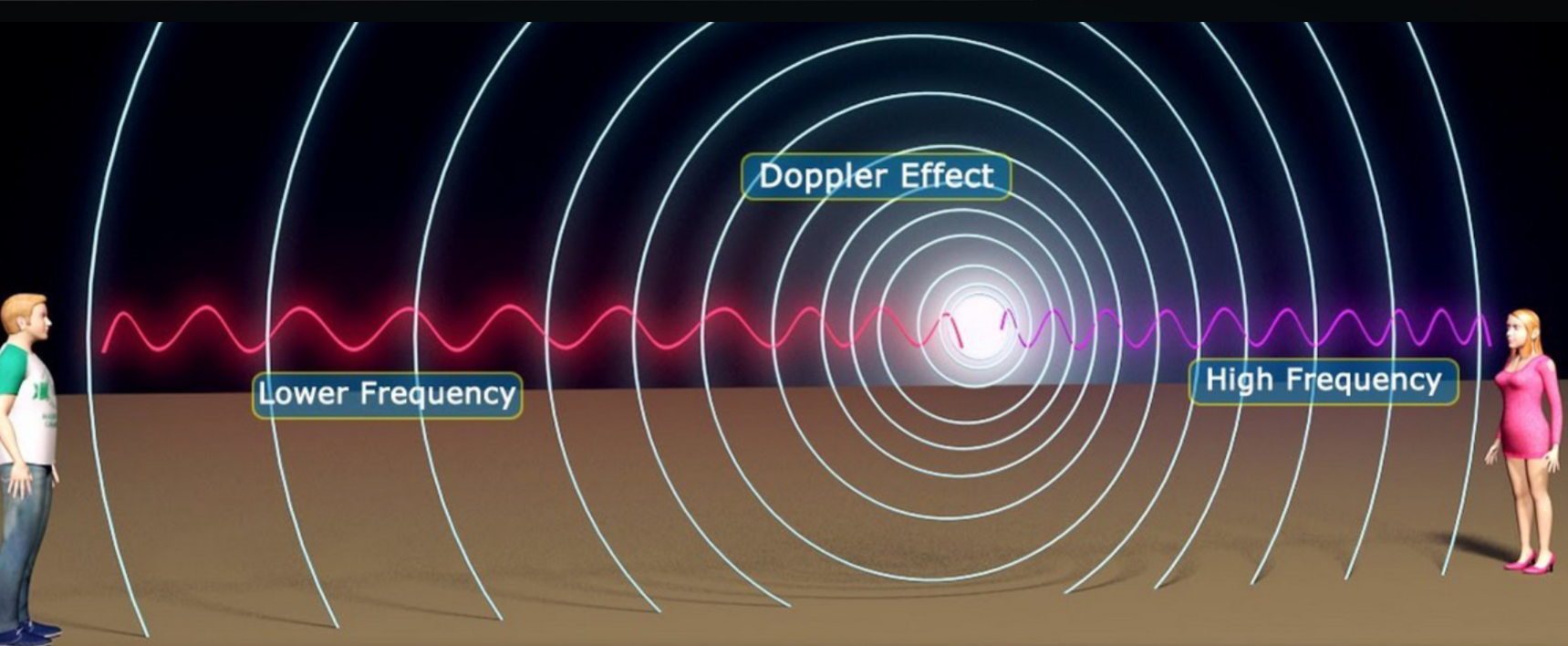
Describe how spectroscopy can be used to measure the physical characteristics of celestial objects, including their:
speed of radial motion
chemical composition
temperature
Radial motion is how fast an object moves away from a viewers line of sight
—> according to the doppler effect, when an observer stands closer to a source of light, they perceive a higher frequency of wavelengths that appear blue. This is called the blue shift, and stars that are have shorter, bluer lines on the spectral lines are most shifting towards the observer —→ the opposite is true and those who are furthest away from the source of light or are moving away from it experience a lower frequency
—> the amount of shift in these wavelengths Is proportional to its radial motion speed.
Chemical composition:
Each element emits and absorbs light at specific wavelengths, and by measuring the emission and absorption spectrum patterns with existing data, one can clean the presence of certain elements of celestial objects
The blackbody radiation (the continuous thermal energy spectrum) peaks at a specific frequency at different temperatures. hot objects can only go up until blue light, whereas cooler objects can go up to red light.
Understand the concept of a molecular cloud
Molecular clouds are insterstellar material Made out of ¾ hydrogen and ¼ helium
Within the clouds are cold, dense regions with typical masses of 50-500 times the mass of the Sun (called clumps)
→ within clumps are smaller, denser regions called cores (embryos of stars, low temperature and high density perfect conditions)
The most massive reservoirs of interstellar matter are the giant molecular clouds
→ most of their gas atoms are bound into molecules
Explain how and why a molecular cloud collapses due to the force of gravity
When a massive star is formed, it emits a large amount of ultraviolet radiation and ejects high-speed gas in the form of stellar wind
→ this heats the gas around the stars, making it expand
→ massive stars exploding also heats the gas with energy
Hot gases pile into the surrounding cold molecular cloud, compressing the material in it and increasing density
When the increase in density is large enough, gravity overcomes pressure and allows stars to form in the compressed gas
A typical core of interstellar material and gases will continue shrinking in radius to make the density grow in order for collapse ( as its internal pressure can no longer support itself against gravity)
Describe multiple methods for how the age of the solar system can be measured (e.g. radioisotope dating and cratering)
the number of craters on surfaces in solar system can indicate a cratering rate—> through noting the celestial objects present today and the number of craters
by noting that the cratering rate has stayed constant, we can estimate how long ago the craters were created
measuring the age of individual rocks
noting the radioactivity of it
atomic nuclei split into smaller nuclei, while radioactive decay involves the emission of gamma rays, or particles such as electrons
we know the amount for one half life of a specific isotope, and exactly half of the nuclei will have degraded at the same rate
By comparing how much of a radioactive parent element is left in a rock vs how much daughter product there is, we can learn how long the decay process has been going on
Relate the observed patterns of motion of objects in the solar system to its formation mechanism
Disk shape:
Massive cloud of gas and dust collapsed under gravity, and as it collapses, it spins faster due to the conservation of angular momentum
the movement of particles removed any random motions and allowed for a protoplanetary disk shape to form into a spinning pancake shape.
all young stars are observed to have protoplanetary discs around them
Same direction revolution::
Since all planets emerged from one solar nebula, they all spin in the same direction as the sun
Relate the patterns of chemical composition in the solar system to its formation mechanism; correctly use the term frost line
The other members of the planetary system lack light elements
→ inner planets are metal-rich, then there are objects made of rocky materials, and ones dominated by ice in the outer solar system
according to the solar nebula theory, as gravity collapsed and the solar nebula began to swirl, the temperature began to decrease at the edges
gases interacted to form compounds throughout this, but only at a specific point were light molecules are able to condense into heavy ice grain such as water, methane and ammonia
The frost line is located between mars and Jupiter and marks this point.
The objects within the frost line were gases, but only those with a high melting point were able to condense into rock.
inside the frost line, only metals can condense
Terrestrial planets formed inside the frost line, whereas jovian planets formed outside the frost line
→ larger cores in jovian planets use gravity to accrete large gas envelopes, giving them their own disks which form moons
Describe the nebular theory for the formation of the solar system
The solar system formed out of a rotating cloud of vapor and dust (solar nebula)
→ as it collapsed under its own gravity, material fell toward the center where things became more concentrated and hot (too hot for solids)
The nebula rotated fast enough for material to collapse into a flat disk rotating around the central object of the nebula
→ when the collapse phase ended, no more gravitational energy meant the nebula began to cool
Gases in the disk interacted and made condensed liquid droplets or solid grains
→ the centre forms a star as it is the hottest and most crowded
→ Solid grains joined into larger and larger chunks, making planetesimals that attracted gravitationally to each other (accretion)
Eventually these made protoplanets
Enough planetesimals striking helped to melt the protoplanet and allow for planetary differentiation
→ Ices and rocks allowed protoplanets to grow much larger (large enough to hold and attract surrounding gas)
→ comets and dwarf planets were formed near Uranus and Neptune but ejected from their orbits by gravitational influence of the gas giants
Asteroid and kuiper belt were only regions where planetesimals avoided impacting planets or ejection so they stayed there
Describe our current model for the formation of the moon
Earth was struck by an object, big enough to disrupt the Earth and eject a large amount of material into space
→ material of the moon is from mantle of the Earth and impacting body
→ the ejected rock cooled and formed a ring of material orbiting earth that eventually condensed into the moon
Accounts for the fact that there are no metals and volatile elements (not in mantles, lost in high temperature phase after impact)
Identify apparent counter-evidence against the nebular theory and explain how it can be accounted for within the theory
Giant impacts between remnant planetesimals in the inner solar system may have stripped mercury of part of its mantle and crust, reversed the rotation of Venus, and broke off part of the Earth to make the moon
Smaller scale impacts added mass to the inner protoplanets, which could have come from anywhere in the solar system, including from beyond the frost line
Earth and Mars could have had mass added by ice-rich impacts, allowing them to have water and organic compounds
Compare and contrast Mercury and the Moon in terms of their surface features, compositions, masses, and origins
Surface Features:
The moon is covered by impact craters
Other areas on the moon are dark “mers” which are lava flows
The highlands of the moon do not have sharp folds and are smooth due to erosion from impact cratering
The surface of the moon is buried under fine-grained soil dust, the product of impacts
Both bodies have extreme temperatures due to little or no atmosphere
Both have heavily cratered surfaces
Mercury has cliffs, ridges, and plains
Water ice was discovered in craters near the poles of Mercury, like the moon
At some point, Mercury shrank, wrinkling its crust
Compositions:
The moon is made up of only silicate rock with no core
Ice has been detected in the moon’s polar craters, carried by comets and asteroids that hit it
Mercury has a metallic iron-nickel core worth 60% of its mass
The rest of mercury is made up of mostly silicates
Part of the core is liquid because it has a weak magnetic field
Masses:
The moon is about one-eightieth the mass of Earth (too small to retain gas molecules, atmosphere)
Mercury is about 4.6 times that of Earth’s moon
Mercury has a much smaller mass than Earth, and is the smallest planet
Mercury is more dense than the moon (indicates it has heavier materials like metals, compared to the moon)
Origin:
Both bodies share the likelihood of a violent birth
Mercury lost its silicates through giant impacts in its youth
Describe the mechanisms by which planets produce and lose heat; explain which methods dominate the energy balance of each planet
Planets cooling:
Convection, rock rises and cooler rock falls in a mantle convection cell, brings heat up from the core
Induction, the rock carries heat through the lithosphere to the surface, very slow process
Radiation, energy is radiated into space from the surface
Earth uses convection at subduction zones when two tectonic plates come together
Warm air is heated by Earth’s surface through convection in the troposphere
Venus traps heat through the runaway greenhouse effect
Core differentiation and accretion heat are heat left over from planet’s formation
Radioactive decay is energy released that converts to heat within the mantle and crust as unstable isotopes decay
Sunlight absorbed by the planet’s surface or atmosphere
Convection
explain why there is a relationship between planet radius and level of geological activity; give examples and make predictions based on hypothetical planets
How fast a planet cools determines how geologically active it is
→ smaller planets cool faster, reason for why the Moon, Mercury, and Mars are dead or dying
→ smaller planets only have less gravity or electromagnetic fields if their radius is smaller too, liquid core allows for electromagnetic field
Describe the processes that shape planetary surfaces, including volcanism, plate tectonics, erosion, and cratering
Craters: a fast projectile strikes a planet and penetrates two or three times its own diameter before stopping
→ energy is transferred into a shockwave and heat, causing the rock of the target to shatter, while silicate vapor generates an explosion
→ typically bowl shaped, however rebound of crust usually fills it in and produces a flat floor
Volcanism: molten rock from the upper mantle makes its way to the surface, covering the existing landscape or creating mountains
Erosion: wind, ice, and water cut into the surface and move material around
Plate tectonics: unique to Earth
→ subduction is one plate going under another (ocean under continental, or continental pushing upward into mountains)
→ diverging plates cause undersea ridges
→ Earth’s mountains are at converging plates
Compare and contrast Venus, Earth & Mars in terms of their sizes, masses, chemical compositions (rocks and atmosphere),
Size:
Earth is medium sized
Venus is medium sized
Mars is very small, but larger than the Moon or Mercury
Mass:
Earth is the densest planet in the solar system
Venus has a mass 0.82 times the mass of the Earth, and almost identical density as Earth
Mars has a mass only 0.11 times Earth
Chemical composition:
Earth is composed largely of metal and silicate rock, mostly solid but some hot enough to be molten
The core of Earth is dense and metallic, made of iron, nickel, and sulfur, compressed to a very high density
Earth’s crust is primarily made of igneous rock
Sedimentary and metamorphic rock are produced on Earth but not common on other planets
Venus has almost as high of geological activity as Earth
Venus is primarily made of basalt igneous rock
Mar’s density suggests it is primarily made of silicates but with a small metal core
Atmosphere:
Earth has a magnetic field generated by moving material in Earth’s liquid metallic core (as it circulates, it sets up a circulating electric current)
Most of the atmosphere of Earth is concentrated near the surface
Earth has a layer of ozone at the top of its stratosphere which absorbs ultraviolet light from the sun
The atmosphere at Earth’s surface consists of mostly nitrogen, oxygen, argon, traces of water, carbon dioxide, and other gases
Venus has a surface pressure 100 times greater than Earth
Mars has a thin atmosphere
The Venusian atmosphere is more than 10,000 times more massive than mars
Venus has a mostly carbon dioxide atmosphere
Venus have a huge troposphere, which is the region of convection
Mars has an atmosphere primarily composed of carbon dioxide
Account for the vast differences between the climates of Venus, Earth & Mars, despite their similarities
If Earth were just a bit warmer, some materials that are now liquid or solid might become part of the atmosphere
On Earth, the atmosphere and oceans redistribute the heat from warmer to cooler areas
Since Earth has CO2 in its atmosphere, it experiences the greenhouse effect
Water and chemical compounds seem to have come from body impacts during the formation of Earth
Venus is very hot due to its thicker atmosphere and the greenhouse effect
There is no water or ice on Venus, and the surface wind speeds are low
As energy output from the Sun increased, it let to increased evaporation of water from the oceans and release of gas from surface rocks on Venus, meaning an increase in CO2 and H2O that amplify the greenhouse effect
Mars has high wind speeds but they exert less force than on Earth because the atmosphere is so thin
Mars’s atmosphere retains small amounts of water vapour and occasional clouds of water ice
Seasonal caps on Mars are composed of frozen CO2 but only on the poles
Because mars is smaller, it means that gravity is lower and atmospheric gases could escape more easily, causing surface temperature to fall
It got so cold that water froze out of the atmosphere, reducing its ability to retain heat
Describe Venus' anomalous rotation and account for it within the nebular hypothesis
Venus has a rotation period of 243 days, but a 225 day orbiting period
→ the day on Venus is longer than the year
→ Venus also spins in the direction of east to west
The reason for Venus’ slow backward rotation is not known, but we can guess it suffered one or more extremely powerful collisions during the formation process of the solar system
Describe the greenhouse effect and make predictions using the model of a planet's thermostat
CO2 acts like a blanket and traps the heat in the atmosphere, impeding its flow back into space
In response, the more CO2, the higher the temperature the surface is to maintain energy balance (total energy radiated by planet has to equal energy received from the sun)
On Venus, the atmosphere has almost a million times more CO2, meaning the effect is much stronger