Biol 2110 - Breathing (external respiration)
 Call Kai
 Learn
 Practice Test
 Spaced Repetition
 Match
 Flashcards
 Knowt Play
1/82

There's no tags or description
Looks like no tags are added yet.
83 Terms
Active ventilation
Uses energy, but more reliable/controllable
Animals make ventilatory currents of air or water via lungs or gills, that flow to/from gas-exchange membrane using positive pressure or suction
Rate of O2 uptake by breathing organ depends on..?
volume of flow of air or water per unit time through the breathing organ
amount of O2 removed from each unit of volume of ventilated medium
Water breathers must ventilate _____ than air breathers
30X grater
Oxygen extraction efficiency
ability to use O2 in the air or water it pumps through its lungs/gills
Breathing organs with different designs exhibit differences in….?
blood PO2
Types of active ventilation
Unidirectional ventilations
tidal ventilation

3 types of Unidirectional Ventilation
Co-current gas exchange
Countercurrent gas exchange
Cross current gas exchange
Co-current gas exchange
Medium flow along GEM in same direction of blood
PO2 of blood leaving breathing organ cannot exceed PO2 of exhaled medium

Countercurrent gas exchange
Medium and blood flow in opposite directions
More effective than tidal or concurrent (Blood PO2 higher than or similar to PO2 in exhaled medium)

Cross current gas exchange
Allows PO2 of the mixed blood leaving the breathing organ to be higher than that of exhaled medium
(not as high as that achieved from countercurrent exchange

PCO2 in water breathers
PCO2 in blood leaving breathing organ similar to PCO2 in ambient water
PCO2 in air breathers
PCO2 in blood leaving breathing organ far above PCO2 in ambient water
Breathing is influenced by..?
total surface area of gas-exchange membrane in the gills or
lungs of vertebrates
thickness of the barrier between the blood and the
environmental medium
Which vertebrate uses skin for gas exchange?
Lungless salamander (100% of GE)
Total area of a fish of a particular body size
is similar to..?
total lung area of an amphibian or nonavian reptile of that size

Gas exchange membrane thickness

Breathing by teleosts (Bony fish)
Gill breathing (complex network that maximizes surface area)
4 gill arches in each opercular cavity, gill arches have two rows of
gill filaments
Each filament has secondary
lamellae

Main sites of gas exchange in teleosts
secondary lamellae (thin walled, highly vascualrized with afferent and efferent vessels to the capillaries)

What type of gas exchange occurs in teleosts?
Countercurrent
Water flows along the surfaces of secondary lamellae from the buccal side to the opercular side, opposite direction

Gil ventilation in teleosts
Water flow is unidirectional, driven by buccal-opercular
pumping (water flows from high pressure to low pressure
Can also use ram ventilation
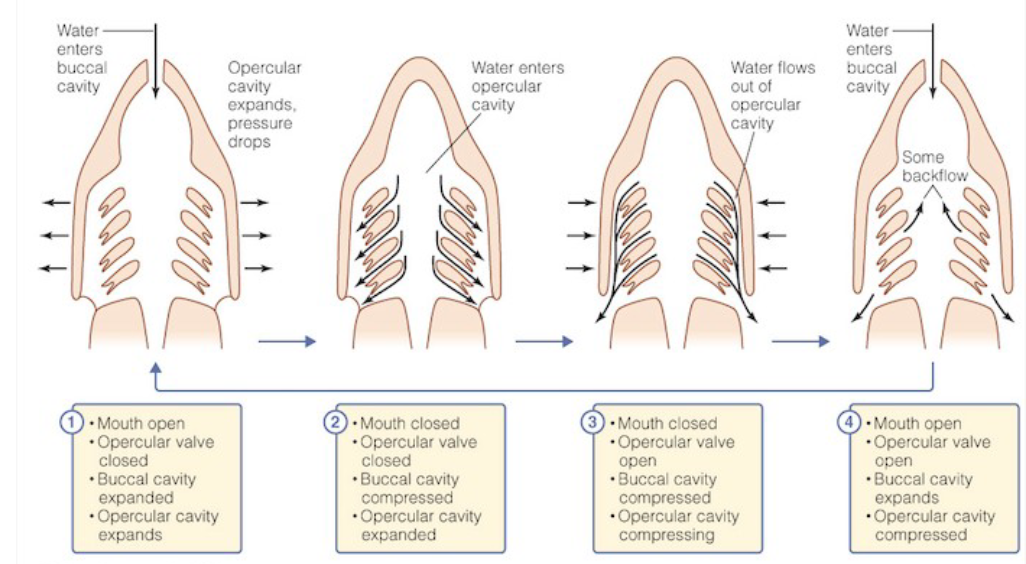
Ram ventilation
Allows for reduced energy to ventilate
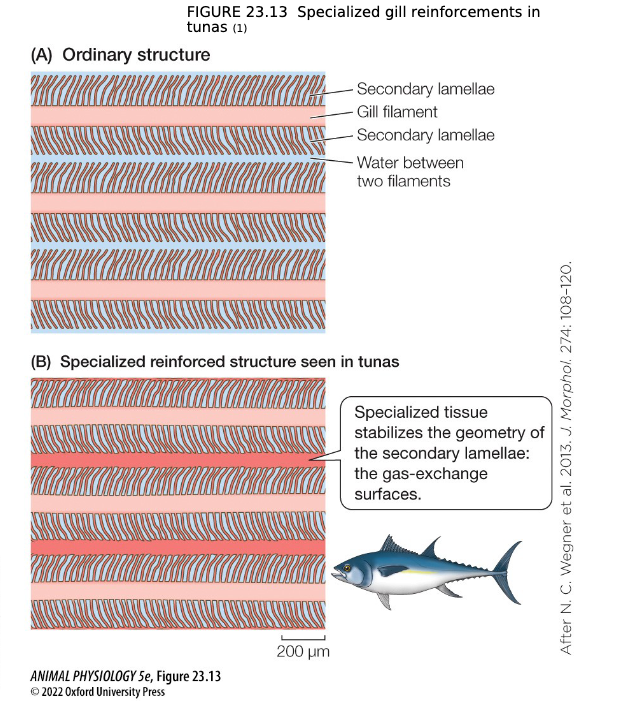
Ram ventilation is obligatory in..?
Tunas, as Buccal-opercular pumping mechanisms are incapable
of producing an adequate vigorous ventilatory stream
Why doesn’t high water movement over gills not
causing damage in tunas during ram ventilation?
specialized reinforced structure; Help stabilize the geometry of the gill filaments and secondary lamellae when gills are subjected to high
velocity water
Major stimuli for increased ventiliation in fish
Decreased PO2 in environment or blood
Exercise
Air breather fish: evolutionary adaptations
Gills do not collapse in air
Accessory breathing organs instead of or in addition to gills
Highly developed lungs (i.e. lungfish)
Amphibian lungs develop from..?
ventral wall of the pharynx near the time of metamorphosis
Amphibian lungs are..?
unicameral (one chamber), well-vascularized sacs
Amphibians ventilate through..?
buccopharyngeal pressure pump
Amphibians use which methods for gas exchange?
cutaneous respiration, external gills, lungs
Amphibian ventilation and gas exchange
Minimal stale air during
ventilation
Intermittent breathers and
can pump air in and out of
the buccal cavity
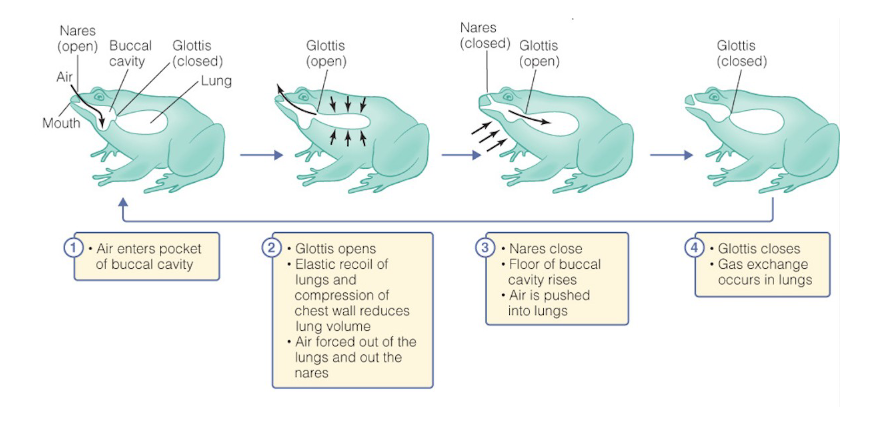
Buccopharyngeal pumping between breaths does what?
washes residual pulmonary exhalant air out of the
buccal cavity
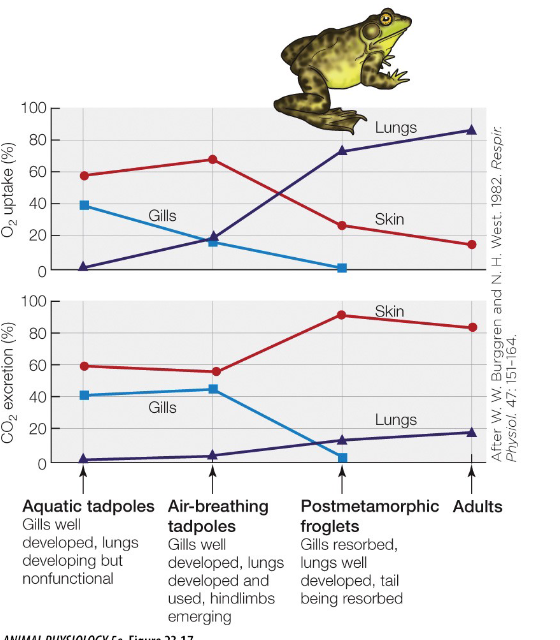
The percentages of O2 uptake and
CO2 excretion that occur across the
gills, lungs, and skin of bullfrogs as
they develop from tadpoles to adults.
Nonovian reptiles use what method to ventilate lungs?
suction pumps
Reptiles separate muscles for breathing and muscles for..?
feeding
Which reptile has one lung reduced in size?
Snakes
In highly active reptiles, lungs have..?
multiple chambers to increase surface area
Ventilation has which two phases in reptiles?
inspiration and expiration or inhalation and
exhalation
Ways nonavian reptiles change thoracic cavity
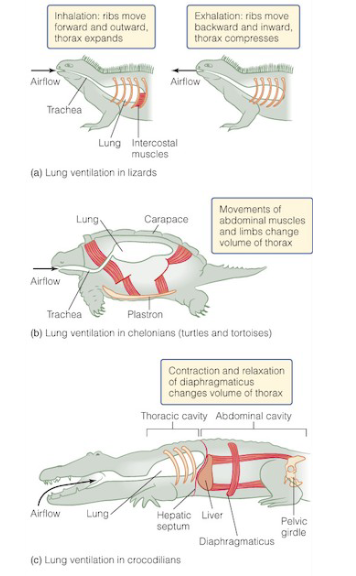
Birds ventilate in which direction?
unidirectionally
The trachea of birds divides at..?
the syrinx, into two primary bronchi
The primary bronchus that enters each lung
passes through mesobronchus within the lung,
which give rise to two groups of branching
secondary bronchi
The anterior and posterior bronchi are connected
by..?
parabronchi
Walls of parabronchi are folded to form..?
air capillaries, highly vascularized for gas exchange
Air sacs in birds
Thin walled, outside lungs, essential for breathing

Pros of air sacs
Expand and contract greatly
Energetically inexpensive way to move air
Cons of air sac
Poorly vascularized, play little role is gas exchange between blood/air
Anterior air sacs connect to..?
anterior secondary bronchi
Posterior air sacs connect to..?
posterior portions of the mesobronchi
Avian lungs
Undergo little change in volume at each breathing cycle
Rely on air sacs expansion and compression to move gas
Resting birds breather at a ____ frequency than resting mammals of equivalent body size
lower, but they have greater tidal volumes
In birds, blood PO2 is ____ in blood leaving lungs compared to exhaled air
higher
Inhalation in birds
Rib cage expanded by contraction of
internal intercostal muscles
Thoracoabdominal cavity expansion enlarge
all the air sacs: develop suction in anterior
and posterior air sacs to cause gas flow
Posterior air sacs are filled with fresh air
from environment, Anterior air sacs are filled with stale gas
following respiratory exchange in the
parabronchi (direction of the parabronchi is from
posterior to anterior)

Exhalation in birds
External intercostals and abdominal muscles
compress thoracoabdominal cavity and air
sacs
Fresh air of posterior air sacs is directed to parabronchi
Air flows through the parabronchi from
posterior to anterior (like inhalation, Cross-current gas exchange)
Gas exiting the parabronchi anteriorly and
anterior air sacs is directed into the
mesobronchus via anterior secondary bronchi
and exhaled

Mammals ventilate their lungs through which method..?
tidal
Mammal lungs are covered by..?
Pleura
2 types of pleura
Parietal pleura (membrane on thoracic wall)
Visceral pleura (memrbane on external lung surface)
Pleural fluid
fills in pleural cavity between two pleurae
Provides lubrication and surface tension that
assists in expansion and recoil of lungs
Zones of the mammal respiratory
system
Conduction zone (prepares air)
Respiratory zone (where gas exchange occurs)
Site of gas exchange in mammals is called..?
Alveoli
Two types of alveolar cells
Type I alveolar cells (main gas exchange site)
Type II alveolar cells (secrete surfactant)
Capillaries
Extensive yet thin network covering
outer surface of alveoli
Rapid diffusion/gas exchange
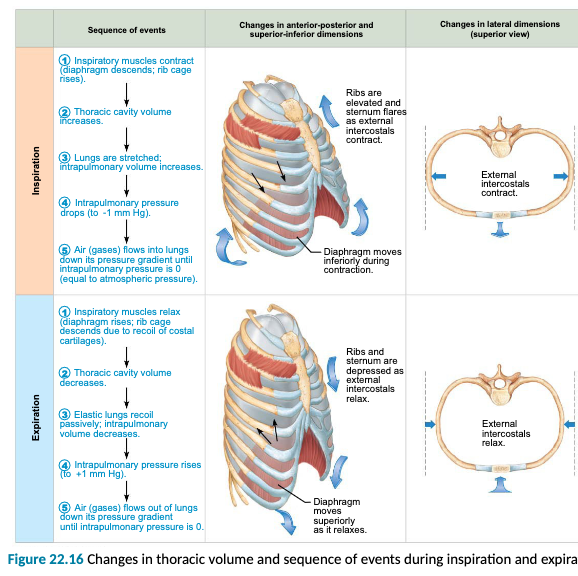
Pulmonary Ventilation
Consists of inspiration (gas flow into lungs) and
expiration (gas exit lungs)
Pulmonary Ventilation depends on..?
Volume changes (lead to pressure
changes). Pressure changes lead to flow of
gases to equalize pressure, air moves down pressure gradient
Pressures that drive ventilation
Intrapulmonary (Ppul)
Intrapleural press (Pip)
Transpulmonary press (Ppul - Pip)
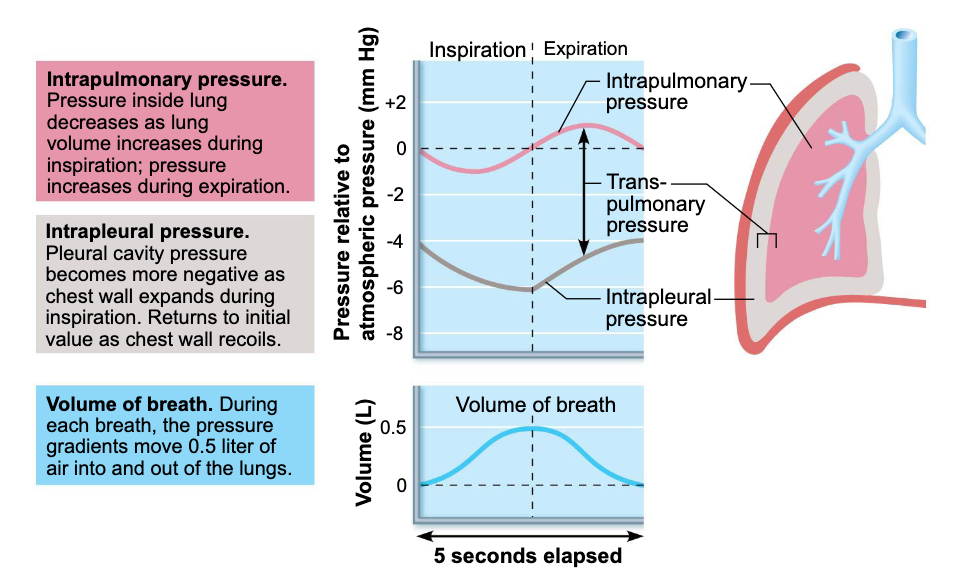
In quiet breathing..?
Inhalation is active, exhalation is passive
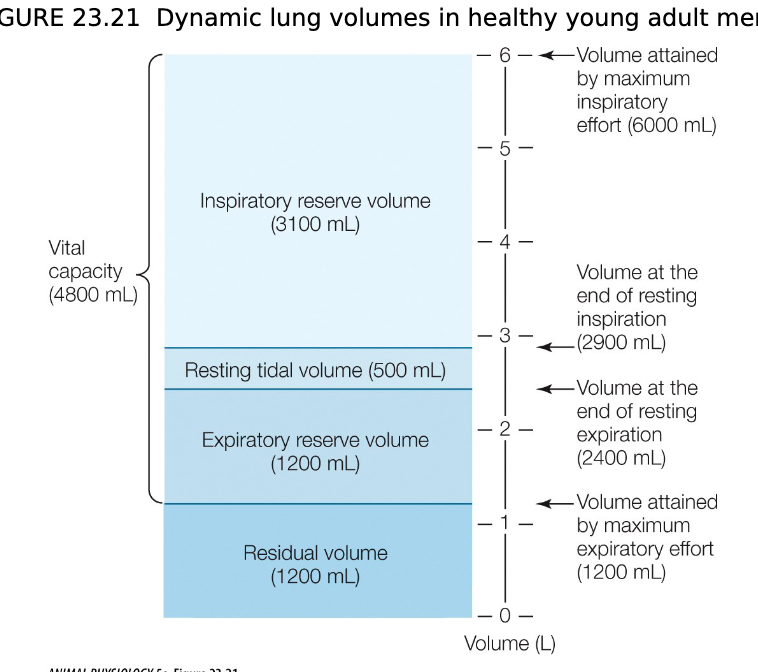
What factors affect lung volumes?
Age and disease
which 3 physical factors influence ease of air passage and amount of energy required for ventilation?
Lung compliance
Airway resistance
Alveolar surface tension
Compliance of lungs
how much effort is required to stretch the lungs and chest wall
(high compliance, lungs expand easily. low compliance, difficult for lungs to expand)
Airway resistance
Most encountered at the bronchioles, affected by bronchiole size
Dilation (Decreases resistance) and constriction (Increased resistance)
Alveolar surface tension
attraction of water molecules to one another (cohesive forces) in the
liquid film lining the alveoli
Pulmonary Surfactant
Reduces alveolar surface tension, helps keep alveoli from collapsing and maintain similar size in alveoli
Infant respiratory distress syndrome (IRDS
immature lungs of premature infants may not be able to produce surfactant , alveoli collapsed between breaths
Alveolar Gas is mostly comprised of..?
Nitrogen gas, followed by oxygen, CO2, and water
Pulmonary Ventilation
modulated by chemosensation of CO2, H+ and O2
Control system affects frequency and depth of breathing
In pulmonary ventilation; CO2 and H+ are the most..?
potent stimulus to affect ventilation in mammals
Increased CO2
stimulates..?
both central and peripheral chemoreceptors

Peripheral chemoreceptors in aortic and carotid bodies sense..?
arterial O2 levels
Declining PO2 normally has only slight effect on ventilation because..?
huge O2 reservoir bound to Hb, requires substantial drop in arterial PO2
(below 60 mm Hg) to stimulate increased ventilation
When excited, chemoreceptors cause
respiratory centers to..?
increase ventilation
Lowlanders response to high altitude
hyperventilation and acclimatized
Tibetan native highlanders
Less susceptible to high altitude
diseases including high BP
Moderately lower PO2 in arterial
blood
Inreased # of blood capillaries per
muscle fibers cf. lowlanders
Tibetan native highlanders
Muscle mitochondria tend to
oxidize carbohydrates as
metabolic fuels
More ATP per O2 molecule with
CHO than with lipid fuels
Tibetan vs Andean highlanders
Tibetan: large lungs, high pulmonary diffusing
capacity, similar hyperventilation to lowlanders
Andean: less hyperventilation, exhibit different blood
properties