muscle tissue chap 11
 Call Kai
 Learn
 Practice Test
 Spaced Repetition
 Match
 Flashcards
 Knowt Play
1/70

There's no tags or description
Looks like no tags are added yet.
71 Terms
what is the job of muscle tissue
to convert chemical energy into mechanical energy
where is skeletal muscle found
attached to bones
which muscle types are striated
skeletal and cardiac
order of muscle organization
whole muscle, fascicle, muscle fiber, myofibril, myofilament
what does the epimysium surround
the entire muscle
what does the perimysium surround
the fascicles
what does the endomysium surround
each individual muscle fiber

myofibril can be found
inside of muscle fiber

sarcolemma
cell membrane
sarcoplasm
cytoplasm
Sarcoplasmic reticulum
stores and releases calcium
t tubules
Carry electrical impulses deep into the muscle cell

what makes up 80% of muscle cells volume
myofibrils
what is a sarcomere
the part of the muscle that shortens when a muscle contracts
what does the z disc represent
the beginning and end of a sarcomere
z disc action
z disc moves closer together during contraction and anchors the thin filament
I band characteristics
contains only thin filaments (actin), located on either side of z disc, gets shorter during contraction
A band characteristics
represents entire length of thick filaments (myosin), length unchanged contraction
H zone characteristics
in middle of A band, contains thick filaments, gets shorter during contraction may disappear
M line characteristics
in center of sarcomere, holds thick filaments in place
what is the name of the two protein filaments inside a sarcomere
actin and myosin
characteristics of actin
thin filament making up I band, binding site for myosin
characteristics of myosin
thick filament making up A band, has heads that attach to actin
what is a triad
1 t tubule 2 terminal cisternae
why is triad relationship important
electrical impulse travels down t tubule and tells sarcoplasmic reticulum to release calcium. calcium helps initiate muscle contraction.
depolarization
sodium enters the cell
repolarization
potassium leaves the cell
what is action potential
electrical impulse telling your muscle fiber to contract
what role does acetylcholine play in muscle signaling
ACH causes depolarization of muscle fiber triggering action potential which travels along the sarcolemma
what does tropomyosin usually do
blocks the binding site on actin preventing myosin from attaching
after calcium is released signaling muscle contraction, what happens
calcium binds to troponin changing shape of troponin and moving tropomyosin away so myosin can attach to actin and sarcomere can shorten
what is the main thing that has to happen for contraction to begin
myosin has to attach to actin
what is the sliding filament theory
when myosin heads attach to actin, it forms a cross bridge. myosin pulls actin filament towards sarcomere causing actin filaments to slide past myosin and shorten sarcomere
isometric contraction
muscle develops tension with no movement ex. a plank
isotonic contraction
muscle tension is due to movement causing shortening ex. bicep curl
what are the two types of isotonic contractions
concentric and eccentric
concentric contraction
muscle shortens
eccentric contraction
muscle lengthens
a motor unit
a motor neuron and all its muscle fibers
small motor units
control fewer muscle fibers for more precise movements
latent period
muscle received stimulus but you cannot yet see the contraction
contraction period of muscle twitch
myosin attaches to actin allowing contraction
relaxation period
calcium is pumped back to SR and muscle rests
summation
muscle receives another stimulus before it has completely relaxed from the previous stimulus
tetany
sustained muscle contraction caused by fast repeat stimulation
direct phosphorylation
uses creatine phosphate to regenerate atp, short intense activity
anaerobic glycolysis
breaks down glucose to produce atp but only makes a little. makes lactic acid
why does muscle fatigue happen
a decline in ph within muscle fibers and ionic imbalances between potassium, calcium and phosphate
what is excess postexercise oxygen consumption
the increased rate of oxygen your body uses after working out
what does your body do with the extra oxygen
replenish oxygen, atp,creatine phosphate, glycogen and convert lactic acid to pyruvic acid
what determines muscle contraction force
recruitment, hypertrophy, frequency, length tension relationship
what is length tension relationship
how the length of a muscle affects how much force or tension the muscle produces
when does a muscle produce the greatest amount of force
when its sarcomeres are at their optimal length
why is a sarcomere being at optimal length important
actin and myosin overlap just the right amount and the greatest number of effective cross bridges can form
what happens when sarcomere is too short
actin filaments overlap too much and effective cross bridges cant form
slow oxidative fiber characteristics
small diameter, contract slowly, for endurance
fast glycolytic fibers
large diameter, fatigue quickly, for powerful quick contractions
fast oxidative fiber characteristics
contract quickly, use aerobic metabolism, more resistant to fatigue than fast twitch fibers
persistalsis
the contraction and relaxation of smooth muscle that pushes substances through hollow organs

what type of muscle is this
skeletal
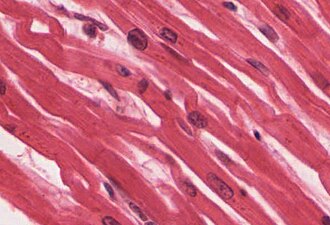
what type of muscle is this
cardiac muscle

what type of muscle is this
smooth muscle
in skeletal muscle we know calcium is stored in sarcoplasmic reticulum (SR) but in smooth muscle, where is calcium stored
in extracellular fluid
skeletal muscle has a neuromuscular junction, but how does smooth muscle receive its signals
through diffuse junctions
what are varicosities
stimulate smooth muscle contractions
what are the two types of smooth muscle
visceral (unitary) and multiunit
unitary (visceral) smooth muscle
most common, found in hollow organs, contracts synchronously
multiunit smooth muscle
found in large airways and arteries, contractions are independent, responds to autonomic nervous system stimulation
female skeletal muscle makes up how much of body mass
36%
male skeletal muscle makes up how much of body mass
42
sarcopenia
age related loss of muscle mass