5.1 Demand for Labour
 Call Kai
 Learn
Learn Practice Test
 Spaced Repetition
 Match
Match Flashcards
 Knowt Play
1/12

There's no tags or description
Looks like no tags are added yet.
Name | Mastery | Learn | Test | Matching | Spaced | Call with Kai | Chat |
|---|
No analytics yet
Send a link to your students to track their progress
13 Terms
Derived Demand for Labour
-The demand for labour is derived from the demand for the output of goods and services
-When the economy is growing strongly, many businesses will be looking to hire extra workers to supply increased output
-During a recession, the demand for labour tends to fall causing a rise in cyclical unemployment.
The demand for labour curve
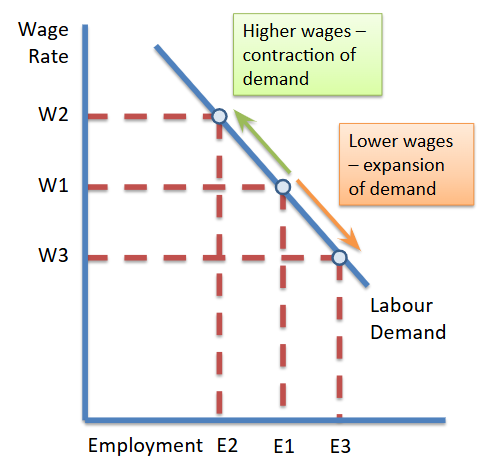
-There is an inverse relationship between demand for labour & the wage rate
-If the wage rate is high - more costly to hire extra employees
-When wages are lower, labour becomes relatively cheaper than capital. A fall in the wage rate might create a substitution effect and lead to an expansion in labour demand
The demand for labour
The demand for labour shows how many workers an employer is willing and able to hire at a given wage rate in a given time period
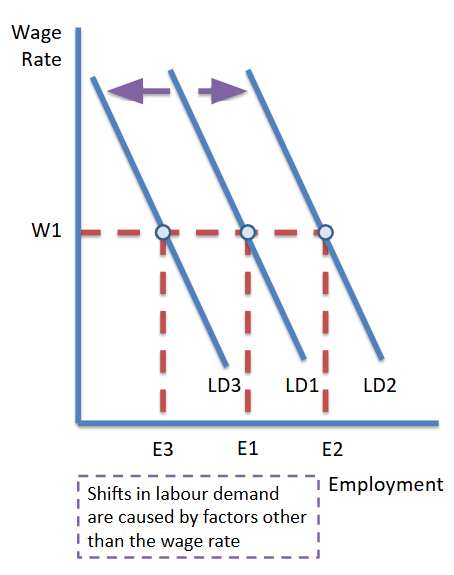
Causes of shifts in the Labour Demand curve
-A rise in final consumer demand which means that a business needs to take on more workers
-A change in the market price of the output that labour is making
-An increase in the productivity of labour which makes labour more cost efficient than capital (higher productivity increases the marginal product of labour)
-A government employment subsidy which allows a business to employ more workers
-A change in the cost of capital equipment (a possible substitute for labour) e.g. robotic technologies
Labour productivity
The efficiency of the workforce calculated as output per worker, output per job and output per hour. Labour productivity is an important factor in determining the productive potential of the economy
Labour cost per unit of output formula
Total labour costs (over period of time)
—————————————————
Total output (over period of time)
or
Wages x quantity of labour
__________________
Total output in period
Labour productivity formula
Output in period (unit)
Number of employees at work
Marginal Revenue Product of Labour (MRP)
Calculate using MPL x MR
It is the change in revenue from the output produced by the extra worker employed
MRP curve
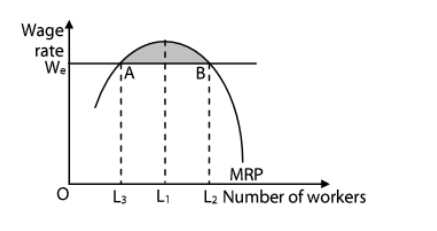
The law of diminishing returns means the MRP falls after a given output, L1. The MRP shows, in a perfect market, the equilibrium level of employment.
Wages
-Main cost of labour
-The wage rate is the marginal cost of labour (MCL)
-Assuming a perfectly competitive industry, (where firms can’t influence wages and can hire as many workers as they want),
If MRP > wage, then hiring more labour will add to profits.
If MRP < wage, too many workers are employed.
Evaluating marginal revenue product
-Measuring labour efficiency / productivity can be difficult
-Collaborative work makes it difficult to establish the productivity of individual workers
-Many products are the result of inputs drawn from different countries – each contributing to value added (e.g. the iPhone)
-Many people have the ability to set their own pay e.g. the self-employed and directors of businesses
Elasticity of Labour Demand
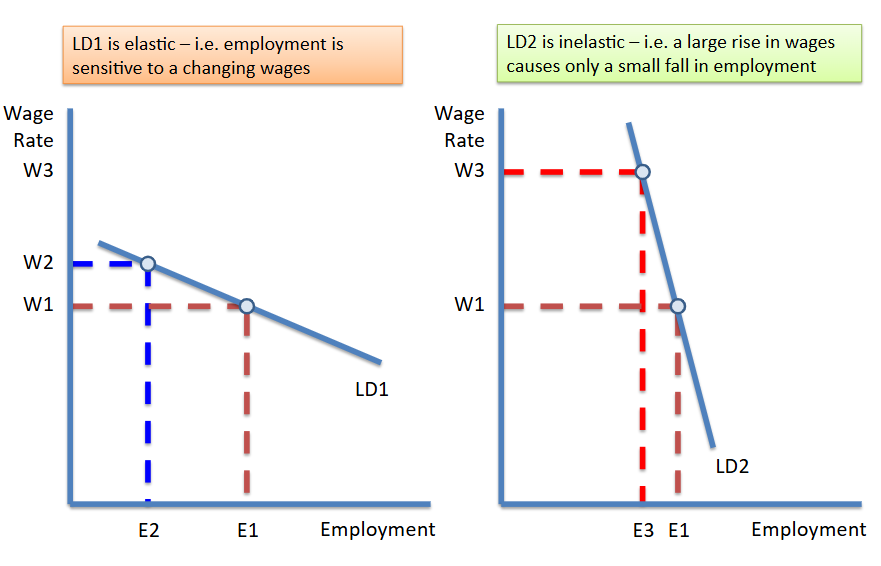
The responsiveness of labour demand when there is a change in the wage rate
Factors affecting elasticity of Labour Demand
-Labour costs as a % of total costs: When labour expenses are a high % of total costs, then labour demand is more wage elastic.
-Ease and cost of factor substitution: Labour demand is more elastic when a firm can substitute easily and cheaply between labour & capital inputs.
-Price elasticity of demand for the final product: This determines whether a firm can pass on higher labour costs to consumers in higher prices. If demand is inelastic, higher costs can be passed on.
-Time period – in the long run it is easier for firms to switch factor inputs e.g. bring more capital in perhaps replacing labour