Fundamental Science and Skills
 Call Kai
 Learn
 Practice Test
 Spaced Repetition
 Match
 Flashcards
 Knowt Play
1/311

There's no tags or description
Looks like no tags are added yet.
312 Terms
What is pressure?
Force acting normally per unit area: P = F/A.
What is the SI unit of pressure?
Pascal (Pa), equivalent to N m⁻².

What is the formula for hydrostatic pressure due to a fluid column?
ΔP = ρgh, where ρ is density, g gravity and h vertical height.
Why does fluid column pressure not depend on its width?
Fluid weight and base area both scale with cross-sectional area; the area cancels in P = F/A.
What are SI units of density, height and gravitational acceleration?
kg m⁻³, m and m s⁻², respectively.
What density should you use for water in hydrostatic calculations?
Approximately 1000 kg m⁻³ (1.00 g mL⁻¹).
What pressure difference does a 3.00 m water column produce?
Approximately 29,400 Pa from ΔP = 1000 × 9.8 × 3.00.
What pressure difference does a 10 m water column produce?
About 98,100 Pa.
Convert 1 bar to pascals.
1 bar = 100,000 Pa.
What is standard atmospheric pressure?
1 atm = 101,325 Pa, approximately 1.01325 bar.
What is the volume of 1 litre in cubic metres?
1 L = 1 dm³ = 0.001 m³.
How do you calculate mean molar mass of a gas mixture?
Multiply each component's molar mass by its mole fraction, then add.
What approximate molar mass does the lecture use for air?
28.8 g mol⁻¹ (using 80% nitrogen and 20% oxygen).
Why is assuming constant air density unrealistic through the atmosphere?
Air is compressible; its density changes with pressure and altitude.
What is a manometer?
An instrument measuring pressure or a pressure difference using a fluid column.
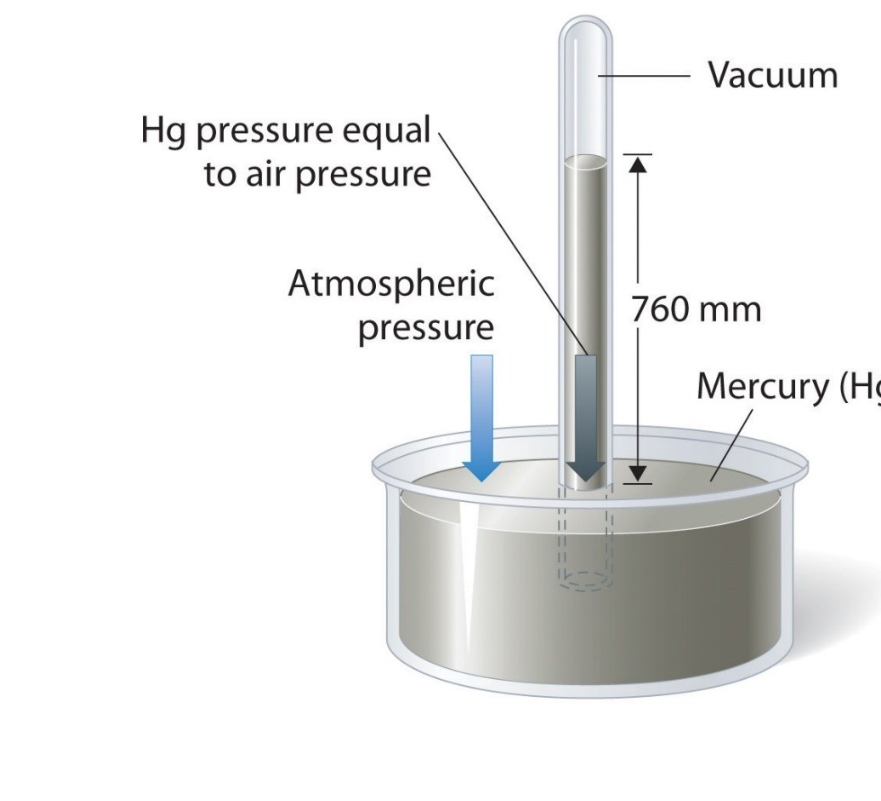
What is a mercury barometer?
A pressure measuring device balancing atmospheric pressure against a mercury column and vacuum.
Why is there a vacuum above the mercury in a barometer?
So the column's height is determined by the atmospheric pressure acting on its reservoir.
How is a barometer different from a differential manometer?
A barometer measures atmospheric pressure against a vacuum; a differential manometer compares two pressures.
What is gauge pressure?
Pressure measured relative to a reference pressure, usually the surrounding atmosphere.
What is absolute pressure?
Pressure referenced to a perfect vacuum (zero absolute pressure).
Does a reading of 0 Pa gauge mean vacuum?
No. It means the measured pressure equals the reference atmospheric pressure.
What type of pressure do ideal gas law calculations require?
Absolute pressure.
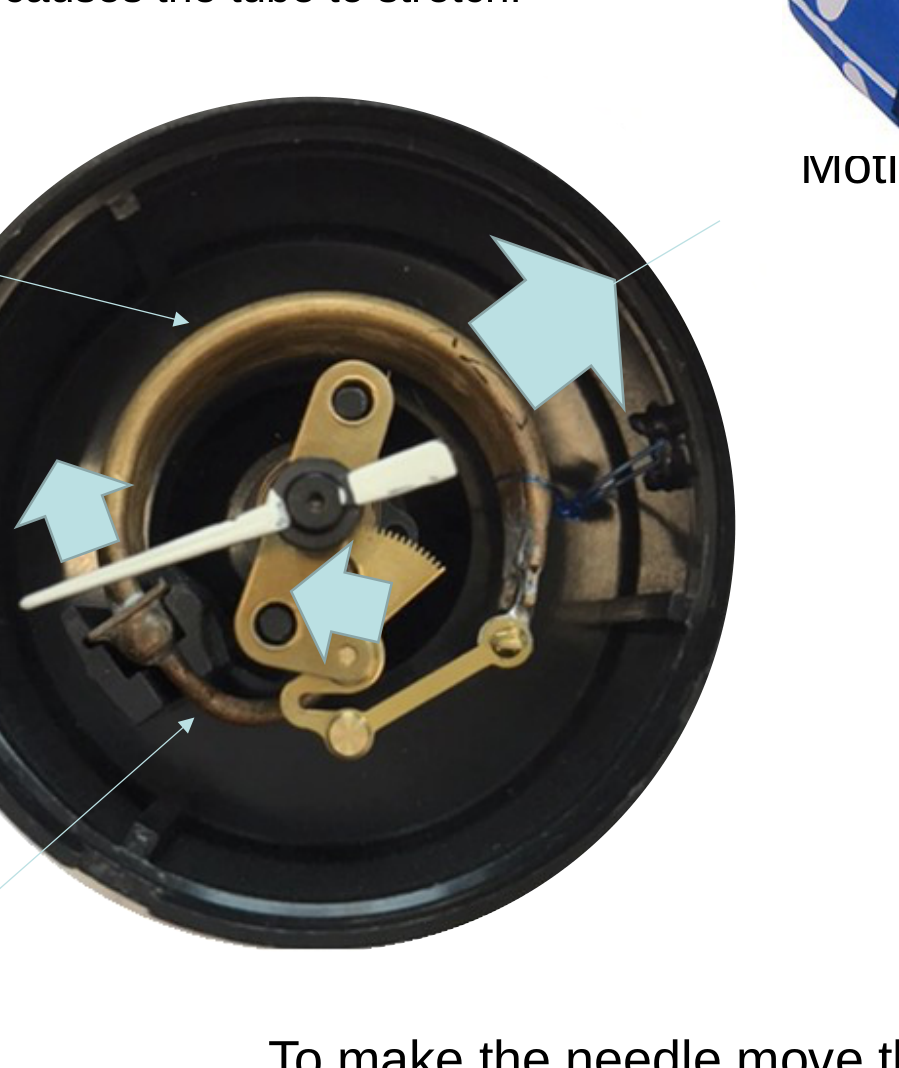
How does a Bourdon tube gauge work?
Pressure tends to straighten a curved tube; its motion drives a pointer.

What equation relates a simple U-tube manometer pressure difference to height?
ΔP = ρgΔh for one manometric liquid when other effects are negligible.
What does the height difference in a U-tube manometer indicate?
A pressure difference between the two ends; a larger Δh means a larger ΔP.
When two U-tube ends are at equal pressure, what happens?
The fluid levels are equal (for identical arms and liquid).
Why is water more sensitive than mercury for small manometer pressure differences?
Water's lower density produces a larger height change for the same ΔP.
For a 1 mm height difference, roughly what ΔP does water indicate?
Approximately 9.8 Pa.
For a 1 mm height difference, roughly what ΔP does mercury indicate?
Approximately 132 Pa using 13,500 kg m⁻³.

How does an inclined manometer improve measurement sensitivity?
A small vertical height change gives a larger distance travelled along its inclined tube.

What does conservation of flow give for steady incompressible flow?
A₁v₁ = A₂v₂, where A is pipe area and v is mean speed.
What happens to flow speed when a pipe narrows at constant volume flow rate?
Speed increases because area decreases.

What is a Venturi tube used for?
Estimating fluid flow rate from the pressure change across a constriction.
Why does static pressure change at a Venturi constriction?
As flow speed increases, static pressure falls under Bernoulli's principle (ideal flow).

What does a Pitot tube measure?
Fluid speed from the difference between stagnation and static pressure.
What is stagnation pressure?
Pressure when a flowing fluid is brought to rest at a measurement point.

What makes a scientifically good graph?
Clear title, labelled axes with units, appropriate legend, and an appropriate model/data display.
How should experimental measurements usually appear on a graph?
As discrete points rather than a falsely continuous line through every measurement.
How should a theoretical model usually appear on a graph?
As a continuous curve or line over its applicable range.
Why avoid Excel's automatically smoothed joining of measured points?
It can imply a physical trend between points that the experiment did not establish.

What does an orifice plate use to estimate flow rate?
The pressure difference caused by forcing fluid through a restricted opening.
How does an orifice plate differ from a Venturi tube?
An orifice plate causes a less recoverable pressure loss.

Why can hydrostatic manometer pressures be equated at the same level?
The fluid is static, so forces balance at that level.
What does 'barg' mean?
Bar gauge: pressure relative to atmospheric pressure.
What does 'bara' mean?
Bar absolute: pressure measured from a vacuum reference.
What are the Celsius ice and water boiling reference temperatures?
0 °C and 100 °C at standard atmospheric pressure.
What are the Fahrenheit freezing and boiling points of water?
32 °F and 212 °F at standard atmospheric pressure.
What is absolute zero in Celsius?
−273.15 °C, equivalent to 0 K.
What is the triple-point temperature of water in the lecture?
273.16 K or 0.01 °C.
How do you convert Celsius temperature to kelvin?
T(K) = T(°C) + 273.15.
How do you convert kelvin temperature to Celsius?
T(°C) = T(K) − 273.15.
Does a change of 1 °C equal a change of 1 K?
Yes. Their steps are the same size, although their zero points differ.
How do you convert a temperature gradient in °C⁻¹ to K⁻¹?
Keep the numerical value: 1 °C change = 1 K change.
Why are absolute temperatures used in gas and thermodynamic equations?
Their zero corresponds to absolute zero, so ratios such as T₂/T₁ are meaningful.
How many degrees Fahrenheit equal a temperature rise of 1 K?
1.8 °F.
How do you convert Fahrenheit to kelvin?
T(K) = [T(°F) + 459.67] / 1.8.
How do you convert kelvin to Fahrenheit?
T(°F) = 1.8 T(K) − 459.67.
How do you convert 4.5 mm °F⁻¹ to mm K⁻¹?
Multiply by 1.8: 8.1 mm K⁻¹.
What is the Rankine scale?
An absolute temperature scale with Fahrenheit-sized steps (mainly informational here).
How is mechanical work calculated for a constant force along a displacement?
W = Fd, force multiplied by distance in its direction.
What are the base SI units of a joule?
1 J = 1 kg m² s⁻².
How do you calculate gravitational potential energy gained by lifting a mass?
E_p = mgh.
How is translational kinetic energy calculated?
E_k = ½mv².
How is the total mechanical energy represented in the lecture?
E_total = kinetic energy + potential energy.
What is the theoretical outlet speed of falling water through height h? [IMAGE: W3-025]
v = √(2gh), neglecting losses and initial surface speed.
What principle gives v = √(2gh)?
Gravitational potential energy lost equals kinetic energy gained: mgh = ½mv².
What is the SI unit of heat transferred?
Joule (J), the same unit as work.
How did Joule connect mechanical work and heat?
He showed mechanical work can be converted into water heating.
What is the mechanical equivalent of heat experiment showing? [IMAGE: W3-029]
Falling-weight energy is converted to heat, raising a water bath's temperature.
How is work transfer described at the molecular level in the lecture?
Organised energy transfer through force and displacement.
How is heat transfer distinguished from work?
Heat transfers energy because of a temperature difference.
What is an equation of state?
A relationship between properties describing a material's state, such as P, V and T.
State Boyle's law for a fixed amount of ideal gas at constant T. [IMAGE: W3-033]
P is inversely proportional to V; PV is constant.
State Charles' law for a fixed amount of ideal gas at constant P. [IMAGE: W3-034]
V is directly proportional to absolute T; V/T is constant.
What is the ideal gas equation?
PV = nRT.
What do P, V, n, R and T represent in PV = nRT?
Absolute pressure, volume, moles, gas constant and kelvin temperature.
What value and units does R have in SI?
8.314 J mol⁻¹ K⁻¹, equivalently Pa m³ mol⁻¹ K⁻¹.
How do you obtain the combined ideal gas equation at fixed n?
P₁V₁/T₁ = P₂V₂/T₂.
What is the combined gas relationship when n can change?
PV/(nT) = R; thus P₁V₁/(n₁T₁) = P₂V₂/(n₂T₂).
What is molar volume?
Volume per mole: V_m = V/n, in m³ mol⁻¹.
How do you calculate ideal gas molar volume?
V_m = RT/P.
What determines ideal gas molar volume at a fixed state?
Temperature and absolute pressure only, not molecular identity.
What is a P–V–T surface? [IMAGE: W3-043]
A three-dimensional surface showing the allowed pressure, volume and temperature states.
What happens to a real gas as it is cooled enough?
It may condense to liquid and then freeze to solid.
What is a phase diagram? [IMAGE: W3-045]
A diagram showing which phase is stable under different temperatures and pressures.
What is the triple point? [IMAGE: W3-046]
Temperature and pressure at which solid, liquid and gas coexist at equilibrium.
How does increasing pressure affect melting of ordinary ice?
It can favour melting because liquid water is denser than ice.
Why are typical gas particles relatively far apart?
Gas density is much lower than liquid density; particles occupy much more space on average.
What microscopic process creates the pressure of an ideal gas? [IMAGE: W3-049]
Molecules change momentum when colliding elastically with the container walls.
Why does a bouncing molecule exert force on a wall?
Its velocity reverses, creating a momentum change and hence a force.
What is Dalton's law of partial pressures?
P_total = p₁ + p₂ + … for an ideal gas mixture.
What is a partial pressure?
Pressure contributed by one gas in a mixture at the same volume and temperature.
How is a component's mole fraction calculated?
x_i = n_i / n_total.
How do you calculate a partial pressure from a mole fraction?
p_i = x_i P_total.
For ideal gases at 1 bar, what is partial pressure at 20% mole fraction?
0.20 bar.
What are the main kinetic theory assumptions?
Many particles; constant random motion; negligible molecular volume; elastic collisions.
What does 'elastic collision' mean?
Total kinetic energy is conserved in the collision.
What is the kinetic-theory expression for root-mean-square speed?
c_rms = √(3RT/M), with molar mass M in kg mol⁻¹.
What do c_rms and M mean in the speed equation?
Root-mean-square molecular speed in m s⁻¹; molar mass in kg mol⁻¹.
How does root-mean-square molecular speed change with temperature?
It is proportional to √T at fixed molar mass.