Body Composition and Weight Management
 Call Kai
 Learn
Learn Practice Test
 Spaced Repetition
 Match
Match Flashcards
 Knowt Play
1/64

There's no tags or description
Looks like no tags are added yet.
Name | Mastery | Learn | Test | Matching | Spaced | Call with Kai | Chat |
|---|
No analytics yet
Send a link to your students to track their progress
65 Terms
What are four different treatment options for individuals who have excess adiposity and health risk?
behavioral interventions
nutrition interventions
pharmacology interventions
surgical interventions
Who should receive bariatric surgery?
those with a BMI = 35-40 with comorbidities who have not had success with other treatments

Who should take weight loss medications?
those with BMI 30+ or > 27 with co-morbid conditions
Is diet or exercise the best way to lose weight?
need a comprehensive plan that includes diet physical activity, behavior change, such as aerobic exercise
How can weight loss be maintained?
continue doing behaviors that led to weight loss
> 200-300 min/week
What are the health benefits of modest weight loss (5-10%)?
help to reduce obesity related co-morbidities
What improvements can you see with 3% BW loss?
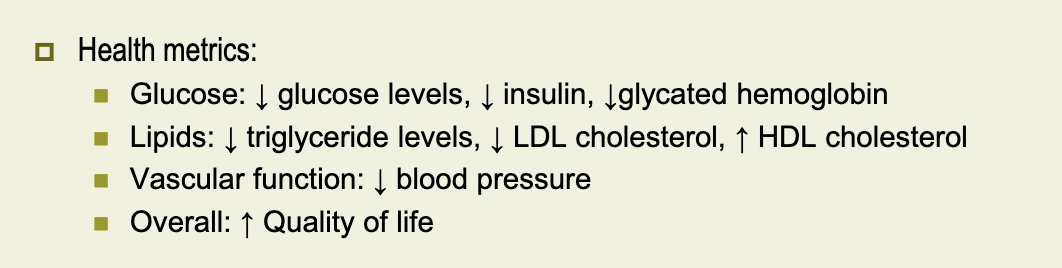
Blood glucose and triglycerides lowering
What improvements can you see with 5% BW loss?
improvements in HDL-C, total cholesterol, BP and quality of life
What improvements can you see with 10% BW loss?
improvements in sleep apnea and fatty liver
What improvements can you see with 10-15% BW loss?
decrease CVD events
What improvements can you see with 15% BW loss?
remission of T2DM
What treatment mode is associated with 3-7% BW loss?
lifestyle modifications
What treatment mode is associated with 5-10% BW loss?
first generation medications
pills that target neurotransmitters and brain activity
What treatment mode is associated with 15-22% BW loss?
second generation meds (10 years or so)
ex: GLP-1
What treatment mode is associated with 20-35% BW loss?
obesity surgeries
Describe how most of the weight loss medications in 1930-1960s worked?
mostly stimulants which acted to increase metabolism and decrease hunger
Describe how most of the weight loss medications in 1990s-2014 worked?
most target brain neurotransmitters (serotonin, dopamine) to lessen hunger and increase sensation of fullness
anorectic drugs: lessen hunger
orlistat: decreased fat absorption in GI tract
had limited effectiveness in overall body weight loss
Describe how most of the weight loss medications in 2014-2026 work?
target gut hormones and incretins (GLP-1) which act at level of the GI tract and at regions of the brain; net effect are to lessen hunger, increase fullness by delaying gastric emptying, lower blood glucose levels
injectable medication but more recently became pills
much greater effectiveness in body weight loss and health benefits
How prevalent is GLP-1 use in the US?
12% of adults (1 in 8) have used it
6% are currently using it as of 2024-2025
What are the four categories of weight loss medications?
thermogenic substances
malabsorptive agents
appetite suppressants
hormone
Describe thermogenic substances and how they work in terms of weight loss.
activate the CNS, increasing heart rate, constricting blood vessels, expanding bronchial tubes → helps to promote heat produciton instead of energy storage
ex: ephedrine
FDA received reports of adverse effects such as cardiac arrhythmias and death → BANNED in 2004
Describe malabsorptive agents and how they work in terms of weight loss.
help to inhibit absorption of dietary fat OR dietary carbohydrate
for inhibiting fat it does it through binding of GI lipase in the gut lumen, decreasing micelle formation
Example of fat malabsorptive agent.
Orlistat (xenical or alli) Rx and OTC
What are some side effects regarding fat malabsorptive agents?
decrease activity of pancreatic lipase
fecal fat increases by 30%
not as useful for low fat diets
may decrease availability of dietary fat souluble vitamins
Example of carbohydrate malabsorptive agent.
Acarbose Rx
used for diabetes management
Describe appetite suppressants aka anorectic drugs and how they work in terms of weight loss.
alter brain neurotransmitter metabolism, works on appetite centers in brain which can
activate CNS as stimulant
increase secretion of brain neurotransmitters (norepinephrine, dopamine, or serotonin)
inhibit re-uptake of neurotransmitters
may bind to 5HT receptor and act as agonist
What are examples of anorectic drugs?
contrave
qysmia
belviq
meridia
OTC: dexatrim, phentermine, amphetamines (not as intense as the prescription level)
Describe hormones (GLP-1 agonist) and how they work in terms of weight loss.
decrease appetite through GLP-1receptors in hypothalamus, delaying gastric emptying (staying full longer)
lowers blood glucose by increased insulin secretion and insulin sensitivity
initially used for type 2 diabetes control
Why is GLP-1 called incretins?
bc it is a peptide hormone that is secreted by the ileal cells within the ileum of the GI tract
What are some examples of hormone weight loss medication?
injectables 1x a week
ozempic (semaglutide) → GLP-1 agonist
wegovy (semaglutide) → GLP-1 agonist
zepbound (tirzepatide) → dual GLP-1 and GIP agonist
mounjaro (tirzepatide) → dual GLP-1 and GIP agonist
daily pills everyday
wegovy oral
foundayo
What is Plenity?
hydro-gel capsule that releases cellulose particles (also has citric acid in it), these particles absorb water in the stomach and small intestine, expanding in size
increases in bulk and signals satiety
particles break down in colon and excreted in stool
not considered a drug bc it is not absorbed
How often do you use Plenity?
3 capsules orally before both lunch and dinner with water
used in BMI 25-40
not that big of a difference compared to placebo
What is GLP-1?
endogenous hormone (incretin) that is typically released in very small amounts from the ileum (distal portion of small intestine) in response to meals
very short half-life (2 minutes) due to rapid DPP-4 enzyme
when circulating it acts on alpha cells and beta cells of pancreas to decrease glucagon secretion and increase insulin release respectively (helps in glucose control)
was not made for long term weight loss, made to be a transient, not sustained satiety signal
Describe the pharmacologic approach to GLP-1 and how the medication differs in order to act as a GLP-1 agonist effective for long term weight loss.
modified GLP-1 molecule to prevent DPP-4 degradation AND the pharmacologic dose is much higher compared to endogenous levels
result: injectable has half life of 7 days and takes 5 weeks for full clearance from body
promotes glucose control and weight loss through multiple mechanisms
Describe GLP-1 Agonist actions at different tissue levels (liver, intestine, brain, muscle, and pancreas) and how it supports weight loss.
liver:
decreased gluconeogenesis
decreased steatosis (fat in liver)
intestine:
decreased gastric emptying
decreased gastrointestinal motility
brain:
decreased food intake
decreased reward behavior
decreased palatability
muscle:
increased sensitivity
increased glucose uptake
pancreas
increased insulin secretion
increased insulin synthesis
decreased glucagon secretion
decreased apoptosis
increased beta cell survival
Characteristics associated with Wegovy.
approved for weight loss
GLP-1 agonist (higher dose of ozempic, originally used for type 2 diabetes)
5-20% change in BW
75% of patients lost at least 5% of BW
Characteristics associated with Zepbound.
approved for weight loss
dual incretin against GLP-1 and GIP-1
same drug as Mounjaro that is approved for Type II diabetes
more effective than Wegovy
15-25% change in BW
85-90% of patients lost at least 5% BW
Overall what are the effects of GLP-1 on the brain, tissues, vascular, and stomach?
brain:
central appetite suppression via hypothalamic pathways
reward center modulation
tissues:
improved blood glucose control
vascular:
anti-inflammatory and cardioprotective pathways
stomach: delayed gastric emptying, feeling of fullness and satiety
What are the common side effects associated with GLP-1 use?

What is sarcopenia? How do GLP-1 increase the risk of sarcopenia?
disproportionate loss of muscle mass
rapidity of weight reduction and low protein consumption due to lack of appetite may contribute to muscle loss and increased risk of sarcopenia
What are the protein requirements for those on GLP-1?
1.2-1.6g/kg/day
don’t fall below 0.4-0.5 g/kg/day
What are some meal recommendations surrounding those on GLP-1?
small breakfast and meals 3-4 hours
drink fluids, ginger, peppermint tea to mitigate side effects
small frequent meals
What is unknown in regard to GLP-1s?
longer term safety (use for >5-10 years is unknown)
diet and lifestyle interactions
diet quality and risk of nutrient deficiencies (don’t know if people change their diets for the better or just eat less overall)
sustainability of weight loss and prevention of regain
During rapid weight reductions, what are 11 nutrients of concern?
Fe
Ca
Mg
Zn
Vitamin A, D, E, K, B1, B12, and C
In terms of the CRAVE study, what happens to diet quality when patients start GLP-1? What happens to food cravings on GLP-1 in a real world setting after following 28 new users for 24 weeks?
see decreased caloric intake
protein intake slightly below 1g/kg/BW and those with higher intake they had better preservation of skeletal muscle mass
no improvement in diet quality
modest or no change in cravings
What did the CRAVE study reinforce?

What is the overall trend seen in different obesity treatments?
initial weight loss seen with most all interventions but unfortunately weight regain often occurs
What obesity treatment seems to have greater success in terms of maintenance?
surgical interventions results in greater weight loss and tends to have greater success in maintenance
diet approaches and physical activity can achieve similar results but only when activity is 300min/week or more
What is more effective second gen medications or first gen?
second gen medications achieve significantly greater weight loss than older first gen meds
Why are GLP-1 and surgical approaches more successful than diet?
diet approaches typically result in a plateau effect and slow regain of fat mass over time
GLP-1 are better in maintaining weight loss bc they have interrupted some of the biological drive for restoration of fat mass (appetite is down-regulated, endocrine signals are modulated, or physiological changes occur in GI due to surgery)
weight gain does occur with someone stops taking the medicine whereas the surgery is more invasive but permanent
What is the criteria for weight loss surgery?

What are two types of bariatric surgeries?
gastric restriction
gastric bypass
What are two types of gastric restriction surgeries
vertical sleeve gastrectomy
gastric banding
Describe vertical sleeve gastrectomy surgery.
removes 80% of the stomach, and keeps the remaining portion (which is shaped like a banana
Describe gastric banding surgery.
device put around top of stomach creating a small pouch above band
tends to be less effective on weight and related diseases
What are some characteristics in general associated with gastric restriction surgeries?
increased fullness and decreased hunger
average loss of 20% excess weight
improves co-morbid conditions usually
tends to have fewer intestinal complications than other weight loss surgeries
What is an example of a gastric bypass surgery?
Roux-en-Y Bypass
Describe the Roux-en-Y bypass.
severely reduces size of stomach to hold 2tbsp of volume
bypasses remainder of stomach and duodenum (called the biliopancreatic limb) as the mid jejunum is pulled up and attached to gastric pouch
the biliopancreatic limb is reattached to the jejunum

What is the general impact of gastric bypass surgery?
increased fullness and decreased hunger
average loss of 20-50% excess weight
improves co-morbid conditions
some intestinal malabsorption occurs
can have sustained weight loss (20-30% is common)
What are two potential complications of the Roux-en-Y GB?
dumping syndrome
malabsorption
What is dumping syndrome?
rapid rush of liquid/soft high caloric food dumping into the limb of small intestine which can cause nausea, bloating, diarrhea, and weakness
What deficiencies can occur as a result of Roux-en-Y GB?
Fe, Ca, B12, and Mg
What could lead to weight regain with gastric bypass?
expansion of gastric pouch is possible
widening of gastro-jejunostomy connection
adaptation of limb of intestine that received food (jejunum)
What are the different recommendations you have to abide by after bariatric surgery?

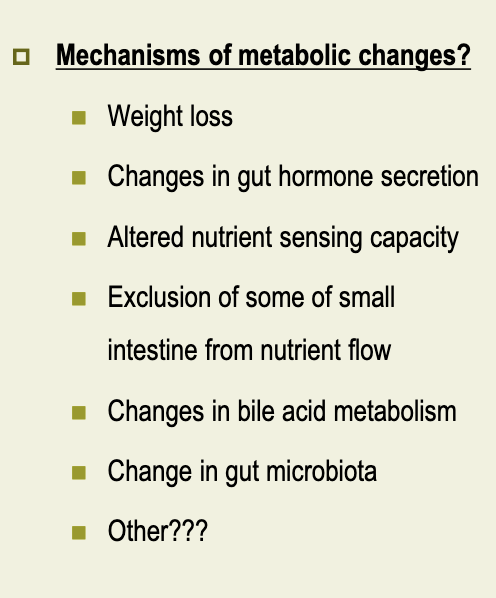
What are some mechanisms of metabolic change that lead to decreased in co-morbidities after surgery?