gas exchange and circulation 2
 Call Kai
 Learn
 Practice Test
 Spaced Repetition
 Match
 Flashcards
 Knowt Play
1/40

There's no tags or description
Looks like no tags are added yet.
41 Terms
what does the circulatory system do in large animals
carries transport tissues (blood or hemolymph) into close contact with
every cell in the body
“Close contact”
0.1 mm = short diffusion distance + large surface area, e.g. capillary beds
what does bulk transport require
But bulk transport requires a circulatory system + other things are
“circulated” e.g. nutrients, hormones, antibodies, (cancer cells, viruses)
where is open circulatory system found
arthropods, most molluscs
open circulatory system
• 1 or more (tubular) hearts + incomplete set of blood vessels
• Circulatory fluid = hemolymph; actively pumped around the body
• Hemolymph not confined to blood vessels; it flows into open sinuses
• Directly bathes tissues and organs directly (= interstitial fluid)
• Low pressure system = slow O2 delivery but low cost
• Body movements (e.g. wings, legs) contribute to pumping and return of
blood to the heart

where are closed circulatory systems found
Annelids, cephalopods, all vertebrates
closed circulatory system
- Circulatory fluid = blood (connective tissue!)
• Confined to blood vessels so separate from interstitial fluid which bathes tissues
• 1 (or more) hearts pump blood in closed series of blood vessels infiltrating tissues (as
capillaries)
• High blood pressure increases effectiveness, and regulation, of O2 delivery in larger, more active, animals
• But high cost

Capillaries
small and extremely thin-walled (1 cell thick); can be “fenestrated” (holes) – this is where exchange occurs
Arteries
carry blood from heart. tough, thick, elastic walls; recoil maintains blood pressure in capillaries when heart relaxes
Veins
carry blood back to heart, thinner with valves to prevent backflow during low pressure return of blood to the heart; compliant for storage of blood
Blood flow through capillary beds
allows for exchange of
gases, nutrients, wastes
some tissues have only…
5-10% of
their capillaries with blood flowing
through them (but closer to 100% in
brain, heart, kidneys)
blood supply is…
“redistributed” with
time (e.g. to skin for
thermoregulation, away from gut
during exercise)
blood flow is regulated by…
• Heart: amount of blood coming from arteries and arterioles
• Smooth muscle fibers in walls of arterioles + pre-capillary sphincters = peripheral circulation
what does high blood pressure in capillaries create
-interstital fluids and lymph
How do simple solutes (O₂, CO₂, sugars, and salts) move between blood and tissues?
-Simple solutes O2, CO2, sugars, salts diffuse across cells or through spaces between cells (“fenestre”) Movement is aided by bulk flow
How does fluid move in and out of capillaries?
• At arterial end of capillary blood pressure >>>> osmotic pressure – fluid
leaks out (20 L/day)
• At venous end osmotic pressure >>>> blood pressure (proteins
accumulate?) most (?) fluid moves back into capillary (17 L/day)
• Lymphatic system recovers any net fluid loss (~3 L/day)
lymphatic system
Separate set of vessels
running throughout the
body
• Returns lymph to
circulation (at major veins
entering the heart)
• Low pressure system
(valves)
• Flow of lymph aided by
limb movements
Evolution of the vertebrate circulatory system
Single circulation → double circulation
2-chambered heart → 4-chambered heart (completely divided ventricle)
single circulation
Closed circulatory system or cardiovascular system
in fish

amphibians
• 3-chambered heart + double circulation
• Pulmocutaneous circuit – lungs and skin; systemic circuit = body
• Incomplete separation (mixing) of O2ated/deO2ated blood in ventricle
• “Shunting” (redistribution) away from lungs when underwater
amphibians
• 3-chambered heart + double circulation
• Pulmocutaneous circuit – lungs and skin; systemic circuit = body
• Incomplete separation (mixing) of O2ated/deO2ated blood in ventricle
• “Shunting” (redistribution) away from lungs when underwater

reptiles (except birds)
• 3-chambered heart but increasingly partly divided by a septum
• Incomplete separation of blood in ventricle (non-crocodiles)
• Vessel b/t pulmonary/systemic circuit + 4-chambered heart (crocodiles)
• “Shunting” (redistribution) of blood during diving underwater

Mammals and birds
• 4-chambered heart with fully divided ventricle
• No possibility of shunting in adults (but fetus?)
• Very extensive capillary system; coronary circulation
• Convergent evolution in birds and mammals
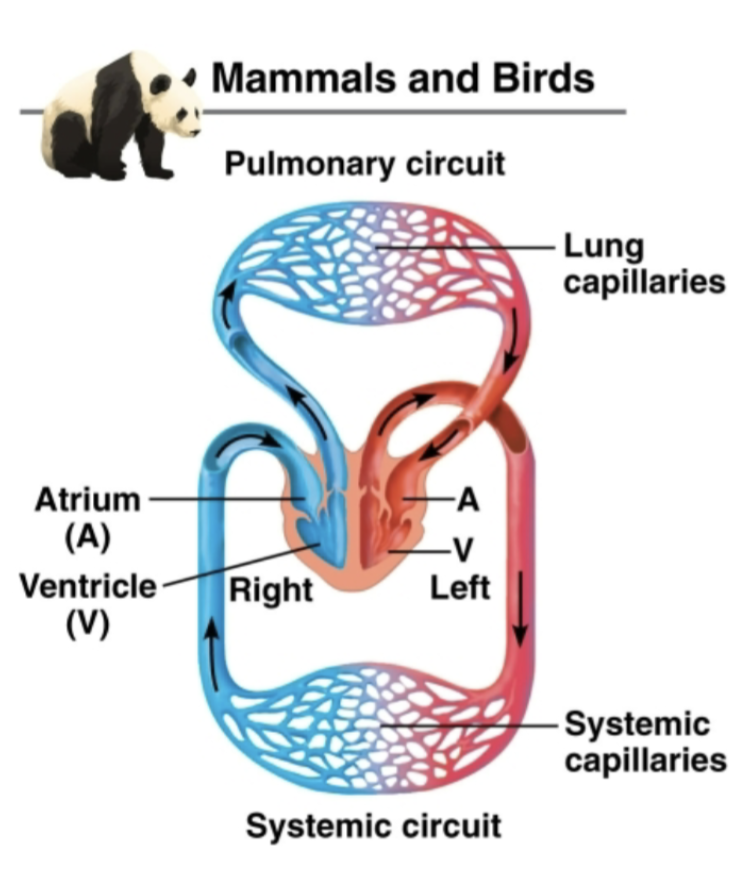
Pulmonary circulation
relatively) low pressure
circuit to and from lungs
- pulmonary artery
- lung capillaries
- pulmonary vein
Systemic circulation
higher-pressure circuit
to and from the rest of
the body (providing O2,
nutrients to tissues)
- aorta
- capillaries
- superior/inferior vena
cava
mammal circulation overview
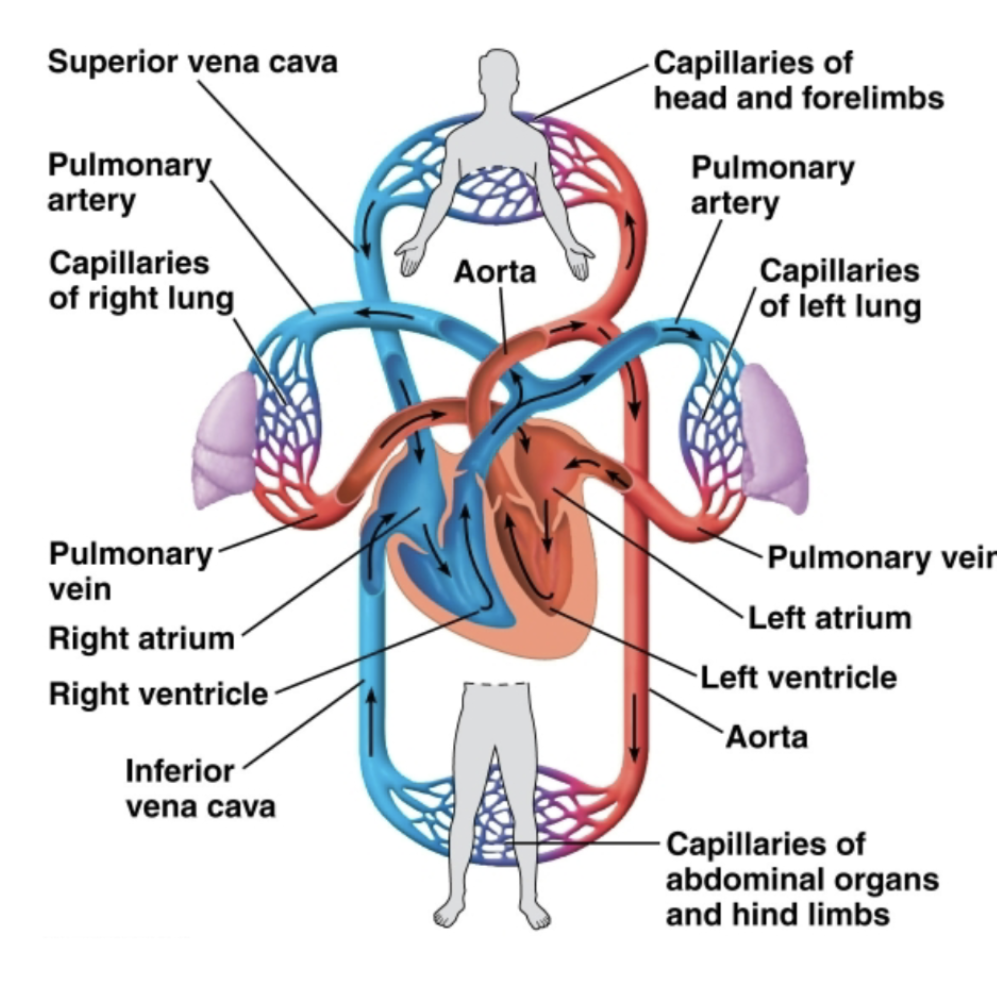
Blood flow through the mammalian 4-chambered heart:
a series of valves makes sure blood goes to the right place

Atrioventricular (AV) valves
separate the atrium and ventricle chambers
Semi-lunar valves
in main vessels: pulmonary and aortic valve
Cardiac cycle:
contraction phase (systole) of atria and
ventricles is closely coordinated with relaxation
(diastole) phase

Cardiac muscle cells are
specialised
electrically
coupled via gap junctions
what does Sequential electrical activation lead to
coordinated
contraction of the heart
electrical activation
1. Signal (yellow) initiated by pacemaker cells in sinoatrial (SA) node
2. Signal spreads over atria which contract
3. Signal delayed at AV node
4. Conducting fibers (bundles) rapidly pass signal to bottom of heart and
upwards through ventricles via Purkinje fibers; ventricle contracts

Patterns in blood pressure and blood flow
-Pulsing nature of blood pressure in arteries is due to heart beating
and elastic recoil in main arteries
-Number of capillaries is ENORMOUS and the TOTAL cross-sectional area of capillaries
>>> arteries and veins
-So mechanical resistance (friction) of large SA decreases blood pressure rapidly in
capillaries – but smooths blood flow
where is velocity of blood flow SLOWEST
in capillaries (same vol. through larger SA) – allows time for transfer between blood and tissues
Baroreceptors
specialised pressure-sensitive nerves
Cardiac output
total vol. blood ejected from ventricle/minute
Circulation needs to be regulated to …
match tissues’ metabolic
needs, e.g. inactivity vs. activity
perfusion
Contraction (vasoconstriction) and relaxation (vasodilation) of smooth
muscle (sphincters) in arteriole walls regulates blood flow in to
capillaries/tissues
Cardiac muscle and smooth muscle function controlled by:
• Signals from nervous system (sympathetic and parasympathetic NS)
• Hormones in blood (e.g. atrial naturitic peptide, ANP)
• Local control by endothelium (NO, endothelin)