Architecture and Society Lecture 1- Study guide
 Note
 Call Kai
 Learn
 Practice Test
 Spaced Repetition
 Match
 Flashcards
 Knowt Play
1/268

There's no tags or description
Looks like no tags are added yet.
269 Terms
Abacus
The separating element between the capital and architrave

Acanthus leaves
The leaves at the capital of Corinthian columns.
Acanthus Motif

Achaemenid (Persian) Empire (dynasty)
Was at its largest whilst under Darius the Great's rule (522-486 BCE). Ended by Alexander the Great in 330 BCE
Achaemenid (Persian) Empire (dynasty) Date
550-330 BCE
Acropolis
The upper town or elevated stronghold of an ancient Greek city, containing its Chief Temples
Agora
The open meeting space or marketplace in an ancient Greek city.
Akhenaten
The ruler that came after Hatshepsut, and made everyone believe in Monotheism. Ruled for a short period of time (1351-1334 BCE).
Ambulatories
Curved passageways that go around a shrine
Amphitheatre
a round, semicircular, or oval outdoor arena surrounded by rising tiers of seats
Anda
The dome-like top section of a stupa
Apadana
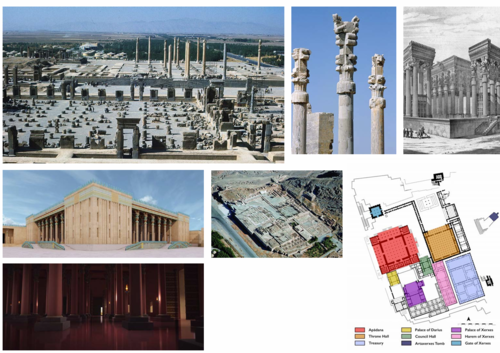
Apadana Date
ca. 500 BCE
Apadana Location
Persepolis, Iran
Apotropaic
(shedus - masculine | lamassus - feminine) A sculpted guardian figure placed at portals and thresholds
Arcade
A series of arches or columns or piers, either freestanding or attached to a wall
Arch
A curved structure, usually made of wedge-shaped stones, that spans an opening
Archaic Architecture
The lesser forms of early architecture due to the lack of artistic development
Architrave
a main beam resting across the tops of columns
Arch of Titus
A triumphal arch, built by Emperor Domitian to honor his older brother Titus.
Arch of Titus
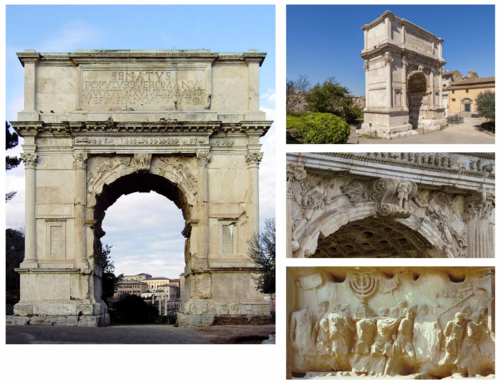
Arch of Titus Date
ca. 81 CE
Arch of Titus Location
Rome, Italy
Ark of the Covenant
An ornate box that held the 10 Commandments
Ashoka
The largest ruler of the Mauryan Empire, who converted to Buddhism, after the horrendous Battle of Kalinga.
Astragal
Composed of a half-round surface surrounded by two flat planes. It can be used at the top or base of a column.
Aten
The sun
Atrium
A large, open space
Attic
The story above the main cornice in a classical facade
Axis and Axial Planning
A design layout where a central point or line serves as the organizing principle for the entire structure.
Barrel

Basilica
An ancient Roman meeting hall, oblong in plan, with a high central space lit by clerestory windows
Bronze Age
A prehistoric period that followed the Stone Age and preceded the Iron Age, when certain weapons and tools were created from a certain material that made stone obsolete.
Bronze Age Date
ca. 3200-1500 BCE
Buddhism
Based on teachings attributed to the Buddha; a wandering teacher, this religion believed in nonviolence.
Caitya Hall
Carved out areas, which had ambulatories and other stone structures. These acted as stupas, except they were located within a hill or cliffside
Caldarium
A room in a Roman bath house with a hot plunge bath
Capital
The top section of a column
Caryatid
A draped female figure used as pillar
Chattra
A symbolic mantle piece, that was placed on the top of a stupa. It symbolized the important people (Buddhists) who had their remains buried underneath
Classical Greek
Established around 5th century and considered a sophisticated form of architecture
Colonnade
A row of columns supporting a beam or entablature
Concrete
Artificial stone (widely used by the Romans) made of a mixture of cement, water, gravel, and sand
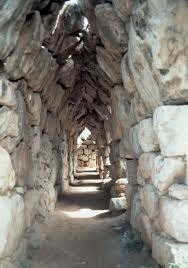
Corbel (arch, vault)
A doorway created from stacked stones with smoother edges
Corinthian Order

Corinthian Order Definition
The frieze on the capital of the column is fully round and plant-like. Designed from the Acanthus plant
Cornice
The horizontal molding that acts as the top section of an entablature
Cubiculum
Small side rooms within a domus
Cycladic Islands
Marble is very common here, Approximately, 90 cities have been discovered here as well.
Cycladic Islands Location
Aegean Sea
"Cyclopean" masonry
Large scale stone construction, often used for defense. Incorporated small doorways to slow down intruders.
Dental
Low hanging rectangular ornaments that sat between the triglyphs
Djoser's Tomb
image

Djoser's Tomb (Funerary Complex) & Stepped Pyramid Date
ca. 2650 BCE
Djoser's Tomb (Funerary Complex) & Stepped Pyramid Location
Saqqâra, Egypt
Djoser's Tomb & Stepped Pyramid
An enclosed separated space with only one entrance (mortuary precinct). And has multiple tombs ontop of each other.
Djoser's Tomb & Stepped Pyramid Materials
Outer Walls - White Limestone
Dome

Doric Order
A coloumn

Doric Order Definition
The most masculine of the orders, the columns have minimal flourishes, no base. Most simplistic
Dromos
Greek for "passageway"
Echinus
The semicircular segment that sat below the abacus
Engaged Columns
Columns that are embedded in a wall and partly projects from the surface of the wall
Entablature
An upper section of a Greek temple that included a frieze, metope, and triglyph
Entasis
The slight convex bulge given to a column to offset the optical illusion that it is thinner in the middle
Entemenanki Tower
A Ziggurat, which was the most iconic during its time. It honors the god Maraduk
Erechtheion

Erechtheion Date
ca. 420 BCE
Erechtheion Location
Acropolis, Athens, Greece
Etruscans
(ca 900 BCE - 1st century BCE) Predecessors of the Romans. Most of their history is barely understood.
Etruscan Temple

Fauces
Narrow passageways
Fillet
Rectangular bands that separate moldings and ornaments
First Temple
Established by King David and later taken over by his son Solomon. Built to house the Ark of the Covenant. One chamber for the Ark, another for the high priestess.
First Temple

First Temple Date
ca. 961 BCE / MkI destroyed in 586 BCE / MkII destroyed in 70 BCE
First Temple Location
Jerusalem, Israel/Palestine
First Temple Materials
Mainly cedar wood and gold
Flavian Amphitheatre (Colosseum)
Constructed from concrete. Home of gladiatorial games, and later a church. Storage can be found below the main arena. Estimated to have been able to hold 50,000 spectators. Organized by social class (the upper class were in the lower sections, the lower class were towards the top). The exterior facade incorporates Greek and Roman architecture.
Flavian Amphitheatre (Colosseum)

Flavian Amphitheatre (Colosseum) Date
ca. 70 CE
Flavian Amphitheatre (Colosseum) Location
Rome, Italy
Fluted Shaft
The vertical grooves/cuts that ran up the main section of a column
Fluting
The indentations found in columns
Fresco
This is applied (in wet form) before paint to prevent chipping
Frieze
a broad horizontal band of sculpted or painted decoration, especially on a wall near the ceiling. (or on the sides of stairs at Apadana)
Frigidarium
A room in a Roman bath house with a small pool (sometimes a large pool) of cold water
Great Altar (of ____)
(Zeus) - Hellenistic detailing. The enormous frieze, which spans a large portion of the altar, describes the battle between the Olympian Gods and the Giants.
Great Altar (of Zeus)

Great Altar of Zeus Date
ca. 250 BCE
Great Altar of Zeus Location
Pergamon, Turkey
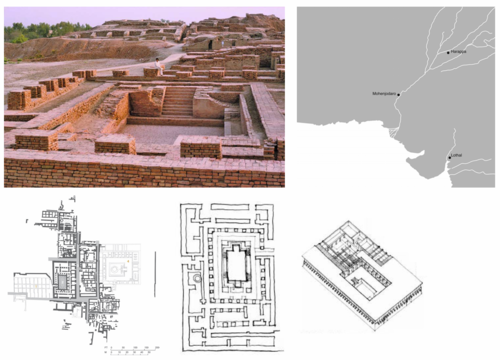
Great Bath
Great Pyramid of Khufu

Great Pyramid of Khufu Date
ca. 2570 BCE
Great Pyramids
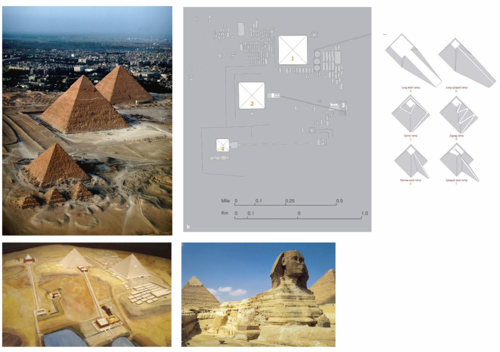
Great Pyramids Date
ca. 2551-2472 BCE
Great Pyramids & Great Pyramid of Khufu Location
Giza, Egypt
Great Stupa
Meaning "piled up", it is the largest Buddhist worship site. It is a solid mass. And it is slightly shifted in a clockwise direction (with four entrances)
Great Stupa

Great Stupa Date
Began in the middle of 3rd century BCE