Chapter 11: Fundamentals of the Nervous System and Nervous Tissue
 Call Kai
 Learn
 Practice Test
 Spaced Repetition
 Match
 Flashcards
 Knowt Play
1/46

There's no tags or description
Looks like no tags are added yet.
47 Terms
functions of the nervous system
gathers sensory input, integrates sensory input, causes response or motor output
histology of nervous tissue
supporting cells:
“nerve glue”
surrounded and wrap neurons
called neuroglia or glial cells
neurons:
excitable nerve cells that transmit electrical signals
supporting cells in the CNS
astrocytes, microglia, ependymal cells, oligodendrocytes
astrocytes
star-shaped, most abundant glial cell, support neurons (anchor them to capillaries), mop up leaked K+, recycle neurotransmitters
microglia
transform into a microphage (phagocytize neuronal debris, microorganisms)
ependymal cells
line central cavities of brain and spinal cord, beat their cilia to circulate CSF
oligodendrocytes
line up along thicker CNS neurons and wrap them with cytoplasmic extension, produce insulating covers called myelin sheaths
supporting cells in the PNS
satellite cells and schwann cells
satellite cells
surround neuron cell bodies within ganglia and function unknown
schwann cells
surround and form myelin sheaths around large fibers of PNS and vital for peripheral nerve fiber regeneration
neurons
the structural units of the nervous system
functions of neurons
conduct messages (nerve impulses), extreme longevity, amitotic, and high metabolic rate
parts of a neuron: the cell body
biosynthetic center: rough ER most active of any cell, no centrioles. plasma membrane of cell body receives info from other neurons. most cell bodies within CNS. clusters of cell bodies in CNS=nuclei. cell bodies that lie along nerve in PNS=ganglia
tracts
bundles of neuron processes in the CNS
nerves
bundles of neuron processes in the PNS
dendrites and axons
two types of neuron processes
dendrites
branching, receptive or input region. large surface area to synapse with other neurons. convey incoming short-distance signals (graded potentials) toward the cell body
axon
generates and transmits nerve impulses away from cell body. each neuron has single axon (long axon called nerve fiber). terminal branches have endings called synaptic knobs (boutons) release neurotransmitters.
myelin sheath and neurilemma
whitish, fatty segmented sheath (covers nerve fibers especially long or large fibers). protects. electrically insulates fibers from one another. increases speed of nerve impulse (150x over unmyelinated fiber)
myelin sheath formation in PNS
formed by Schwann cells (wrap around axon in “jelly roll fashion”. adjacent Schwann cells along axon don’t touch: gaps in sheath called nodes of Ranvier
PNS peripheral nervous system
central nerves and spinal nerves, communication lines between the CNS and the rest of the body
2 branches of PNS
sensory (afferent) division and motor (efferent) division
motor (efferent) division
motor nerve fibers, conducts impulses from the CNS to effectors (muscles and glands)
2 branches of motor (efferent) division
somatic nervous system and autonomic nervous system
somatic nervous system
somatic (voluntary) motor nerve fibers, conducts impulses from the CNS to skeletal muscles
autonomic nervous system (ANS)
visceral (involuntary) motor nerve fibers, conducts impulses from the CNS to cardiac muscles, smooth muscle, and glands
2 branches of ANS
sympathetic division, parasympathetic division
sympathetic division
mobilizes body systems during activity
parasympathetic division
conserves energy, promotes housekeeping functions during rest
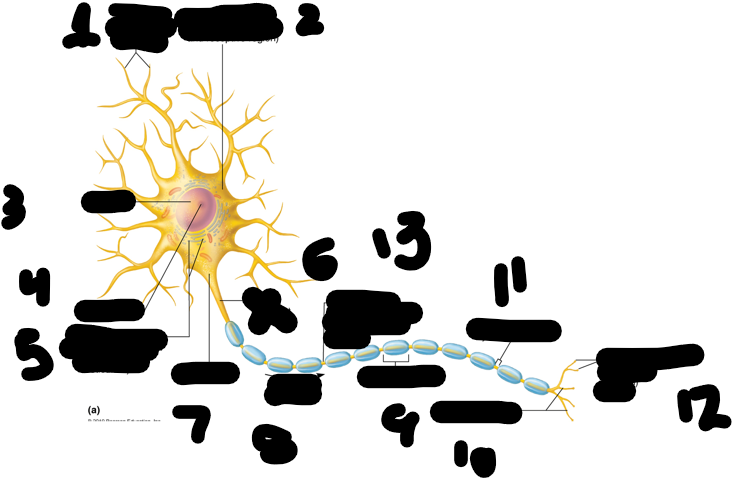
neuron diagram
dendrites
cell body
nucleus
nucleolus
chromatophilic substance (rough ER)
initial segment of axon
axon hillock
impulse direction
Schwann cell
terminal branches
myelin sheath gap
axon terminals (secretory region)
axon (impulse-generating and conducting region)
myelin sheath and neurilemma
whitish, fatty segmented sheath: covers nerve fibers, especially long or large fibers
protects
eclectically insulates fibers from one another
increases speed of nerve impulse (150x over unmyelinated fiber)
classification of neurons
structural: multipolar, bipolar, unipolar
multipolar neurons
three of more process, 99% of neurons in this class
bipolar
rare, two processes- axon and dendrites; receptors of retina, olfactory mucosa
unipolar
single, short process that divides T-like into proximal and distal branches
functional classification of neurons
direction nerve impulse travels relative to CNS
sensory (afferent)
from skin/internal organs toward CNS
motor (efferent)
carry impulses away from CNS to the effector organs (muscles and glands), usually cell bodies in CNS, usually multipolar
interneurons (association neurons)
lie between motor and sensory neurons, shuttle signals through CNS, often multipolar, 99% of neurons in body
neurophysiology
neuron stimulated, electrical impulse (action potential) conducted along length of axon; separated electrical charges of opposite sign have potential energy: for example- stored potential energy of battery, complete circuit, allow negatively charged electrons to flow to positive area, energy released
voltage
measure of potential energy generated by separates charge, volts or millivolt (mV), measured between two points
current
flow of electrical charge from one point to another, used to do work, current flow in body by ions
resistance
hindrance to charge flow, insulators (high electrical resistance), conductors (low resistance), plasma membrane provides resistance to current flow
Ohm’s law
current (I)= voltage (V)/resistance (R)
operation of gated channels
gating mechanisms
chemically gated ion channels
open in response to binding of the appropriate neurotransmitter
voltage-gated ion channels
open in response to changes in membrane potential