Intro to Machine shop final
 Note
Note Call Kai
 Learn
Learn Practice Test
 Spaced Repetition
 Match
Match Flashcards
 Knowt Play
1/86

There's no tags or description
Looks like no tags are added yet.
Name | Mastery | Learn | Test | Matching | Spaced | Call with Kai | Chat |
|---|
No analytics yet
Send a link to your students to track their progress
87 Terms
Semi-precision measurement
A measurement when tolerances or levels of desired accuracy are no finer than 1/64 or 1/100 inch, 0.5 mm, or 1 degree.
Comparison/comparative measurement
A measurement that compares the specification of a part feature to a known standard size, as when using fixed gages.
Rules for using measuring tools
Do not pile measuring tools on top of each other or drop them, keep them away from moving parts of machinery and metal chips. Use measuring tools only for their intended purposes.
Storing semi-precision measuring tools
When not in use, measuring tools should be cleaned and gently stored in safe locations away from moisture to prevent rust.
Smallest graduation on English fractional rule
1/100
Smallest graduation on English decimal rule
0.010
Key points in caring for precision measuring tools
The measuring tool and the part surfaces must be clean. Make sure tool is Calibrated, and stored away from dust, dirt, and moisture.
Fixed gage for checking hole diameters
Precision fixed gage is used to check hole diameters.
Fixed gage for checking threaded holes
Threaded plug or pin gage is used to check a threaded hole.
Identification of go member of go/no-go ring gage
The go ring gage is identifiable by there not being a groove around its circumference.
Fixed gage for checking external threads
Thread ring gages are used to check external threads.
Quality assurance
An overall view, commitment, or plan for meeting customer demands.
Four basic parts of a process plan
Material selection, machine selection, tooling selection, speed and feed calculation.
Quality control
Actions of inspecting the dimensions of machined parts to ensure tolerances are met.
Purpose of a sampling plan
A quality control guideline that states how many parts should be inspected from a given batch.
Purpose of an inspection plan
Indicates what dimensions of parts to inspect and what measuring tools and processes to use.
Difference between ferrous and nonferrous metals
Ferrous metals contain iron, while nonferrous metals contain no iron.
Alloy
A homogeneous combination of two or more metals or a metal and a nonmetal element.
Three alloying elements added to steel
Chromium, manganese, molybdenum, nickel, tungsten, and vanadium.
Effect of steel carbon content on hardness
Higher carbon content increases hardness but makes the steel more difficult to machine.
Cast iron
Ferrous metal with carbon content between 1.7% and 4.5%, recognized by a rough scaly surface.
Heat treatment
Controlled heating and cooling of metals to change their properties.
Carbon content for direct hardening
Direct hardening can be performed on steel containing at least 0.3% carbon.
Rapid cooling of metal
Quenching is the rapid cooling of metal during heat treatment.
What type of hardening operation that leaves the inner core in a softer condition is sometimes performed on medium-carbon steel
Surface hardening
Ways to accomplish surface hardening
Case hardening and carburizing.
Importance of routine maintenance plan
To keep machinery in proper working order and operate safely.
Lubricants
Greases and oils used to minimize friction between moving machinery parts.
Purposes of lubricants
Minimize friction and prevent seizing of machinery parts.
Methods of applying lubricants
Reservoirs, oil cups, ball oiler.
Components of machine tools to inspect for wear
Belts and gears.
Gib
A tapered wedge found on dovetail-shaped slides used to tighten the slide.
Definition of layout
The process of locating and marking a workpiece to guide machining operations.
Purpose of layout fluid (dye)
To provide contrast and aid in seeing layout lines.
Safety precautions when using layout dye
Review the SDS for safety, work in a ventilated area, wear safety glasses.
Scriber
A tool used to mark straight layout lines with a sharp point.
Angles laid out with combination square
45 degree angles.
Safety rules when using screwdrivers
Use the correct type and size, do not carry in pockets, keep away from moving machinery.
Types of screwdriver tips
Straight/slotted, Phillips, Torx.
Advantage of slip joint or tongue and groove pliers
Pliers can be adjusted to hold larger work securely.
Pliers for holding small items
Needle nose pliers.
Advantage of locking pliers
User does not need to continuously squeeze them by hand.
Saw with reciprocating cutting motion
Power hacksaw.
Use of vertical band saw
Can make straight cuts and more complex contouring operations.
Ideal use of horizontal band saw
Cutting large pieces.
Safety precautions for horizontal band saw
Do not hold material by hand, keep clear of moving parts.
Preparation for internal contour sawing
Drill a hole large enough for the blade to pass through.
Benefit of offhand abrasive machining
Can cut hardened steels that cannot be cut by other methods.
Metals not to grind on pedestal grinder
Nonferrous metals.
Abrasive machine for light deburring
Abrasive belt.
Abrasive type wheel for grinding steel
Aluminum oxide.
Abrasive wheels for grinding carbide tools
Silicon carbide and diamond-impregnated.
Definition of drilling
Using a cylindrical rotating cutting tool to create a hole.
Reasons for finishing a hole by reaming
To achieve precise size with a smooth surface.
Reasons for countersinking/chamfering a hole
To install a flathead screw flush or to deburr and ease entry of pins.
Purpose of a counterbore
To increase the diameter of a hole to allow a screw head to be positioned flush.
Purpose of pilot on counterbore
To keep the tool aligned in the existing hole.
Main materials for holemaking cutting tools
High speed steel and tungsten carbide.
Types of shanks found on twist drills
Straight-shank and tapered shanks.
Functions of flutes on a twist drill
Pathway for chips, cutting fluid, and create cutting lips.
Specific part of twist drill point that cuts
The lips.
Central point of a drill point that does not cut
Flutes.
Drill press safety guidelines
Always wear safety glasses, remove drifts and keys, secure workpiece.
Definition of cutting speed
The distance a point on the circumference of a rotating tool travels in 1 minute.
Unit of measure for cutting speeds
Surface feet per minute (SFPM).
RPM formula
× ⋅ D12 ⋅ CS
Definition of feed
Movement or advancement of the cutting tool into the workpiece.
Benefits of precision grinding
Secure work, precise movements, fine surface finishes, and tight tolerances.
Primary use of surface grinder
To produce flat surfaces.
Spindle types used for surface grinders
Horizontal and vertical.
Table movements for surface grinders
Reciprocating or rotary table motion.
Wheel shapes for surface and cylindrical grinding
Type 1 straight wheels.
Wheel shapes for tool grinding
Cup, saucer, and dish-shaped wheels.
Common abrasive for grinding steels
Aluminum oxide or silicon carbide.
Abrasive for grinding nonferrous metals, cast iron, and stainless steel?
Silicon carbide.
Ability of individual grains to create new cutting edges
Fracture.
Safety guidelines for surface grinders
Never operate locked machines, ensure wheels are sound, and keep hands clear.
Check before mounting grinding wheel
Maximum RPM must match or exceed spindle RPM.
Paper discs used for cushion when mounting wheels
Blotter.
Best position to mount diamond dresser
Left edge.
Offset for diamond dresser
Left side.

1
elevating hand wheel

2
Wheel head
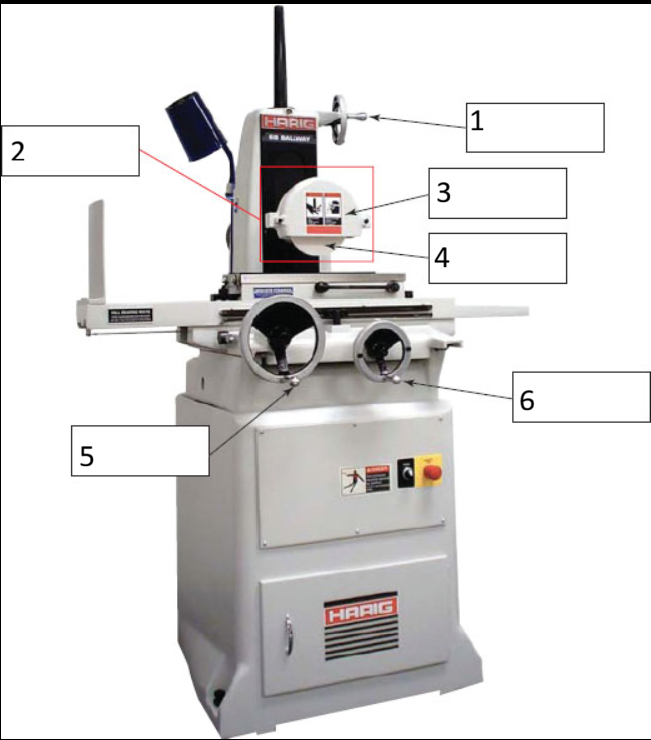
3
Wheel guard

4
Grinding wheel

5
longitudinal-feed hand wheel

6
cross-feed hand wheel