Lecture 14: Liquid Chromatography
 Call Kai
 Learn
 Practice Test
 Spaced Repetition
 Match
 Flashcards
 Knowt Play
1/46

There's no tags or description
Looks like no tags are added yet.
47 Terms
What is the most common type of liquid chromatography
partition chromatography, or liquid liquid chromatography
Block Diagram for High-Performance Liquid Chromatography (HPLC)
HPLC pump → simple/binary/ quaternary pump
Injector → simplest one is manual, most common is the autosampler
HPLC column → usually high pressure and stainless steel
Detector → most common is the uV-vis detector, second most common is mass spec

HPLC COlumsn
columns are significantly shorter than in gas chromatography (5-25 cm long)
colmn temperature is maintained, not regularly altered
HPLC parameters
Partition Chromatography
separates compounds based on their distribution between a stationary liquid phase (usually non polar) and a mobile phase (usually polar)
Separation is usually by their difference in polarity, resulting in different retention factors
Nonpolar phase is likely c18
good for separating compounds of medium to low polarity

The reversed phase principle
in normal phase chromatography, polar molecules are typically attracted to the polar silica surface, thereby traveling slowly through the column.,
By attaching carbon chains to the silica, the polar molecules are retained less strongly and are eluted more quickly
Instead, nonpolar compounds are now retained by the carbon chains on the silica
Modified surface of the silica particles → modified by binding alkyl chains
molecule is partitioning between the surface of the particle and the mobile phase
The modified surface may act as a liquid phase

Column efficiency
Measures the quality of separation of analytes
H → plate height (want to be small so we have more plates in teh column
dp → particle diameter (changing this has the most of an effect; proportional to the C term )
Decreasing the particle diameter, the pump has to now pump liquid through a column that is very difficult to pass liquid through → pressure increases → huge load on the pump

Particle Size Effects on Column Efficiency
smaller particles → better
more surface area for the analyte to interact w the stationary phase , enhancing resolution
HPLC Columns for partition chromatography

Normal-phase chromatography (HILIC - Hydrophobic Interaction Chromatography)
highly polar stationary phase and relatively nonpolar solvent
Good for separating polar molecules
change the stationary phase to be more polar as you go
The most polar substance will take the longest to elute because it interacts the most with the column (A in this picture is farthest to the right)

Reversed-phase chromatography (also known as C18 Chromatography)
most common type of chromatography
nonpolar stationary phase and relatively polar solvent
stationary phase has to become more and more nonpolar as you go
The most nonpolar substance will take the longest to elute because it interacts the most with the column ( C, th e most non polar is the farthest to the right)

How does the polarity of the stationary phase impact separation
longer carbon chain → longer retention time, but better separation
shorter carbon chain → compound peaks don’t fully separate
C18 is the safest

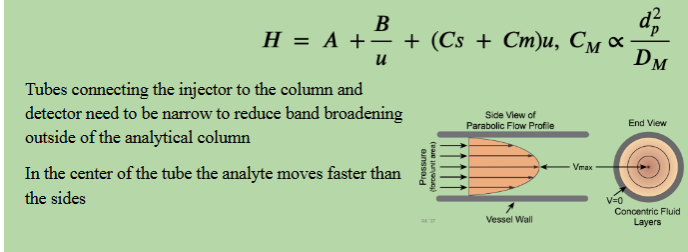
Extra column broadening in column efficiency
May happen when the tubes to connect the injector to the column are less narrow
in the center of the tube, the analyte moves faster than the sides
can also be caused by overloading the column
Narrow tubing and column →, narrow peaks → this is why they use cpaillary columns, whcih are smaller
helps account for extra column brodening
Column Overloading
if you overload your column with too much sample, your peak broadens and distort
there’s not enough surface area for all the molecules to partition back and forth
How does Liquid Chromatgrpahy work?
mobile phase (filtered with no bubbles → removed by degassing unit)
Solvent Delivery Pump → delivers a constant flow of mobile phase
Sample Vials → closed and sealed because solvent can evaporate
Column → to separate each compound contained in the sample
Column oven → to keep the temperature constant (not ramped up like in gc ; used as a control)Detector
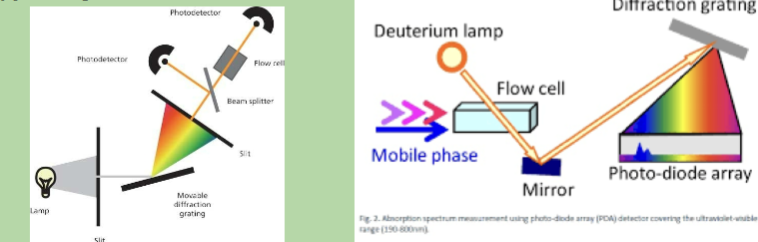
most common detector is a uv-vis detector
two types:
1. standard (variable wavelength detector)→ measures absorbance at the wavelength of your choice (has a flow through cell)
Photodiode array → uses an arrray of photodiodes ro capture the netire UV spectrum at each moment the sample passes through the flow cell

Mobile phase reservoirs and treatment systems
You can use multiple mobile phases to optimize separation
before analysis, particulates from the mobile phase, as well as gases, need to be dissolved
Isocratic Elution (choosing a mobile phase)
separation using a mobile phase with a fixed composition

Con of Isocratic Elutions
an appropriate mobile pages strength for resolving early eluting solutes may lead to unacceptable long retention times for late eluting solutes

Gradient Elutions
Gives you the best separation
When you adjust the composition of the mobile phase as the separation progresses so that it becomes more polar
reduces peak broadening for a wider polarity range
For analytes spanning a wider polarity range

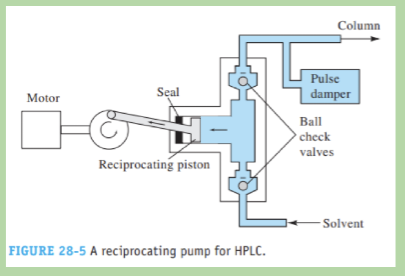
Pumping System
Delivers the mobile phase at a constant rate
sucks in solvent from the bottom and pushes it through the column at the top
ideally, the flow needs to be pulse free → allows for reproducible results
Sample injection
injecting the sample quickly into the mobile phase may give you me reproducible results
Positions
fixed volume injected in the sample loop, excess goes out the vent
Valve switches to injection position → mobile phase is connected to the loop and then it goes to the column
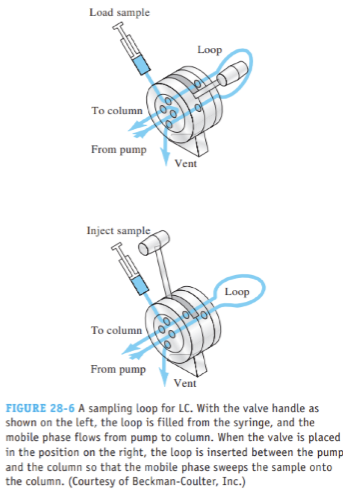
6 port injection valve
the 6 port injection valve allows the sample to be injected with the same volume every time without worrying about loading speed
better picture of sample injection
** watch animation

HPLC Columns v. gc columns
significantly shorter
particle diameter size varies based on the type of separation needed
How to pick a HPLC column
type of surface → c18 is most common
Micron particle size → 1.7μm

Bonded phase packing
type of stationary phase used to separate compounds in LC
made of small silica particles whose surface have been chemically modified by covalently bonding organic molecules (C8) to them

Ion pairing agent
bring in a oppositely charged molecule to form a neutral molecule which can be separated
Ideal characteristic of an LC detector (for hplc)
sensitive enough for the application
stable and reproducible
good linear response over three or more orders of magnitude
fast response time, independent of flow rate
reliable, simple to operate, and easy to use
response towards classes of solutes should be predictable
preferably nondestructive
UV Visible absoption detector
A = εbc
A = absorbance, ε = molar absorptivity, b = path length, and c = concentration.
UV-Vis is able to detect analytes by measuring how much ultraviolet or visible light is absorbed by compounds as they pass through the HPLC detector
more analyte → more light absorbed → larger peak
Analytes that absorb light in the UV/Visible range (chromophoric) i.e. organic compounds with conjugated double bonds, aromatics
nondestructive, we’re just seeing if it emits light
What does UV-Vis detect? Is this method destructive?
one for excitation and one for measuring emissions
Why are two wavelength selectors needed for fluorescence detectors
fluoresence detectors
usually the most sensitive but not all analytes are applicable to this technique (because not all analytes fluoresce)

Analytes that absorb light in the UV/Visible range (chromophoric) i.e. organic compounds with conjugated double bonds, aromatics
only analytes that fluoresce are the ones that can be detected
non-destructive, we’re just shining light on the analyte that will be remitted differentl
What do fluorescence detectors detect? Are they destructive?
What is the difference between a fluorometer and a spectrofluorometer
A fluorometer measures the intensity of fluorescence at specific wavelengths, while a spectrofluorometer also analyzes the full spectrum of emitted fluorescence for detailed spectral information.
Fluorometers also have a flow cell → small, enclosed chamber designed so that a liquid or gas passes through it in a controlled, continuous stream while a specific process occurs inside
how does an Evaporative light scattering (ELS) detector work
Column eluent becomes aerosol droplets using an atomizing gas
as the solvent evaporates, it leaves nonvolatile solutes as tiny particles
particles pass through light beam and are scattered
scattered light is detected by a photomultiplier tube and converted into an electrical signal
the amount of light that you detect is proportional to the mass of the analyte

What does an evaporative Scattering (ELS) detector detect? Is it destructive?
most nonvolatile compounds, some with weak UV absorption
response is related to the mass of the analyte present
droplet size must be controlled because it affects particle size and detector response
Yes, it is destructive, since you can’t return the sample to the original state
detects basically any ion
it is destructive as you can’t return the sample to the original state
What does mass spec detect? is it destructive?
Electrochemical detector modes for modern liquid chromatography
amperometric
pulsed amphoteric
coulometric
electrode array
This measures analytes that are redox active
v sensitive
ex. is sugars, neurotransmitters
What do electrochemical detctors detect? is it destructive?
it detects redox active analytes
it depends on the technique whether or not it is destructive.
amperometric
fixed potential
current is proportional to analyte flux
used for catecholamines and phenol
pulsed amperometric
cycle of detection, cleaning, and reactivation
used for carbohydrates
Mitigates electrode fouling (when the surface of an electrode gets contaminated or covered and it stops working correctly)
Measures current
Coulometric detector mode
high conversion at porous electrodes
electroactive biomarkers
electrode array
serial cells at different potentias
redox fingerprinting
three electrode lc detector

Decrease; they need to interact with the stationary phase more, so you have to make the polarity of the mobile phase more different than the stationary phase
the more different the polarities of the two phases are, the more likely compounds are to associate with one or the other
In normal-phase liquid chromatography, if we have two peaks that are not well resolved at the beginning of the chromatogram, we need to (increase / decrease / maintain) the polarity of the starting mobile phase composition.
maintain; first two peaks are sufficiently resolved
decrease; the peak broadening is happening because the analyte is interacting too much with the stationary phase
we want to make the stationary phase and mobile phase more similar to encourage the analyte/mobile phase to come off the column
In reverse-phase liquid chromatography, if we have two peaks that are sufficiently resolved at the beginning of the chromatogram but another two peaks that elute much later and very broadly at the end of the chromatogram, we need to (increase / decrease / maintain) the polarity of the starting mobile phase composition and (increase / decrease / maintain) the polarity of the final mobile phase composition.
liquid/ liquid chromatography
Partition chromatography is another word for
How do ion pairing agents work
the oppositely charged ionizing agent has a hydrophobic tail
when the agent binds the charged analyte, the compound becomes neutral, but is able to be retained by the stationary phase because of its hydrophobic tail
** note that this is for reverse phase chromatography