BIOS 110: Membranes
 Call Kai
 Learn
Learn Practice Test
 Spaced Repetition
 Match
Match Flashcards
 Knowt Play
1/17

There's no tags or description
Looks like no tags are added yet.
Name | Mastery | Learn | Test | Matching | Spaced | Call with Kai | Chat |
|---|
No analytics yet
Send a link to your students to track their progress
18 Terms
What are the functions of biological membranes?
Specialized compartments, regulates reaction sequences, cell-cell recognition, and molecule binding for cell signaling.
Product of one enzyme equals:
Substrate for next enzyme
What are biological membranes mostly composed of?
Phospholipids, cholesterol, proteins, glycolipids, and glycoproteins
Which model is more accurate: Sandwich Model, or Fluid Mosaic Model?
Fluid Mosaic Model
Do saturated fatty acids have double or single bonds between carbons?
Single bonds
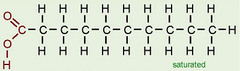
Do desaturated fatty acids have double or single bonds between carbons?
Double bonds

Does fatty acid saturation increase or decrease lipid fluidity?
Fatty acid saturation decreases lipid fluidity
Does fatty acid desaturation increase or decrease lipid fluidity?
Fatty acid desaturation increases lipid fluidity.
True or False: Long hydrocarbon tails make lipids more fluid, whilst short hydrocarbon tails make lipids less fluid.
False: Long hydrocarbon tails make lipids less fluid, as short hydrocarbon tails make lipids more fluid.
When the membrane becomes more fluid, it is:
More permeable
When the membrane becomes less fluid, it is:
Less permeable
True or false: Cholesterol maintains membrane integrity at extreme temperature conditions
True, it prevents too fluid/permeable membranes at warmer extreme warmer temperatures, and it prevents phospholipids from crystalizing at extreme lower temperatures.
Increase in temperature:
More fluid membranes
Decrease in temperature:
Less fluid membranes
What are membrane proteins?
Either peripheral (surface) or integral proteins.
What is the structure of an integral protein, and what does it do?
Alpha-helices with a hydrophilic end and hydrophilic core, which helps anchor proteins in a membrane.

What are glycolipids and glycoproteins used for?
Labels for packaging and distribution in the Golgi.
What is membrane diffusion?
Spontaneous movement of molecules from areas of high concentration to areas of low concentration.