Biological psychology Flashcard
 Call Kai
 Learn
 Practice Test
 Spaced Repetition
 Match
 Flashcards
 Knowt Play
1/127

There's no tags or description
Looks like no tags are added yet.
128 Terms
Psychology is defined as
the science of behavior and experience and the application of that science
what is the difference between the way experimental psychology and biological psychology treats the intervening processes?
experimental psychology: black box (hypotheses)
Biological psychology: identifies the processes (determination)
Define stroop effect
A cognitive phenomenon demonstrating that naming the color of a word is difficult when the word itself is the name of a different color. (automatic processing of the word interferes with the color naming task.)
Why is Strategy II (manipulate region X → is Stroop still intact?) stronger causal evidence than Strategy I?
It tests whether region X is necessary for the behaviour, not just active during it
What does 'converging evidence' mean?
Independent methods with different weaknesses point to the same conclusion. (Correlation, physical intervention and behavioural intervention)
Which subfield of biological psychology is characterised by direct manipulation or recording of brain function in controlled experiments, almost exclusively in animal models?
Physiological psychology
An interrogation study records heart rate and skin conductance while suspects answer questions. Which subfield does this belong to?
Psychophysiology
name Panel’s 6 sub ctageories
Physiological psychology
psychopharamcoloy
neoropsychology
psychophysiology
cognitive neuroscience
comparative psychology
What is the main method of cognitive neuroscience?
focuses on the neural basis of higher mental processes (thinking, memory, attention); its key method is functional imaging such as fMRI.
Explain materialism
a form of monism holding that only physical matter exists; mental states are brain states
Ontology
study of what exists
In which framework, is vody including the brain (and all animals) = matter, science. Only the immaterial mind and self-knowledge = religion.
Descartes' framework
what is ths an example of?
Consciousness arising from the interaction of many neurons, none of which is conscious
an “emergent” property
A stroke patient speaks fluently and grammatically but produces meaningless sentences and understands speech poorly. Most likely:
Wernicke's aphasia, left posterior-temporal lesion
Oliver Sacks' 'The Man Who Fell Out of Bed' illustrates which condition, typically linked to which region?
Asomatognosia – right parietal lobe
In Rainville et al. (1997), hands were immersed in 47°C water. Which region was more active when the expectation was 'will hurt a lot'?
Anterior cingulate gyrus
What is basic research vs appication?
basic research: understanding how it works
application: using that knowledge
which function is associated with left anterior
Broca- speech issues
which function is associated with left posterior temporal
comprehension issues
which function is associated with right pariental lobe
asomatognosia (not believing your body parts)
which function is associated with ACC
subjective/ expected pain
Hippocampus is shown to be associate with _____ due to Morris water maze findings
relational/ spacial memory
what is the ball bounce metaphor used for?
to explain how mind is an action of the brain like bouncing is an action of the ball
which philosophy of the mind body problem does biological psychology use?
materialistic monism
system level properties need system level explanations, what approach is that?
modern reductionism
what is important for research strategy 2 (brain to behavior)?
control groups
genotype vs phenotype
Genotype: the genetic make-up, i.e. which alleles you carry, e.g. Bw.
Phenotype: the observable trait, e.g. brown seeds. The same phenotype can come from different genotypes (BB and Bw both look brown).
study of neural mechanisms of behavior by manipulating the NS of animals
physiological psychology
study of drug effects on the brain and behavior
psychopharmachology
study of psychological effects of brain dysfunction in human patients
neuropsychology
what is psychophysiology?
study of relation between phsyiological activity and psychological processes in human volunteers by noninvasive physiological recording
which study looks at neural mechanisms of human higher processes? (brain imaging)
cognitive neruscience
study of evolution, genetics, adaptiveness of behavior + using other species and making sense of humans
comparative psychology
Name 6 major divisions of biopsychology
physiologica psychology
psychopharamcology
neuropsychology
psychophysiology
cognitive neuroscience
comparative psychology
People in this field tried to improve the memoery of Alzheimer’s patients by administering drugs that later brain chemistry. What field?
psychopharmacology
Genotype vs. phenotype
Genotype =the alleles you carry (Bw).
Phenotype = the visible trait (brown). BB and Bw look the same, so phenotype doesn’t reveal genotype.
a DNA section coding for an amino-acid sequence, at a fixed locus
Gene
What are two identical alleles called?
Homozygous
What is the Mendel’s 3 rules?
(1) Uniformity: homozygous P × P gives an F1 that’s all identical and heterozygous.
(2) Segregation: F1 × F1 gives an F2 with phenotype 3:1 and genotype 1:2:1.
(3) Independence: traits are inherited independently (9:3:3:1); the exception is linkage.
Mitosis
1 division gives 2 identical diploid cells (growth)
Meiosis
2 divisions give 4 different haploid gametes, with crossing over.
Haploid vs. diploid
Diploid (2n, 46 in humans, 23 pairs) = body cells.
Haploid (n, 23) = gametes
Gene linkage + crossing over
Genes close together on one chromosome are inherited together (Morgan 1915, Drosophila). Crossing over separates them, and more often the further apart they are, which is the basis for gene maps.
what is the q or p in locus notation?
(NLGN4 = Xp22.33) means chromosome X, p (short) arm, region 2, band 2, sub-band .33.
p= short arm
q = long arm.
What is the male determining gene?
SRY gene on Y chromosome.
XY females have no working SRY
XX males have SRY translocated onto an X
The probability that a genotype produces its phenotype.
Penetrance - carrying a gene does not guarantee its trait
Polygenic
A trait influenced by many genes with small effects (IQ, personality). Most psychological traits are polygenic.
What is the DNA bases?
A–T, G–C (complementary). In RNA, U replaces T.
Transcription vs. translation:
Transcription = DNA → mRNA, in the nucleus (same “language”).
Translation = mRNA → amino acids at the ribosome in the cytoplasm, with tRNA delivering the amino acids.
What happen to exon and intron during mRNA translation
Exons are expressed and stay in the mRNA.
Introns are cut out by splicing
Which gene is the blueprint for a protein?
Structural gene
Operator gene
PROMOTER - the switch that controls whether a structural gene is expressed
Codon
A base triplet (3 bases) = 1 amino acid.
64 codons for 20 amino acids, so the code is redundant.
What is an AUG codon?
start
what are UAA/UAG/UGA?
stop
Is Germline heritable?
yes. it is the “engine of evolution,” but usually shows no effect on the carrier
Which mutation affects the carrier, and is not inherited?
Somatic mutation
Epigenetics
Changes in gene expression without changing the DNA sequence (phenotype changes, genotype doesn’t).
What two mechanisms of epigenetics are discussed ?
DNA methylation(binding)
Histone modification (change shape)
What is this an example of?
Maternal licking in mice changes stress genes.
Epigenetics
Define Variation → fitness → selection:
Variation exists in nature
Fitness = reproductive success, not strength.
Selection = more number of certain fit animal types.
Example: drought → bigger-beaked finches leave more offspring → average beak size rises.
Homologous vs. analogous
Homologous = same origin (human arm, bat wing).
Analogous = same function, different origin (bird wing, insect wing), produced by convergent evolution.
Exaptation vs. spandrel and what are they examples of?
Exaptation = a trait evolved for one function and later reused (feathers: insulation → flight).
Spandrel = a non-adaptive by-product (the triangular space between arches).
Both undermine adaptationism.
Encephalisation quotient (EQ)
Actual brain mass ÷ brain mass expected for body size.
Absolute weight → the elephant wins;
% of body weight → the shrew wins;
EQ → the human wins (about 7).
Heritability estimate
The proportion of genetic variance in total variance of a trait in a population.
Intelligence ≈ 0.70. It does not say how much of an individual’s trait comes from genes, and it changes with the environment.
Why Infants Cry?
Mechanism: Separation from a caregiver triggers the brain's limbic system, releasing stress signals that physically cause vocal cord vibrations.
What type of explanation is this?
Proximate = how (evolved psychological mechanism).
Why babies cry?
Adaptation: Crying alerts parents to a vulnerability, securing food and defense. Infants that cry are more likely to survive and pass on their genes.
What type of explanation is this?
Ultimate explanation - the “why”
Heterozygote advantage example
sickle-cell carriers resist malaria, so the allele is maintained in malaria regions.
Phylogenesis:
a. species history
b. an individual’s development.
c. many genetics
d. ion channels that switch genes on
Phylogenesis: species history
Ontogenesis: an individual’s development.
Neoteny
keeping juvenile features and a long development, so the brain is highly shaped by experience.
maze-bright and maze-dull lines can be bred (genes). Cross-fostering rules out maternal care. Searle showed the lines also differ in___________ . Cooper & Zubek showed ______________ nearly closes the gap
maze-bright and maze-dull lines can be bred (genes). Cross-fostering rules out maternal care. Searle showed the lines also differ in emotionality. Cooper & Zubek showed an enriched environment nearly closes the gap (gene × environment interaction).
according to Basic biopsychological model, what is behavior?
behaviour = interaction of (1) genes (from evolution), (2) experience, (3) perception of the current situation.
Which DNA is inherited from mothers only and mutates slowly and steadily?
Mitochondrial DNA
what is rostral in the brain vs in the spinal cord?
rostral means front in the brain and in the spinal cord rostral means up

Which brain areas are largely contralateral?
motor & somatosensory
Describe the PNS
peripheral nervous system → afferent + efferent (para + sympa)

Where is the grey matter inside the spinal cord?
grey matter is inside (letter H), white outside. Opposite of the cerebral cortex where grey is outisde

What are the fucntions of dorsal & ventral roots?
dorsal = sensory, unipolar neurons (cell body in the dorsal root ganglion).
Ventral = motor, multipolar neurons (cell body in the ventral horn).
They join to form the spinal nerve.
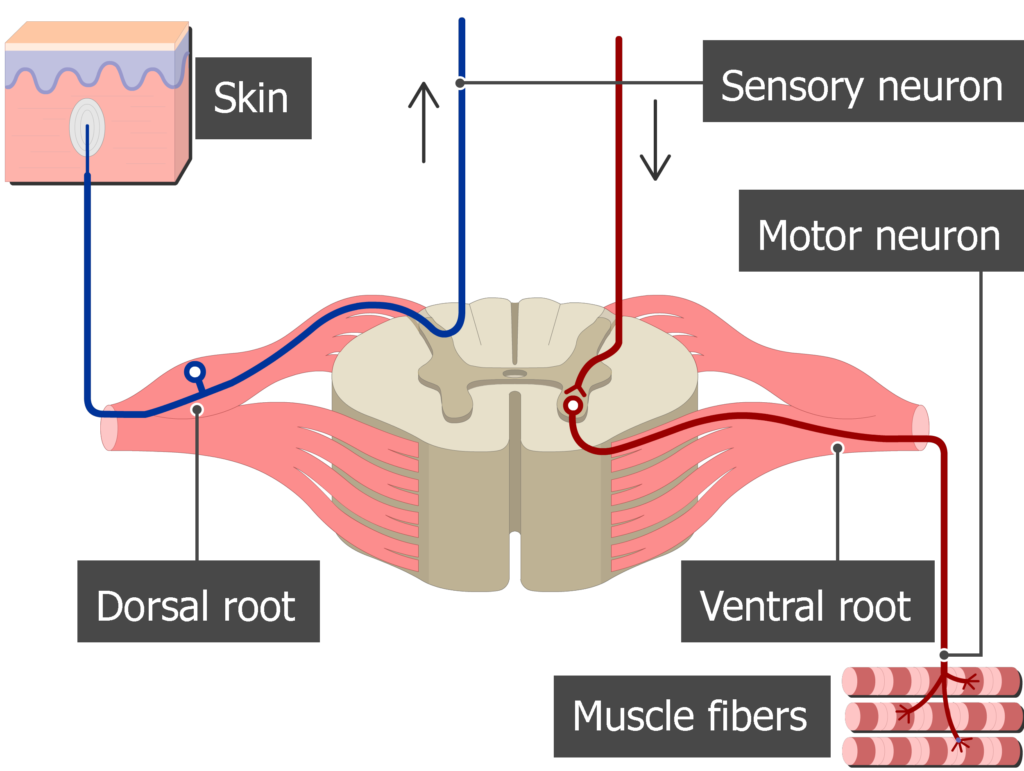
what is Eigenreflex?
Eigenreflex = own reflex (knee jerk)
the trigger and the response are in the same muscle with sensory neuron directly connecting with the motor neuron in the spinal cord → monosynaptic.
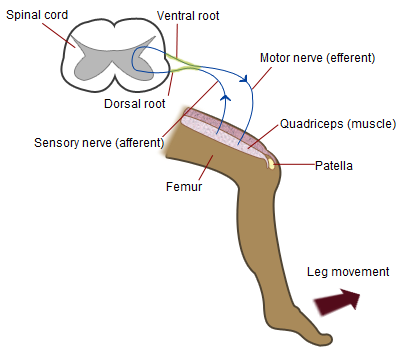
Fremdreflex → foreing flex. What is an example of this?
stepping on a tack. You feel pain in skin → signal goes to spinal cord → interneuron → pull up the foot, move muscles, jerk away
This is polysynaptic. “Foreign Reflex” because trigger area (skin) and response area (muscle) are different

What is special about sweat glands in terms of nervous system?
sweat glands are only sympathetic. They activate to sweat or not.
Ganglia vs Nuclei
Ganglia: group of cell bodies in PNS
Nuclei: group of cell bodies in CNS
Describe 3 Sympathetic effetcs (out of 7)
heart rate ↑
pupils dilate
bronchioles widen (lungs)
saliva ↓ (dry)
sweat ↑
goosebumps
digestion off.
12 cranial nerves. Fill in the blanks
olfactory, optic, ________, trochlear, trigeminal, ________, __________, vestibulocochlear, glossopharyngeal, __________, accessory, hypoglossal.
OOOTTAFVGVAH
olfactory, optic, oculomotor, trochlear, trigeminal, abducens, facial, vestibulocochlear, glossopharyngeal, vagus, accessory, hypoglossal.

Which cranial nerves are for eye muscles ?
III, IV, VI
oculomotor, trochlear, abducens
which cranial nerves are for tongue taste?
front ⅔ of the tongue = VII (facial)
Taste from the back ⅓ = IX (glossopharyngeal)
* movement of tongue is XII (hypoglossal)
What is the vagus nerve?
mixed nerve (efferent & afferent) → sense and control of organs (longest)
5 brain divisions
telencephalon, diencephalon (forebrain)
mesencephalon (midbrain)
metencephalon, myelencephalon (hindbrain)
Brainstem = midbrain + pons + medulla (not the cerebellum).

What does medulla do?
the medulla handles vital functions. (power switch)
The reticular formation’s caudal part (down) controls breathing, blood pressure, swallowing, vomiting and bladder emptying
its rostral part (up) controls hearing, balance, eye movements, chewing and sucking.
The ARAS (going up) activates the cortex (wakefulness).

What does cerebellum do?
compares the efference copy (motor command) with the afference copy
(coordination, sequencing, timing and accuracy, and sharp movements)
Which two areas does the midbrain cover?
tectum (roof) = superior colliculi (vision) + inferior colliculi (hearing).
Tegmentum = periaqueductal grey, substantia nigra (dopamine), red nucleus.

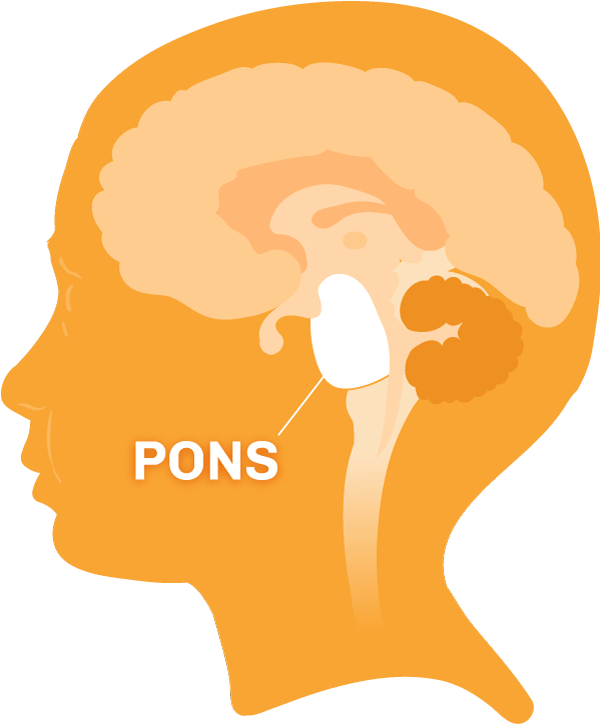
Pons are made out of ______
tracts
What are the gates to the cortex?
Thalamus (relays all sensory input)
LGN → vision
MGN → hearing
VPN → touch
_____ regulates motivated behavior & controls release of ADH and oxytocin hormones
hypothalamus (pituitary gland releases the hormones)
what is phallium in Telencephalon made out of?
medial = hippocampus, lateral = amygdala, dorsal = cortex

What is subphallium in telencephalon made out of?
striatum, globus pallidus

gyrus, sulcus, fissure

precentral gyrus = ______, postcentral gyrus = ________.
precentral gyrus = motor, postcentral gyrus = somatosensory.
what is Homunculus?
postcentral gyrus (sensory) & precentral gyrus (motor)
size = sensitivity/ precision of movement

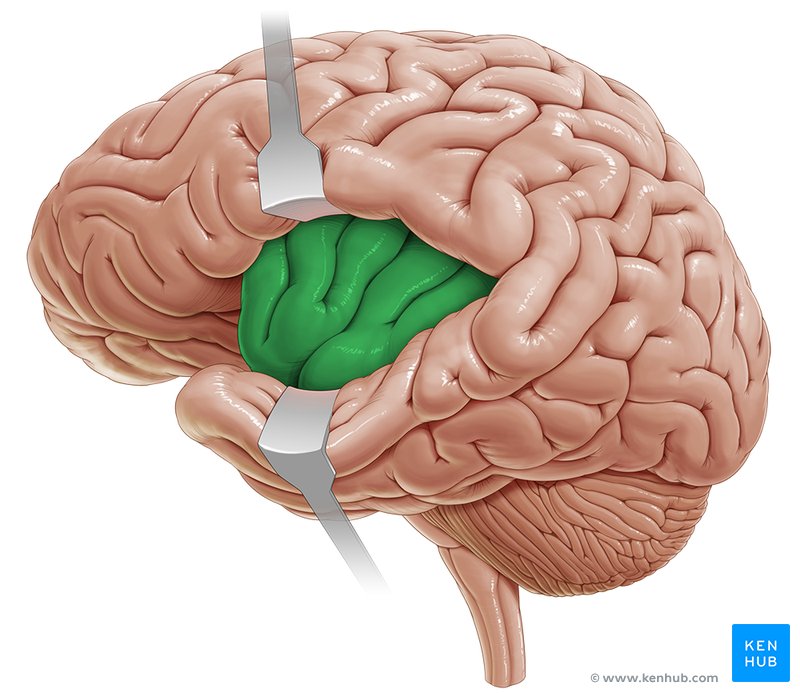
which part makse you have a sense of your organs?
Insula
Posterior = viscerosensory (taste, nausea, hunger)
Anterior = visceromotor (gastric secretion, blood pressure, via amygdala, hypothalamus, brainstem).