Monopoly and Natural Monopoly
 Call Kai
 Learn
 Practice Test
 Spaced Repetition
 Match
 Flashcards
 Knowt Play
1/7

There's no tags or description
Looks like no tags are added yet.
8 Terms
Characteristics
One seller dominating the market - Pure monopoly or monopoly power
Differentiated products - Firms are price makers
High barriers to enter/exit
imperfect information
firms is a profit maximiser.
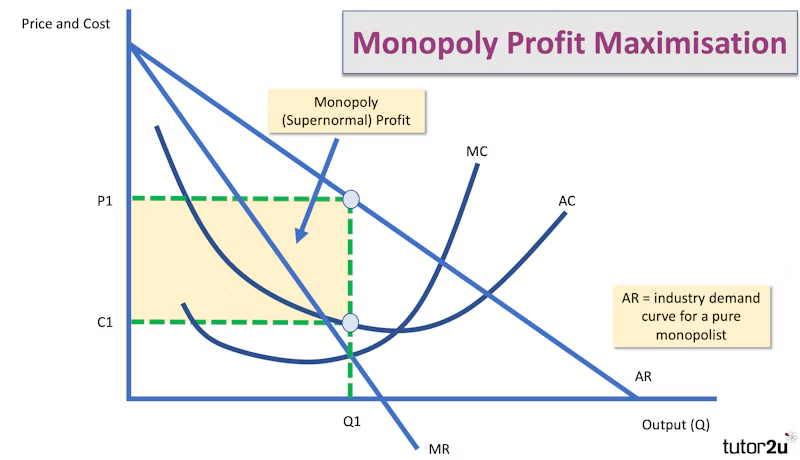
Diagram
average revenue > average cost
Allocative efficiency
occurs where price = marginal cost
not
charging price greater than marginal cost
P > MC - higher than what is what, low consumer surplus
Restricting output to earn more profit
Choice in the market is low
Productive efficient
voluntarily going into EOS
Not producing at the lowest point of AC
X-Efficiency
Occurs when monopolists produce beyond the average cost curve
allowing for waste to come in
difficult to reduce waste
Dynamic efficiency
potential
long run supernormal profit
due to high barriers of entry and imperfect info
keeps firms out of the market
can allow the profit to persist long term
reinvest in the form of R&D, innovation etc.
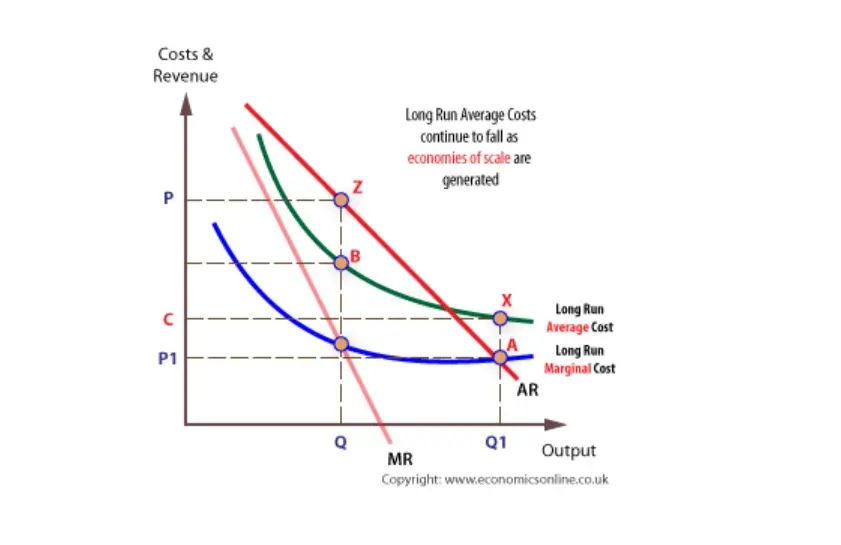
Natural Monopoly
occurs when a single firm can supply an entire market at a lower average cost than multiple competing firms due to massive economies of scale and high fixed infrastructure costs
High fixed costs, low marginal costs: Building infrastructure (like pipes or rail tracks) is expensive upfront, but serving one extra user costs very little.
Deep economies of scale: Average costs fall over a large range of output, meaning minimum efficient scale (MES) is a high share of total market demand.
Avoids duplication: Multiple networks (such as duplicate water mains or electricity grids) would waste scarce resources.
Common UK examples: Water supply (e.g., Thames Water), electricity and gas distribution grids, and rail track infrastructure.
gives desirable outcomes, as less competition
Evaluation points
dynamic efficiency
EOS or DOS
Objective of firm
Regulation
Price discrimination
Natural Monopoly
Type of good or service.