Calculus (MATH 1500): Antiderivatives
 Call Kai
 Learn
Learn Practice Test
 Spaced Repetition
 Match
Match Flashcards
 Knowt Play
1/17

There's no tags or description
Looks like no tags are added yet.
Name | Mastery | Learn | Test | Matching | Spaced | Call with Kai | Chat |
|---|
No analytics yet
Send a link to your students to track their progress
18 Terms
Give the antiderivatives of the following: ∫ 0 dx, ∫ 1 dx, ∫ xn dx, ∫ ex dx.
∫ 0 dx = 1 + C
∫ 1 dx = x + C
∫ xn dx = xn+1 / (n+1) + C (n ≠ -1)
∫ ex dx = ex + C
Give the antiderivatives of the following: ∫ ekx dx, ∫ bx dx, ∫ 1/x dx, ∫ cos(x) dx.
∫ ekx dx = ekx/k + C
∫ bx dx = bx/ln(b) + C
∫ 1/x dx = ln|x| + C (only when x-1!)
∫ cos(x) dx = sin(x) + C
Give the antiderivatives of the following: ∫ sin(x) dx, ∫ sec2(x) dx, ∫ csc2(x) dx, ∫ sec(x)tan(x) dx.
∫ sin(x) dx = -cos(x) + C
∫ sec2(x) dx = tan(x) + C
∫ csc2(x) dx = -cot(x) + C
∫ sec(x)tan(x) dx = sec(x) + C
Give the antiderivatives of the following: ∫ csc(x)cot(x) dx, ∫ 1/√(1-x²) dx, ∫ 1/(1+x²) dx.
∫ csc(x)cot(x) dx = -csc(x) + C
∫ 1/√(a2-x²) dx = arcsin(x/a) + C
∫ 1/(a2+x²) dx = 1/a arctan(x/a) + C
Give the antiderivatives of the following:
∫ tanx dx = -ln|cosx|
∫ cotx dx = ln|sinx|
∫ secx dx = ln|secx+tanx|
∫ csc dx = -ln|cscx+cotx|
When should I think “logarithm” for an antiderivative?
If the numerator is (or is a constant multiple of) the derivative of the denominator:
∫ f’(x)/f(x) dx = ln|f(x)| + C
How do find a function such that you have its given implicit derivative, input, and output are given?
> Multiply by dx on both sides and ensure x and y variables are separated.
> Integrate both sides.
> Sub the input x and output y → solve for C.
> Rewrite antiderivative with the solved C.
How do you solve particle motion problems given force, acceleration, velocity, or position?
> Convert units if needed.
> Convert physics into calculus (F = ma) → Find acceleration a(t).
> Integrate to get velocity v(t) → Use initial velocity to find C.
> Integrate to get position s(t) → Use initial position to find C.
> To find time at max height, etc., set v(t) = 0.
> Plug that time into s(t).
What does FTC 1 state?
If
g(x)=∫axf(t)dt⇒g′(x)=f(x)
or rather
\frac{d}{\differentialD x}\left\lbrack\int_{a}^{x}f\left(t\right)\!\,dt\right\rbrack=f\left(x\right)
The derivative of an integral is the original function.
How do you show proof of FTC 1?
> Convert to d/dx [ ∫ax f(t) dt].
→ d/dx [F(x)|ax]
→ d/dx [F(x) - F(a)] = d/dx F(x) - d/dx F(a) = F’(x)
> Solve.
What does FTC 2 state?
If
F′(x)=f(x)
then
∫abf(x)dx=F(b)−F(a)
A definite integral equals the antiderivative evaluated at the endpoints.
How do you show proof of FTC 2?
> Get the antiderivative F(x).
> Solve for F(b) - F(a).
How do you compute the Riemann sum for the partition of a given interval with n equal-sized subintervals with the left-, right-, and mid-point approximation?
> Find ∆x = b - a / n.
> Create partition points and number line.
> Choose sample points.
Left: x0, x1, … xn-1
Right: x1, x2 … xn
Midpoint: midpoints of each subinterval.
> Compute A = ∆x ∑ f(xi).
> IF NEEDED: Compute definite integral and compare if under- or over-estimation.
is Ln always an underestimate and Rn always an overestimate?
> For an increasing function, left is an under- and right is an over-estimate.
> For a decreasing function, right is an under- and left is an over-estimate.
You can check f’(x) > 0 if increasing or f’(x) < 0 for decreasing.
How do you compute the area under a given graph with its equation on a given interval?
Use FTC 2.
How do you compute the total area of a graph over an interval?
> Find where the graph crosses the x-axis by setting the f(x) = 0 and solving for x (which we will now call b).
> Split at b, where a = lower limit and c = upper limit: (-1) ∫ab f(x) dx + ∫cb f(x) dx.
> Find the antiderivative → Solve each integral and ensure the ∫ab is positive due to (-1).
> Add the positive areas → Atot.
How do you show that f(x) ≤ ∫ax g(x) dx ≤ h(x)
> Look at the interval. Find its length by adding the endpoints together.
> Find the smallest value (f) and largest value (h) by evaluating f(x) with x as the lower and upper limits.
> f ≤ f(x) ≤ h
> Integrate all three parts.
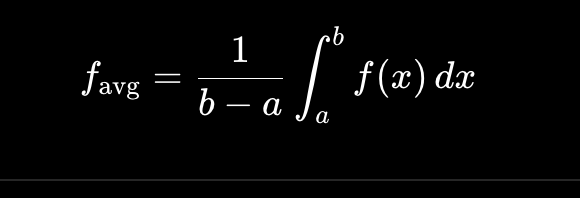
Formula for mean value of f(x) on interval