Learning and Behavior Exam 2
 Call Kai
 Learn
Learn Practice Test
 Spaced Repetition
 Match
Match Flashcards
 Knowt Play
1/54

There's no tags or description
Looks like no tags are added yet.
Name | Mastery | Learn | Test | Matching | Spaced | Call with Kai | Chat |
|---|
No analytics yet
Send a link to your students to track their progress
55 Terms
Light intensity increase (US)
Pupil of the eye constricts (UR)
Light intensity decrease (US)
Pupil of the eye dilates (UR)
Physical of chemical irritant to the eye (US)
Eye tears up (UR)
Physical or chemical irritation to the throat (US)
Coughing (UR)
Low temperature (US)
Shivering (UR)
High temperature (US)
Sweating (UR)
Cold or “fright” (US)
Hair erection on body (UR)
Food in mouth (US)
Salivation (UR)
Bad food in stomach (US)
Vomiting (UR)
Pain or intense heat (US)
Hand withdraws (UR)
Tap to knee (US)
Knee jerk (UR)
Painful, very intense, or very unusual stimulus (US)
Startle response/activation (fight-or-flight) (UR)
Describe Pavlov’s scenario that led to the discovery of respondent conditioning.
While running an experiment on dogs about salivary reflex, Pavlov noticed that the dogs began to salivate at the appearance of researchers in white lab coats before food was introduced.

Unconditioned Stimulus
Stimulus that naturally and reliably elicits a response
Conditioned Stimulus
NS becomes the CS through association with the US that elicits a response
Unconditioned Response
Response that is naturally and reliably elicited by the US
Conditioned Response
After conditioning, the response that is elicited by the CS
Neutral Stimulus
Does not elicit a reaction when presented
Automaticity
Conditioning occurs without our verbal awareness or consciousness
Phylogeny
Evolutionary history of organisms; behavioral tendencies were passed down via natural selection, useful tendencies remained
Types of Behaviors
Movement of skeletal muscles (waving arm, opening mouth)
Movement of smooth muscles (blushing, heart rate, pupil dilation)
Gland Secretion (tears, salivation, sweat, adrenaline)
Respondent Extinction
The process where a conditioned stimulus is repeatedly presented without the unconditioned stimulus, causing the conditioned response to gradually weaken and eventually disappear
How are unconditioned responses phylogenetic in nature?
They are innate, unlearned behaviors passed down through a species' genetic history via natural selection rather than acquired through individual experience.
What’s another name for the US-UR relation?
Innate/natural reflex
Habituation
Reduction of an unconditioned response through repeated exposure to an unconditioned stimulus. For example, someone will stop noticing the sound of passing trains or traffic if they live near a busy street. For another example, a small squirt of lemon juice on the tongue elicits the salivary reflex. Squirting lemon juice on the tongue once every two minutes (with a water rinse in between) will cause a gradual reduction in saliva production
What is the ideal conditioning arrangement?
Delay conditioning is when the US immediately follows the NS, often with a brief overlap. This is generally regarded as the ideal conditioning arrangement. In the context of animal training, a trainer would press a clicker and then immediately deliver a treat to the animal.
Conditioned Taste Aversion
Nausea conditioned to specific foods after being paired with illness.
Single-trial Conditioning
A strong behavior or aversion forms after just a single pairing of a stimulus and a response. An example of this is getting in a car accident and immediately becoming afraid of driving
Delayed conditioning
A timing technique where the CS starts first and stays present until the reward or outcome (US) happens. For example, a dark cloud appears in the sky (the trigger). It stays dark for a few minutes, and then it starts pouring rain (the outcome). The cloud doesn't disappear before the rain starts; they overlap. You quickly learn that dark clouds mean rain is coming.
What is the activation syndrome / fight-or-flight response? What are the three types of stimuli that cause us to engage in the activation syndrome?
A series of psychological events that occur to fuel the skeletal muscles and brain to allow us to prioritize thinking and movement in dangerous situation. The stimuli that cause us to engage in this behavior is physical stimuli, psychological/emotional stimuli, and psychological/internal stimuli
What is the Little Albert experiment? Was Little Albert likely to maintain the phobia?
The Little Albert experiment involved a child named Albert being presented with a white rat. Whenever he reached for the rat, a loud steel rod was stuck creating a loud noise that elicited a fear response. It was noted that Little Albert would avoid the rat after only two pairings of the presence of the rat and the loud sound. The experimenters then conducted five additional pairings of the white rat with the loud sound, and eventually, Little Albert would cry in the presence of the white rat despite the absence of the loud sound. Little Albert was unlikely to maintain the phobia as he would learn through experiences that white rats do not create loud noises (repeated encounters with the CS (white rat) without the US (loud noise).
Compensatory Reactions
The body compensating for incoming stimuli like caffeine, drugs, or alcohol
How do compensatory reactions affect drug overdose?
They can trigger a drug overdose when a tolerant user takes a normal dose in a new environment without the usual environmental cues that activate the body's physiological responses
CS (Usual environment) → CR (Compensatory response)
NS (New environment) does not elicit R (Compensatory response)
Evaluative Conditioning
Changes in the like (or dislike) of a stimulus that result from pairing with another positive (or negative) stimuli
Counterconditioning
The conditioned stimulus that elicits a negative response (CR) is repeatedly paired with a stimulus that elicits an incompatible response (usually pleasant emotions).
Mary Cover Jones and Little Peter
Mary Cover Jones first demonstrated counterconditioning in a case study with a 2-year-old boy named Peter, who was significantly afraid of rabbits. Rather than exposing Peter to the rabbit to reduce his fears through extinction, she presented snacks whenever the rabbit was shown. This greatly reduced Peter’s fears by establishing a new pairing of the rabbit with pleasant stimuli
NS (rabbit) does not elicit R (pleasant emotions)
US (snacks) → UR (pleasant emotions)
NS (rabbit)/US (snacks) → UR (pleasant emotions)
CS (rabbit) → CR (pleasant emotions)
How could have Mary Cover Jones used respondent extinction for Little Peter?
CS (rabbit) elicits CR (fear)
Present CS (rabbit) by itself → CR (fear)
Repeat several times!
CS (rabbit) no longer elicits CR (fear)
Lower-order Respondent Conditioning Diagram
NS does not elicit R
US → UR
NS/US → UR (repeated several times)
CS → CR
Higher-order Respondent Conditioning Diagram
NS does not elicit R
CS1 → CR1
NS/CS1 → CR1 (repeated several times)
CS2 → CR2
Lower-order VS Higher-order Conditioning!
Lower-order conditioning pairs a neutral stimulus directly with an unconditioned stimulus, while higher-order conditioning pairs a new neutral stimulus with an already established conditioned stimulus

Emotions from a behavioral perspective
Emotions consist of a collection of respondent behaviors that together are called the “activation syndrome.” (All emotions are respondent, not operant behaviors).
Stimulus Generalization
The conditioned stimulus and similar stimuli evoke a conditioned response
Stimulus Discrimination
Only the conditioned stimulus evokes conditioned response, similar stimuli have no effect.
Generalization VS Discrimination Example
A red balloon evokes a fear response in person A and B. Person A shows generalization, as they are afraid of all red balloon shaped objects. Person B shows discrimination, as they are only afraid of red balloons specifically, not similar stimuli.
Spontaneous Recovery
The sudden, unexpected reappearance of a conditioned response after a not encountering the conditioned stimulus for an extended period of time.
In the first line of the counterconditioning diagram, the rabbit is an NS even though it elicits a fear reaction. Explain why it is an NS rather than a CS in this diagram.
The purpose of counterconditioning is to pair the rabbit with a positive unconditioned stimulus to evoke a new, desired response (ex: happiness). Because the rabbit does not naturally or automatically elicit a calm/happy response before this new training begins, it acts as a Neutral Stimulus (NS) relative to that specific target behavior.
Why is the following relation unusual? US (pain to hand or foot) à UR (hand or foot withdrawal)
It involves the movement of skeletal muscles. Typically, respondent conditioning causes the movement of smooth muscles or gland secretion.
Implicit Bias
Unconscious attitudes and prejudices about groups, rooted in respondent conditioning. Exposure to certain types of visuals, text, and other imagery and what their paired with.
Staats and Staats
Demonstrated how emotions toward things/people/ethnic groups that we have never had contact with can be respondently conditioned.
NS (Dutch)/CS1 (joy, happiness) → CR1 (pleasant emotions)
NS (Swedish)/CS1 (death, pain) → CR1 (unpleasant emotions)
NS (German)/NS (book, table) → No emotional reaction
The participants rated Dutch as very positive/pleasant, Swedish as very negative/unpleasant, and German, Italian, and French as neutral.
When asked why they rated them that way, the students could not tell the experimenters. That is, the conditioning occurred completely without their awareness.
Lower VS Higher order conditioning with tone, meat powder, and light
Lower Order
NS (tone) does not elicit R (salivation)
US (meat powder in mouth) → UR (salivation)
NS (tone)/US (meat powder in mouth) → UR (salivation) [Repeated]
CS (tone) → CR (salivation)
Higher Order
NS (light) does not elicit R (salivation)
CS1 (tone) → CR1 (salivation)
NS (light)/CS1 (tone) → CR1 (salivation) [Repeated]
CS2 (light) → CR2 (salivation)
Doll Test
Black children picked between a white or black doll for different questions
Positive traits were associated with the white doll
Negative traits were associated with the black doll
The children were upset choosing the black doll when asked which one looks like them
Inherited Behavioral Relations
⭐Unconditioned reflexes (unlearned)
Instinctual behaviors (Ex: hibernation)
⭐Capacity for respondent conditioning (learning by association)
Capacity for operant conditioning (learning through consequences)
Simultaneous Conditioning
US and NS/CS are presented and removed at the same time (Bad because them occurring at the same time could result in one blocking the other)

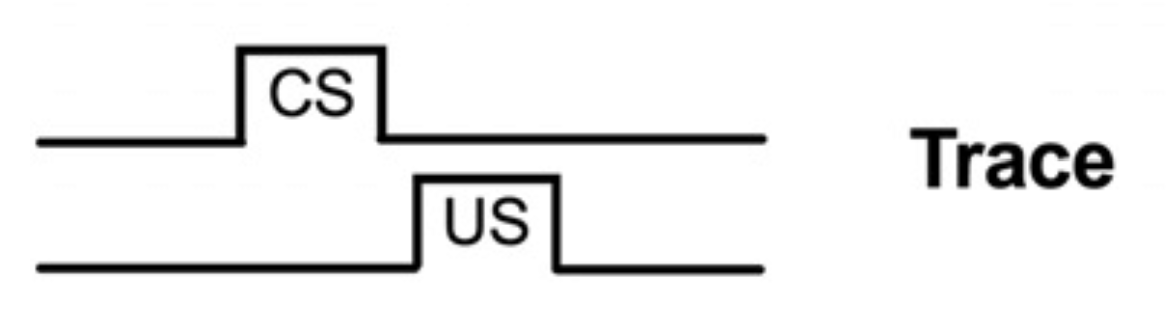
Trace Conditioning
NS/CS is introduced and then removed, with a small break before the US appears (Bad because there’s too much time in between)
Backward Conditioning
US is presented before the NS/CS (Bad because the US is already presented, so likely UR is already occurring before CS)
