Microbio526 Exam 2
 Call Kai
 Learn
 Practice Test
 Spaced Repetition
 Match
 Flashcards
 Knowt Play
1/71

There's no tags or description
Looks like no tags are added yet.
72 Terms

What precursor is this?
Glucose-6-phosphate

What precursor is this?
Fructose-6-phosphate
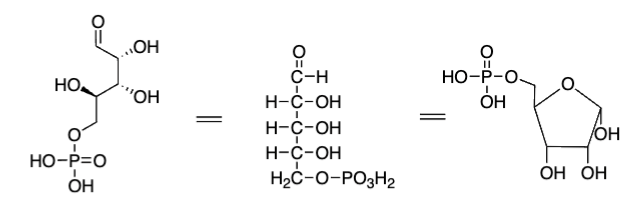
What precursor is this?
Ribose-5-phosphate

What precursor is this?
Erythose-4-phosphate

What precursor is this?
Triose-phosphate
(glyceraldehyde-3-Phosphate)

What precursor is this?
3-phosphoglycerate

What precursor is this?
Phosphoenolpyruvate

What precursor is this?
Pyruvate
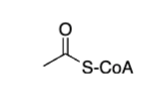
What precursor is this?
Acetyl-CoA

What precursor is this?
α-ketoglutarate
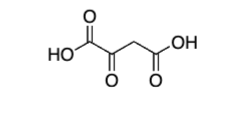
What precursor is this?
Oxaloacetate

What precursor is this?
Succinyl-CoA
What are the two types of diffusion and their differences?
Passive diffusion: no protein transporter; molecules move across a concentration gradient; slow rate.
Facilitated diffusion: uses a protein transporter; molecules are usually charged/polar; fast rate. (saturation: all transport proteins are occupied)

What diffusion is this?
Passive diffusion
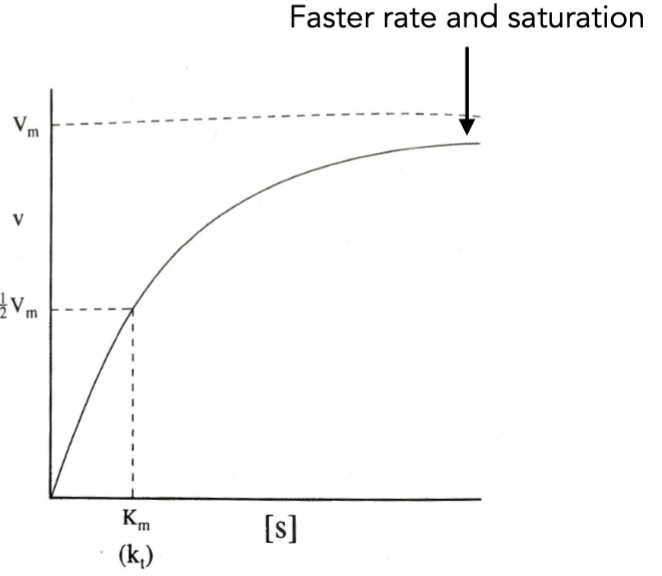
What diffusion is this?
Faciliatated diffusion
When are ABC (ATP-Binding Cassettes) used and how does this transport system work?
Used when the cell needs to move molecules from low to high concentration. There are importers and exporters (which move stuff out).
The substrate diffuses into the periplasm (area between the cytoplasm and the outer membrane)
A binding protein grabs the floating substrate in the periplasm, and this causes a conformational change
The binding protein delivers the substrate to the transporter, which hydrolyzes ATP.
ATP is broken down into ADP + Pi, providing the energy needed to transport the substrate across the inner membrane into the cytoplasm.

What are the two main jobs of the PTS (Phosphotransferase System)?
Transports glucose into the cell and phosphorylates it to G6P (for the EMP pathway).
Signals which carbon sources are available to the cell (and glucose is prioritized)
How does it ensure glucose is used first then lactose?
Glucose present → high concentrations of unphosphorylated EIIAGlc → inhibits LacY (membrane transport protein that imports lactose into the cell).
Carbon catabolite repression (CCR): more glucose available → low cAMP levels → the cAMP–CRP complex cannot activate the lac operon → fewer proteins to metabolize lactose.
What are nucleophiles and electrophiles?
Nucleophiles are electron donors → they go to positively charged atoms.
Examples: OH-, S-, NH2
Electrophiles are electron acceptors → they often have a positively charged atom. Examples: C=O, NH2+, Phosphorous of a phosphate group, H+
What happens to hydrogens on neighbouring carboxylic acids?
The carbonyl causes the hydrogen to be acidic and easily removed by a catalytic base. Therefore, the placement of carbonyls in a chemical structure is essential if a C-C bond break is required.
How to identify redox?
If oxidation number increases → oxidation (loss of electrons). Ex. NADH oxidizes to → NAD+
Which precursors are found in the EMP pathway?
glucose-6-phosphate, fructose-6-phosphate, glyceraldehyde-3-phosphate, 3-phosphoglycerate, phosphpenolpyruvate, pyruvate. (G6P, F6P, GA3P, 3PG, PEP, pyruvate)
What are the products and reactants of the EMP pathway (glycolysis) and what are the net yield for each - molecule?
1 glucose molecule → 2 pyruvate molecules. Net yield: 2 ATP and 2 NADH.
What are the 2 main goals of the first half of the EMP pathway?
2 things: Preparation for C-C bond breakage. Using ATP to phosphorylate glucose.
Why does the upper half of the EMP pathway use ATP?
Phosphorylation of a sugar alcohol is super thermodynamically uphill. The first half has no oxidation step or high-energy intermediates.
How does the EMP pathway set up the C-C break?
2 ATP dependent phosphorylations + isomerization.
Glucose → G6P → F6P → F-1,6BP
So that F-1,6BP can be split by aldolase into GA3P + DHAP.
How to turn DHAP → GA3P?
Using the triose phosphate isomerase enzyme. To move the C=O bond on DHAP to make aldehyde (GA3P).
Why does the lower half of the EMP pathway use inorganic phosphate?
GA3P gets oxidized + coupled to phosphorylation → 1,3-BPG which has an inorganic phosphate that is transferred to ADP → ATP.
What is the main goal of the second half of the the EMP pathway?
Recover energy by converting GA3P → pyruvate. 1 glucose makes 2 GA3-P, so this half runs twice. 4 ATP are generated, but minus the 2 ATP used in the first part, so the net gain = 2 ATP.
Why do cells keep some reactions in close to equilibrium?
For flexibility and efficiency! Near-equilibrium reactions means its easily reversible, requires little enzyme to proceed in either direction, quick reactions and prevents any futile cycling!
Which reactions are physiologically irreversible and what enzymes used?
Glucose → G3P (Hexokinase/PTS)
F6P → F1,6BP (Phosphofructokinase (PFK))
PEP → Pyruvate (Pyruvate kinase)
All the phosphorylation reactions have very negative free-energy changes.
Allosteric regulation of glycolysis
Via 2 molecules:
PFK: F6P + ATP → F1,6BP + ADP. This enzyme is regulated by 2 molecules: PEP and ADP. High ADP concentrations activate the enzyme, while PEP inhibits it.
Pyruvate kinase: PEP + ADP → pyruvate + ATP. F6P is a precursor activator of this enzyme; when F6P levels are high, it signals that the reaction is moving too slowly and activates the enzyme.
What is gluconeogenesis?
Synthesis of glucose from non-carbohydrate precursors. Cannot just run glycolysis backward.
How does gluconeogenesis bypass the irreversible pyruvate kinase enzyme and why can’t it simply run the reaction in reverse?
In glycolysis: PEP + ADP → Pyruvate + ATP. The reverse reaction is way too unfavorable.
In gluconeogenesis, there are 2 ways:
Using pyruvate carboxylase coupled to PEP carboxykinase. Carboxylation and decarboxylation.
Pyruvate + CO2 → Oxaloacetate → PEP + CO2.
PEP Synthetase: Pyruvate + ATP + H2O → PEP + AMP + Pi.
Costs 2 ATP equivalents to turn it into AMP; this extra energy helps convert pyruvate → PEP (otherwise super unfavorable).

How does gluconeogenesis bypass the irreversible PFK enzyme and why can’t we just run the reaction in reverse?
Glycolysis: F6P + ATP → F1,6BP + ADP; the reverse is highly unfavorable.
Gluconeogenesis: using Fructose-1,6-bisphosphatase (FBPase-1).
ADP activates PFK, and hydrolysis removes the inorganic phosphate.
F1,6BP + H2O → F6P + Pi

How is gluconeogenesis allosterically regulated? How are the bypass enzymes controlled?
PEP carboxykinase: inhibited by ADP and PEP.
PEP Synthetase: inhibited by PEP, ADP, and AMP.
FBPase-1: inhibited by AMP.
Not every organism uses the classic EMP pathway. For example: Pyrococcus furiosus
Instead of:
GA3P → 1,3-BPG → 3-PG
via Triose phosphate Dehydrogenase.
Uses Glyceraldehyde-3-phosphate: ferredoxin oxidoreductase (GAPOR) and no ATP-producing step.
GA3P → Phosphoglycerate → Reduced ferredoxin
How does reduced ferredoxin generate ATP?
Reduced ferredoxin reduces H+ → H2 and couples it to pumping protons out of the cell to generate a PMF.
Products and reactants of the Entner Doudoroff (ED) pathway? And what are differenced between ED and EMP?
Both pathways convert 1 glucose molecule to 2 pyruvate molecules. But the ED pathway has a net of 1 ATP, 1 NADPH and 1 NADH molecules. While EMP pathway has net gain of 2 ATP and 2 NADH molecules.
What is a 14C tracer and how do studies distinguish ED from EMP?
14C tracer is a radioactive carbon atom that tracks where glucose ends up in the products of a reaction. ED and EMP pathways split the C-C differently.
ED pathway: 6C splits into 1 pyruvate and 1 GA3P. Tracer on pyruvate’s C1.
EMP pathway: 6C splits into 2 GA3P molecules. Tracer on pyruvate’s C3.

What essential metabolite does the EMP pathway produce that the ED pathway does not?
Fructose-6-phosphate (F6P)
What are the two “signature” enzymes for this pathway and what are their functions?
6-phosphogluconate dehydratase (EDD) - Dehydrates Gluconate-6-P → KDPG + H2O. Makes a C-beta-keto group, which allows for a C-C split.
KDPG aldolase cleaves KDPG → Pyruvate + GA3P.
Why is the ED pathway is more common than EMP in aerobic than anaerobic organisms?
ED makes 1 less ATP but requires fewer catabolic enzymes, so it is more energetically favorable and requires fewer resources to synthesize enzymes. Aerobic molecules are able to generate more ATP, so they can afford this energy-saving pathway.
What are the products and reactants of the pentose phosphate pathway?
Glucose → GA3P + 3CO2. Mostly supplies NADPH, Ribose-5-phosphate (R5P) and Erythose-4-P. (E4P).
How does phosphoglucoisomerase help the PPP?
Converts Fructose 6-P to Glucose 6-P (reversible). PPP makes intermediates that can be rearranged to F6P and GA3P, so PGI allows carbon to be recycled back to G6P. The link between PPP and EMP.
What are all the essential precursors found in the PPP pathway?
Ribose-5-P, Erythose-4-P, G3AP, F6P.
What happens in the first part of the PPP?
Oxidative decarboxylation:
G6P + NADP+ is oxidized by Glucose-6-dehydrogenase → 6-P-gluconolactone + NADPH.
Gluconolactone undergos hydrolysis by lactonase → Gluconate-6P
Gluconate-6P +NADP+ undergoes another oxidation/decarboxylation → Ribulose-5P + NADPH + CO2
What happens in the second part of the PPP pathway?
Isomerizations: PPP converts Ribulose-5-Phosphate → 5C sugars via 2 enzymes. Phosphopentose isomerase converts Ru5P → ribose-5-phosphate. (changes atom arrangement)
Phosphopentose epimerase converts Ru5P → xylulose-5-phosphate (changes the configuration at one stereocenter)

What happens in the final step of the PPP pathway? (non-oxidative)
Rearrangements via 2 important enzymes that trabsfer carbon units onto aldehydes:
Transketolase: transfers 2-carbon units.
Transaldolase: transfers 2-carbon units.

Why does the transketolase enzyme require the TPP cofactor?
TPP stabilizes the reactive carbon intermediate in the reaction.
How does the transadolase mechanism work? What is it similar to?
Similar to the C-C bond break in the ED and EMP pathway, where the bond break occurs before the 3-C unit is transferred. A catalytic serine is required.
How does the cell control carbon flow using the PPP, EMP, ED, and gluconeogenesis?
If more R5P is needed than NADPH: non-oxidative pathway. (first part of EMP) G6P → F6P → F1,6P → 2x GA3P → (via PPP) R5P
If both NADPH and R5P are equally needed: enter the oxidative PPP. G6P → Gluconate-6-P → Ru5P → R5P
If more NADPH is needed than R5P: enter the oxidative PPP to make NADPH and R5P, then enter the non-oxidative PPP to make GA3P and F6P to recycle into glucose-6-P and run oxidative again.

What happens in the TCA cycle?
Acetyl-CoA gets converted to 2CO2.
Which 3 enzymes convert pyruvate to acetyl-CoA? What products + reducing power do they generate alongside Acetyl-CoA? What kind of cells are they normally found in?
Pyruvate dehydrogenase: CO2 + NADH, found in aerobic cells.
Pyruvate formate: Formate (no reducing power), found in anaerobic cells.
Pyruvate ferredoxin: CO2 + reduced ferredoxin, found in anaerobic cells.
How to initiate the TCA cycle?
Condensation reaction using the citrate synthase enzyme: oxaloacetate + acetyl-CoA → citrate.
How does the TCA cycle set up 2 decarboxlyation reactions?
Citrate is rearranged (using aconitase) → isocitrate is oxidized + NADP+(isocitrate dehydrogenase) → oxalosuccinate decarboxylation + NADPH (isocitrate dehydrogenase) → α-ketoglutarate + CO2
NADP+ + α-ketoglutarate (stabilized by TPP) is decarboxylated by α-KG-dehydrogenase → succinyl-CoA + NADPH + CO2
The second decarboxylation is similar to pyruvate dehydrogenase (both using TPP)
What are the two ways TCA cycle can be run?
Oxidative TCA cycle for aerobic growth:
E. coli runs the TCA cycle as a complete cycle. Acetyl-CoA is oxidized; 2 CO2 are released per acetyl-CoA, producing 1 ATP, 3 NADH, and 1 FADH2, and regenerating oxaloacetate.
Branched TCA cycle for anaerobic growth:
Runs half of the oxidative branch and half of the reductive branch.
Oxidative branch: Acetyl-CoA → citrate → isocitrate → α-ketoglutarate
Reductive branch: PEP → oxaloacetate → malate → fumurate → succinate + succinyl-CoA
What enzymatic changes allow for the “horseshoe” pathway of the TCA cycle?
Pyruvate formate-lyase (PFL) catalyzes: pyruvate + CoA → acetyl-CoA + formate.
PEP carboxylase catalyzes: PEP + CO2 → oxaloacetate.
Using reducing power rather than the oxidative version, fumarate reductase reduces fumarate → succinate

Why does the cell still run part of the oxidative pathway when growing anaerobically?
The TCA pathway still needs to make the essential precursors: α-Ketoglutarate (α-KG) and succinyl-CoA
What are anaplerotic reactions?
Reactions that replenish intermediates that have been removed from the central metabolic pathways to make other molecules that the cell needs.
How the cell use anaplerotic reactions to replenish oxaloacetate pools?
PEP carboxylase: PEP + bicarbonate → OAA + phosphate.
Pyruvate carboxylase: pyruvate + bicarbonate → ATP + OAA + ADP + phosphate
How is PEP carboxylase regulated?
Allosterically regulated by OAA. OAA is not chemically stable; it can spontaneously decarboxylate and is stored in the cell as L-aspartate.
Higher concentrations of aspartate signal to PEP carboxylase that OAA is probably already abundant → deactivates PEP carboxylase.
Higher concentrations of acetyl-CoA signal that more carbon is able to enter the cycle → activates PEP carboxylase.
Higher concentrations of Fructose-1,6-bisphosphate (F1,6BP) activate PEP carboxylase.

What is in the glyoxylate cycle?
Alternative pathway from the TCA cycle to break down acetyl-CoA. Used when the cell is growing on acetate as its carbon source. Acetate is 2C, so if it enters the TCA cycle (2 decarboxylation reactions), it loses both carbons. The glyoxylate cycle conserves carbon by bypassing these reactions.
What are the two signature enzymes used in the glyoxylate cycle?
Isocitrate lyase: isocitrate → succinate + glyoxylate.
Otherwise, isocitrate → aKG + CO2Malate synthase: glyoxylate + acetyl-CoA → malate.
Then malate → OAA, which allows the cycle to continue.

How is the glyoxylate cycle regulated? What enzyme controls this? What enzymes control the enzyme?
The key is isocitrate! Can either go through isocitrate dehydrogenase (TCA cycle) or lyase (glyoxylate). Isocitrate dehydrogenase must be regulated via… phosphorylation.
IDH phosphorylated: inactive → glyoxylate cycle.
IDH dephosphorylated: active → TCA cycle.
IDH regulated by:
High concentrations of pyruvate → IDH Kinase (phosphorylates/inactivate).
High concentrations of AMP → IDH Phosphatase (dephosphorylates/activates).
What is the goal of the catabolism of acetate?
Acetate → acetyl-CoA so that it can enter the TCA cycle.
What are the two possible pathways for the catabolism of acetate?
Acetate kinase (ACK) → (PTA): used when acetate concentrations are high.
Acetate + ATP → Acetyl-Phosphate + ADP + CoA → Acetyl-CoA.
Acetyl-CoA Synthetase (ACS): used when acetate concentrations are low because it activates Acetate to make acetyl-AMP, and ATP cleavage and PPi hydrolysis push the reaction forward.
Acetate + CoA + ATP → Acetyl-AMP → Acetyl-CoA + AMP + PPi

How does β-oxidation of fatty acids → acetyl-CoA work?
Chemistry at the β-carbon. Oxidation → hydrolysis → oxidation → split/thiolysis until everything gets converted to acetyl-CoA. Similar to TCA cycle where succinate → fumurate → malate → OAA. (Oxidation → hydrolysis → oxidation)
What is the result of β-oxidation of odd number fatty acid chains?
β-oxidation removes two-carbon units, but with an odd number of carbons, the final fragment is 3C → propionyl-CoA. This is toxic for Gram-positive organisms.
What are the 3 dominant pathways to detoxify propionyl-CoA?
The methylmalonyl-CoA pathway: propionyl-CoA → methylmalonyl-CoA → Succinyl-CoA, which enters the TCA cycle.
The acrylyl pathway: propionyl-CoA → acrylyl-CoA → pyruvate → central metabolism.
The methylcitrate cycle: propionyl-CoA → pyruvate
What is the main purpose and net reaction of the Calvin cycle?
Let organisms use inorganic carbon (CO2) to make organic molecules. 3CO2 + 1GA3P. (Quite energetically expensive)
What are the three stages of the Calvin Cycle?
CO2 fixation: RuBisCO attaches 1CO2 to RuBP and this 6C molecule immediately splits → 2 molecules of 3-PGA. (So if 3CO2 → 6 molecules of 3-PGA)
Reduction: 6 molecules of 3-PGA → 6 molecules of GA3P using ATP (providing energy and phosphate) and NADPH (providing electrons). Only 1 GA3P molecule leaves as the product.
Regeneration: Remaining 6 molecules of GA3P → regenerate 3 RuBP molecules to fix more CO₂.