Chapter 9
 Call Kai
 Learn
Learn Practice Test
 Spaced Repetition
 Match
Match Flashcards
 Knowt Play
1/67

There's no tags or description
Looks like no tags are added yet.
Name | Mastery | Learn | Test | Matching | Spaced | Call with Kai | Chat |
|---|
No analytics yet
Send a link to your students to track their progress
68 Terms
order of bases, 3-D conformation of backbone, supercoiling of the molecule
Name the primary, secondary, and tertiary structure of Nucleic acids
ribosomes
the sites of protein synthesis in all organisms consisting of RNA and protein
nucleotides
monomers of nucleic acids, purine or pyrimidine bases bound to sugars (ribose or deoxyribose) which in turn are bonded to phosphate groups (base, sugar, phosphate group)
nucleic acid bases
nitrogen containing aromatic compounds that make up the coding portion of nucleic acids
pyrimidine bases
nitrogen containing aromatic compounds that make up the coding portion of nucleic acids (Cytosine and thymine)
purine bases
N-containing aromatic compounds that contain a 6-membered ring, parent compounds of several nucleobases (Adenine and Guanine)
unusual bases
bases with different structures typically modified by methylation commonly found in t-RNA
nucleoside
purine or pyrimidine base bonded to a sugar (ribose or deoxyribose) with NO phosphate group

ribonucleoside
compound formed when a nucleobase forms a glycosidic bond with ribose (beta- D- ribose)

deoxyribonucleoside
compound formed with a nucleobase forms a glycosidic bond with ribose
3’ 5’ phosphodiester bond
a covalent linkage in which phosphoric acid is esterified to the 3’ hydroxy; of one nucleoside and the 5’ hydroxy; of another nucleoside; it forms the backbone of nucleic acid
deoxyribose lacks the 2’ OH unlike ribose
only RNA uses Uracil
some RNA has thymine
how does DNA structure differ from RNA
left, 5’, right, 3’
If p (phosphate) is to the ___ of the base letter like (pA) then it is a ___ nucleotide and to the ___ is a ___ nucleotide
Double helix
2 polynucleotide chains wrapped around each other, the fundamental structural motif of DNA
amount of A in DNA must be = to T and C to G because of complementary base pairing since one must always bind to the other the amounts must be equal
what is Chargaff’s rule
antiparallel, complementary
sugar phosphate backbone of each chain run in _____ directions (one 3’ to 5’ and the other 5’ to 3’). And because bases are complementary ____ must be complementary as well
3
how many H-bonds are between adenine and thymine
3
How many h-bonds are between cytosine and guanine
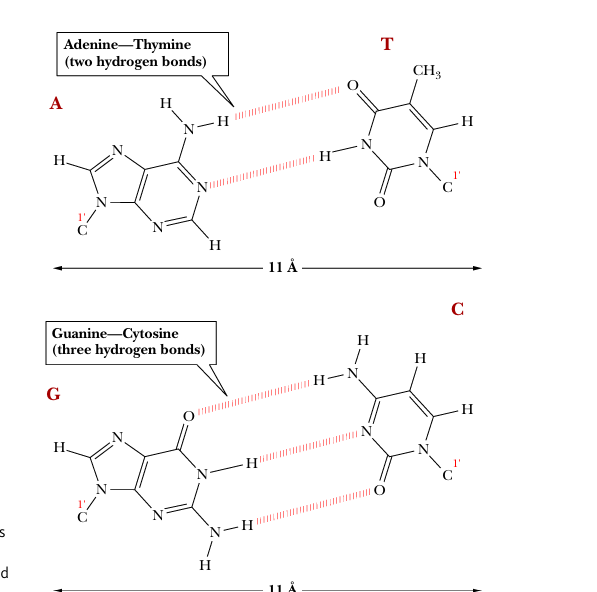
11 Armstrong (1.1nm)
the inside diameter of the sugar phosphate backbone of the double helix as well as distance between complementary bases (AT and CG) is _____
backbone may bulge
What happens to the backbone when noncomplementary base pairing occurs(AC or GT)
34 armstrong (3.4nm) and 10 base pairs
what’s the length of one complete turn of helix along axis

major groove
the larger of 2 empty spaces in an imaginary cylinder that encloses the DNA double helix (22A)

minor groove
the smaller of the 2 empty spaces in an imaginary cylinder that encloses the DNA double helix (12A)

B-DNA
most common form of DNA helix (right handed)

A-DNA
form of DNA double helix characterized by having fewer residues per turn and major/minor grooves with dimensions that are more similar to each other than of B-DNA
11 base pairs per tern
bases 20 degree perp to helix axis compared to 90 perp for B-DNA
right handed
found in dehydrated DNA samples or RNA/DNA hybrids

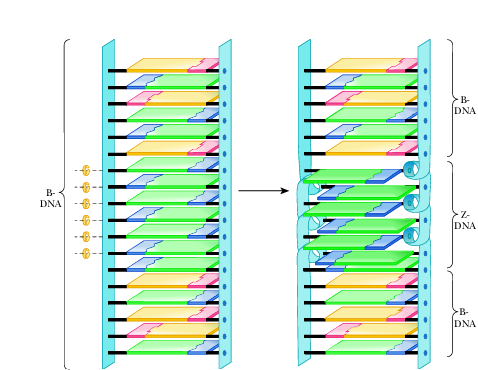
Z-DNA
a form of DNA that is left-handed helix which has been seen to occur naturally under certain circumstances
found in alternating purine-pyrimidine (CGCGCG)
found in sequences with C methylated at numbers 5 position of pyrimidine ring
can become B form by flipping 180 degrees without breaking backbone or H-bond
base stacking
interactions between bases that are next to each other in DNA chain
bases can also slide sideways allowing for between contact with bases aove and below them on the same chain
ring potions are hydrophobic and interact with each other vis van der waals
base, overlap, minor
B-DNA is optimal for ___ pairing but not for maximal ____. Because bases in the ___ groove are exposed/ come in contact with water

propeller twist
base pairing less optimal but overlap from base stacking is. It also eliminates contact in the minor groove with water
Step
dinucleotide pair + complementary bases
Ex) AG/CT has a different structure than GC/GC
supercoils
extra twists (over and above the double helix) in closed circular DNA
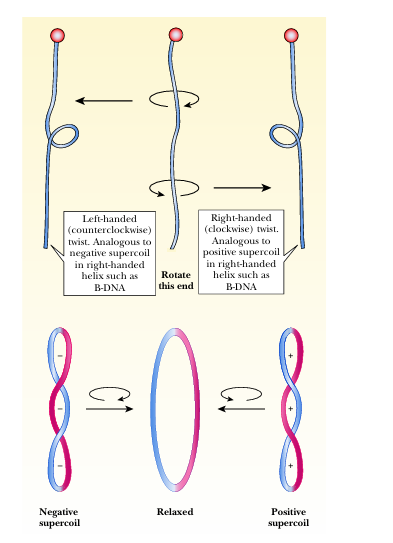
negative supercoils
circular DNA with fewer than the normal number of turns of the helix (counterclockwise)
positive supercoils
circular DNA with more than the normal number of turns in the helix (clockwise)
topoisomerases
enzymes that relax supercoiling in closed circular DNA
Class I topoisomerases
cut phosphodiester backbone of 1 strand of DNA, ass the other end through and then reseal backbone
Class II topoisomerase
cut both strands of DNA, pass some of the remaining DNA helix between the cut ends and then resealD
DNA Gyrase
bacterial topoisomerases that introduces supercoiling into closed circular DNA
positive charged side chains on proteins (like Histones) and negatively charged groups of DNA at pH 7 allow for electrostatic interactions that favor the form of complexes
How does supercoiling take place in Eukaryotic DNA
chromatin
a complex of DNA and protein found in the Eukaryotic nucleus
histones
basic proteins found complexed to eukaryotic DNA (help form chromatin)
nucleosome
a globular structure in chromatin in which DNA is wrapped around an aggregate of histone molecules or core
150 base pairs of DNA in contact
protein core
octamer; contains 2 molecules of each histone EXCEPT H1 (H2A, A2B, H3, H4)
H-bonds between complementary bases
stacking of bases in native confirmation of DNA (largest contributor to stabilization)
For DNA to be denatured what must break
melting
heat denaturization of DNA
hyperchromicity
bases once stacked on top of each other in native DNA become unstacked as DNA denatures causes the bases to become more exposed they still absorb the same wavelengths (260nm) of light just MORE of it
amount of G/C vs A/T pairs
G/C has 3 H-bonds which takes more energy to break than the 2 A/T has as a result if the DNA has more G/C pairs it will take more heat to denature
aromatic ring shapes allow the pi clouds from base stacking to overlap more efficiently= more van der waals interactions
what effects melting point of DNA
transcription
order of bases passed from DNA to RNA (mRNA)
translation
process of protein synthesis which the amino acid sequence of the mRNA codes for a protein
prokaryotes: no nuclear membrane= transcription and translation can happen at the same time
eukaryotes: mRNA synthesized in the nucleus and undergoes processing including splicing out introns so that the expressible parts (exons) are next to each other
explain how and where transcription and translation occur in prokaryotes and eukaryotes
RNA interferece
a process where short pieces of RNA effect gene expression

transfer RNA (tRNA)
transports AA’s to site of protein synthesis (reads 3 bases at a time)
single polypeptide chain folded over
intrachain bonding between AU and GC
secondary structure= cloverleaf
stems
H-bonded portions of the molecule
leafs
non- H-bonded portions of the molecule
protein synthesis
both tRNA and mRNA are bound to the ribosome

L-shaped confirmation
tertiary structure needed for tRNA to interact with the enzyme that covalently attaches the AA to the 2’ or 3’ end
CAA
tRNA nucleotidyl transferase adds sequence ___ to 3’ end without it the molecule can’t pick up the correct amino acid or will degrade the molecule if it has structural deficiencies
Ribosomal RNA (rRNA)
combines with proteins to form ribosomes, the site of protein synthesis
small and large subunit
small: 1 large RNA molecules and around 20 different proteins
large subunit: 2 RNA molecules and around 35 different proteins in prokaryotes and 50 in eukaryotes
sedimentation coefficient (S)
S value increases with the molecular weight of the sedementing particle (not totally directly proportional)
messenger RNA (mRNA)
sequence of bases in mRNA that specify the order of AAs in proteins
formed when needed—> direct protein synthesis—> degrade afterwards and nucleotides recycled h
heterogenous RNA (hnRNA)
eukaryotic RNA that is initially produced by transcribing DNA, contains intervening sequences that do not code for proteins
introns
intervening sequences in DNA that do not appear in the final sequence of mRNA
small nuclear RNA (snRNA)
processes initial mRNA to its mature form in eukaryotes (only found in nucleus)
small nuclear ribonucleoprotein particles (snRNPs)
snRNA + protein= protein/ RNA complex found in the nucleus that aid in processing mRNA molecules for export to cytosol
small interfering RNA (siRNA)
affects gene expression; used by scientists to knock out a gene being studied
binds to mRNA and cleaves it
20-30 nucleotides
used in RNA interference
antisense RNA
short piece of RNA complementary to the mRNA produced by a gene of interest and keeps mRNA from being translated and eventually degraded by a nonspecific nuclease (RNase)
micro RNA
affects gene expression important to growth and development
bind to mRNA to prevent translation
Long noncoding RNA
do not code for protein, function still under debate but appears to affect development and be related to certain disease states
CRISPR
clustered regularly interspaced short palindromic repeats repetitive structures of DNA found in bacteria and archaea
uses proteins that are guided to a specific DNA sequence and then cut the DNA into 2
uses short-stranded RNA from invading organism to targe invader DNA