Ch 3: Birth to 2 years
 Call Kai
 Learn
Learn Practice Test
 Spaced Repetition
 Match
Match Flashcards
 Knowt Play
1/55

There's no tags or description
Looks like no tags are added yet.
Name | Mastery | Learn | Test | Matching | Spaced | Call with Kai | Chat |
|---|
No analytics yet
Send a link to your students to track their progress
56 Terms
Physical changes
Most physical change in first two years (aside from prental)
During infancy: 1 inch/ month
At 2 (females) or 2.5 (males), toddlers are half as tall as they will be as adults
Two yr olds have much larger heads that adults (nearly full sized brains)
Irregular growth could be indication of health/ nutritional issues, require intervention
Sudden unexpected infant death (SUID)
Occurs when infant under one year of age dies unexpectedly, often while asleep, and there is an identifiable cause of death (eg suffication)
Sudden infant death syndrome (SIDS)
There is no identifiable cause of death
What is recommended to parents as a way to reduce SUIDS risk (mainly suffocation)
ABC method
(Alone, back, crib)
First six months, infants are fed
Human milk
Infant formula
Combination of both
Feeding after 6 months
Infants introduced to solid foods around 6 months (depending on physical development, cultural norms, overall readiness)
Still fed frequently in first year but typically can eat enough is single sitting to eat only three meals
Brain/ nervous system development during first two years
Midbrain and medulla (regulate vital functions) are most fully developed at birth
Least developed part is cortex (perception, body movement, thinking, language)
Synaptogenesis
Creation of synapses, followed by a period of synaptic pruning to make brain more efficient
One year old’s synapsis
Has denser dendrites and synapses than adult does, enabling brain to reorganize neural pathways and connections in response to experience (neuroplasticity)
Network operates far less efficiently than that of the adult
Myelination
Myelin gradually covers individual axons and electrically insulates them from one another, improving the conductivity of the nerve
Biological process of wrapping nerve fibres (axons) in a fatty, protective coating called a myelin sheath to speed up electrical signal transmission
Myelination is most rapid during first two years after birth, continues throughout childhood/ adolescence
What part of the brain isn’t fully myelinated until mid 20s
Reticular formation (regulates formation)
Adaptive reflexes
Such as sucking, helping newborns survive
Some disappear in infancy/ childhood
Others persist throughout life
Eye blink reflex
Shine bright light at eyes/ clap near head
Quickly closed eyelids
Permanent
Protects infant from strong stimulation
Rooting reflex
Stroke cheek near corner of mouth
Head turns towards source
Lost at 3 weeks
Helps infant find the nipple
Sucking reflex
Place finger in infants mouth
Infant sucks rhythmically
Lost at 4 months
Permits feeding
Swimming reflex
Place infant face down in pool of water
Infant paddles and kicks in swimming motion
Lost at 4-6 months
Helps with survival if dropped into water
Moro reflex
Hold infant on back and let head drop slightly or produce a loud sound against supporting surface
Infant makes “embracing” motion by arching back, extending legs, and throwing arms outward then bringing arms in
Lost at 6 months
May have helped infant cling to mother in past
Palmer grasp reflex
Place finger in infants hand and press on palm
Spontaneous grasp of finger
Loss at 3-4 months
Prepares infant for voluntary reaching
Tonic neck
Turn infants head to one side while infant is lying awake on back
Infant takes a “fencing position” one arm extended in front of eyes and the other is flexed
Lost at 4 months
Prepares infant for voluntary reaching
Acquisition of motor skills depends on
Brain development and substantial changes in other body systems
Physical development proceeds from … and from …
Head downward (cephalocaudal pattern)
Centre of body outward (proximodistal pattern)
Motor development
Locomotor skills (gross motion): lifting head, rolling, crawling, walking
Nonlocomotor skills: controlling head movements
Manipulative skills (fine motor)
Wide variability within and between cultural settings
First month motor skills
Locomotion → stepping reflex
Nonlocomotion → lifts head slightly
Manipulative → holds object if placed in hand
Month 2-3 motor skills
Non locomotor→ lifts head 90 degrees when on stomach
Manipulative→ swipe at objects in sight
Month 4-6 motor skills
Locomotor→ rolls over, moves on hands/knees (creeps)
Nonlocomotor→ holds head erect while sat
Manipulative→ reaches for/ grasps objects
Month 7-9 motor skills
Locomotor→ sits without support, crawls
Manipulative→ transfer objects between hands
Preterm infants
Born before 37 weeks
Preterm/ low birth weight may move more slowly through developmental milestones
Catches up by two or three
Visual acuity
How well one can see details at a distance
VA of newborn is 40x worse than normal sighted adult
By 6 months, only 8x worse
Develops rapidly during the first year as a result of synaptogenesis, pruning, myelination
Tracking
Process of following a moving object
Integral to object recognition
Colour vision
Red, green and blue present by 1 month
Infant’s ability to sense colour is almost identical to an adult’s
Depth perception
Ability to perceive whether objets are nearer or farther away than other objects
Not present at birth
When does depth perception develop
Over first months with acquisition of binocular vision
Eleanor Gibson and RD Walk
Studied infant perception using a “visual cliff”
Determine when infants developed depth perception
Development of depth perception involves 3 cues
Binocular cues
Monocular cues
Kinetic cues
Binocular Cues
Involves both eyes; each eye receives a slightly different image of an object
Used to determine distance
Used beginning at 4 months
Monocular Cues
Input from one eye
Interposition: one object is in front of another
Linear perspective: lines get closer together as they get farther away than other
Used last, perhaps at 5-7 months
Kinetic cues
Come from your own motion/ motion of some object
3 month
Auditory acuity
Newborns hear nearly as well as adults do
High pitched noises need to be loud to be heard
Can locate direction of some sounds at birth
Smelling and tasting
Smell has nearly unlimited variations
Newborns react differently to each basic taste
Touch and motion
Best developed of all senses
Responsive to gentle social touching, important in early brain development
Intermodel perception
Ability to integrate info from two or more sensory modalities into a coherent/ holistic experience of a single event or object
Discriminating speech sounds
1 month: discriminate between single syllables (pa vs ba)
6 months: between two syllable words (bada vs baga)
Babies can distinguish sound contrasts in any language but at 6 months this ability begins to fade
Discriminating individual voices
Newborns can discriminate mother’s voice from another female, but not father’s from another male
Mother’s voice is preferred
Babies learn this in utero
Discriminating other sound patterns
Babies recognize melody patterns by 6 months
Piaget and the first two years
Sensorimotor stage (infants use info from senses and motor actions to learn about the world)
Primary, secondary, and tertiary circular reactions: infant progressively gain experience of himself and his surroundings
By 18-24 months infant has the beginnings of mental representation
Assimilation
Info from environment fits with what you already know
Accommodation
Occurs when you change/ accommodate your understanding because it does not fit into an existing schema
Substages of sensorimotor development
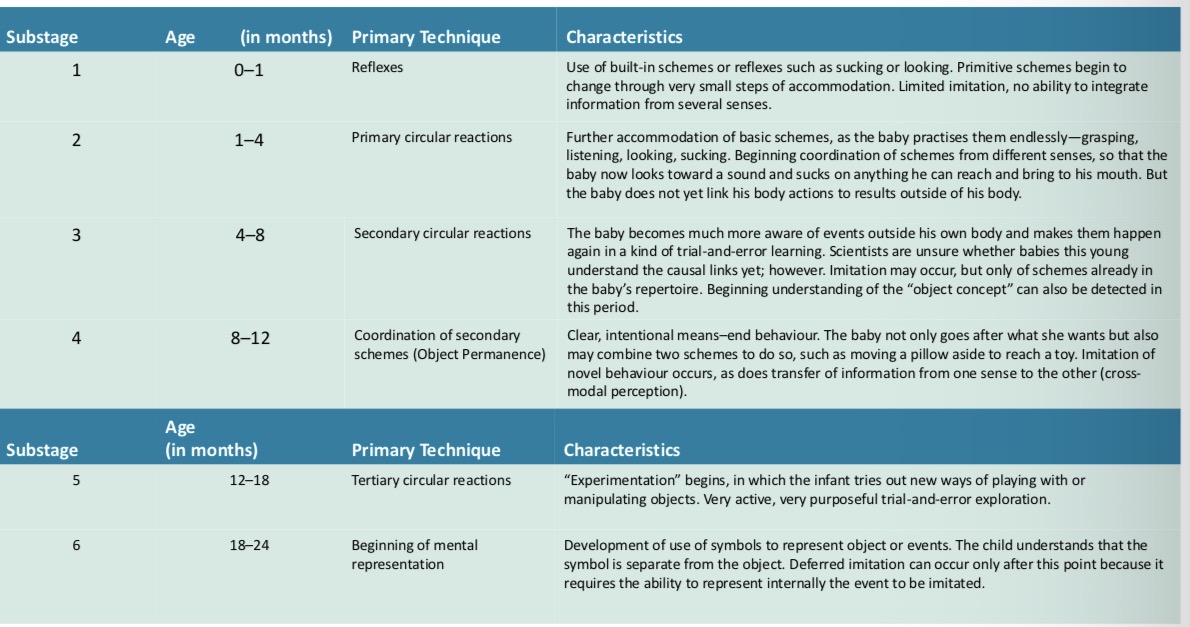
Object permanence
2 month olds are surprised when object disappears
6-8 month olds start looking (if partially hidden)
8-12 months reaching for a toy that is completely hidden
Corresponds with infants beginning to show signs of distress when caregivers leave
Piaget’s view of imitation
Infants capable of imitating actions such as hand gestures in first few months
Imitation of facial gestures around 8-12 months
Deferred imitation not possible until 18-24 months
Contemporary research on imitation
Newborns will imitate facial gestures (when observed for one minute or longer)
Infants as young as 6 weeks can defer their imitation for a few mins
Limitations to Piaget’s view
Underestimated cognitive capacities of infants
Perhaps equated lack of physical capacity with lack of cognitive understanding
Babies as young as 4 mo show object permanence
Most 5 mo look to other side of screen when moving object disappears behind it (hold mental representations)
Imitations of facial gestures and defered imitation earlier
Sustained attention
Capacity to hold our attention to stimulus/ task
Improves substantially over first year, and continue into early childhood
At 4 mo we see capacities for controlling attention and shifting focus to begin
Memory
Development requires both development of cognitive skills and language
Results from “mobile task” studies show us that implicit memory is present in infancy
Explicit memory takes more time to develop (why we cant remember much of our earliest years)
Language development in first two years

Language/cognitive development based on Lev Vygotsky’s work (sociocultural theory of development)
Social speech (ec child’s teacher talking through task) supports development of problem solving and decision making capacities
Evident when we hear children engage in ego centric speech (talking to themselves)
Also learn through observation/ social referencing to know how to respond to act in certain situations