Gen Chem Midterm #2
 Call Kai
 Learn
 Practice Test
 Spaced Repetition
 Match
 Flashcards
 Knowt Play
1/71

There's no tags or description
Looks like no tags are added yet.
72 Terms
l =
n-1
s shape
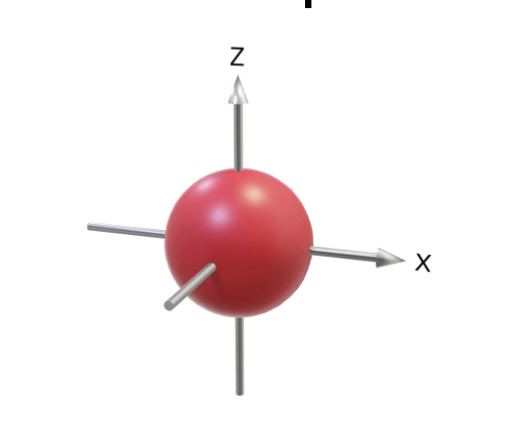
p shape

d shape

ml
-l ~ l
shielding
electrons that are closer to the nucleus “cancel out” nuclear charge for electrons further away (symbol = S)
Zeff
effective nuclear charge
Maximum value of Z (no shielding) and minimum of 1 (complete shielding)
Aufbau Principle
Electrons tend to fill atomic orbitals of the lowest available energy before occupying higher energy levels
Minimize energy of atom → most stable configuration, ground stat
Pauli Exclusion Principle
No two electrons in an atom can have the same set of four quantum numbers
Hund’s Rules
When degenerate orbitals are available, electrons singly occupy orbitals before occupying them together
Maximize number of unpaired electrons
Lowest energy configuration is the one with parallel spins (unpaired electrons have same ms)
Violating Aufbau principle and/or Hund’s rule…
gives an excited state electron configuration
number of degenerate orbitals
2l+1
number of radial nodes
n-l-1
number of nodes
n-1
larger Zeff means…
electrons are closer to nucleus in orbital of lower energy (larger negative values)
smaller Zeff means…
electrons are further from the nucleus in orbital of higher energy (smaller negative values)
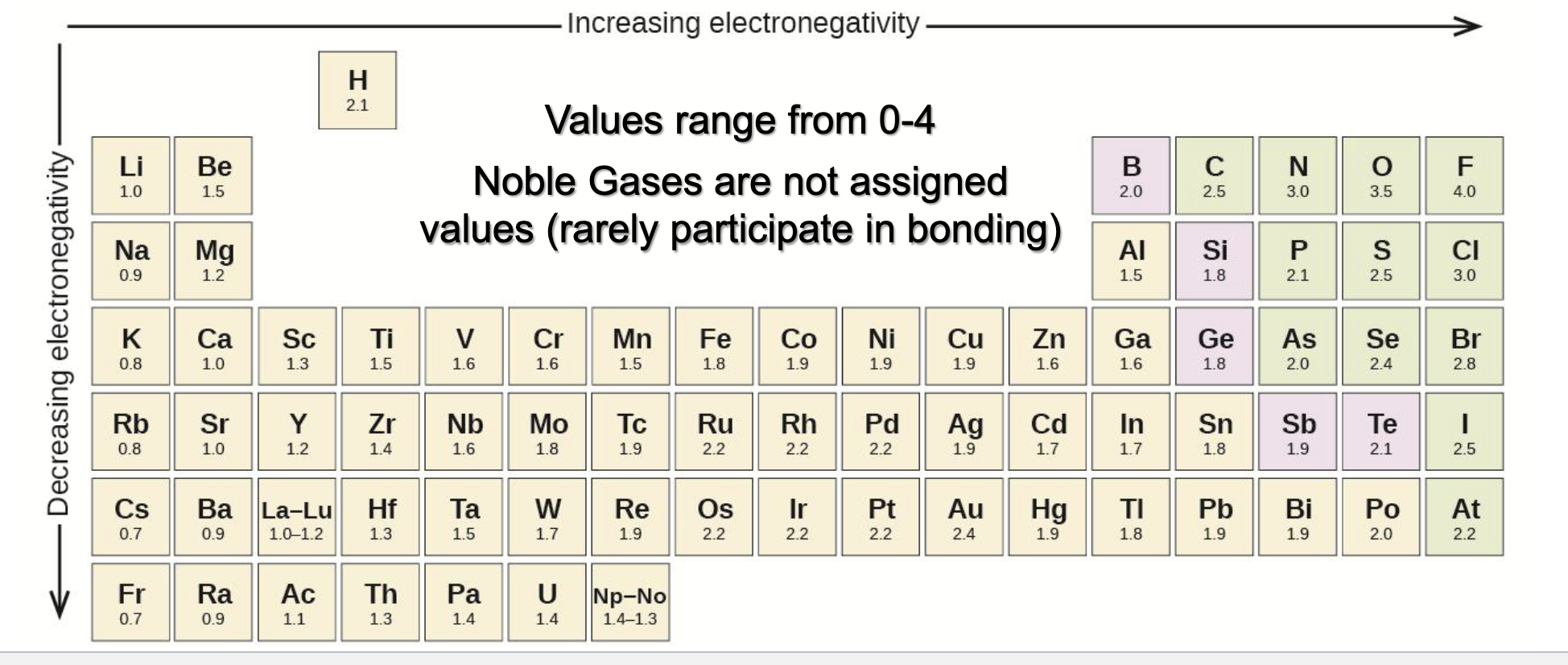
electronegativity periodic table
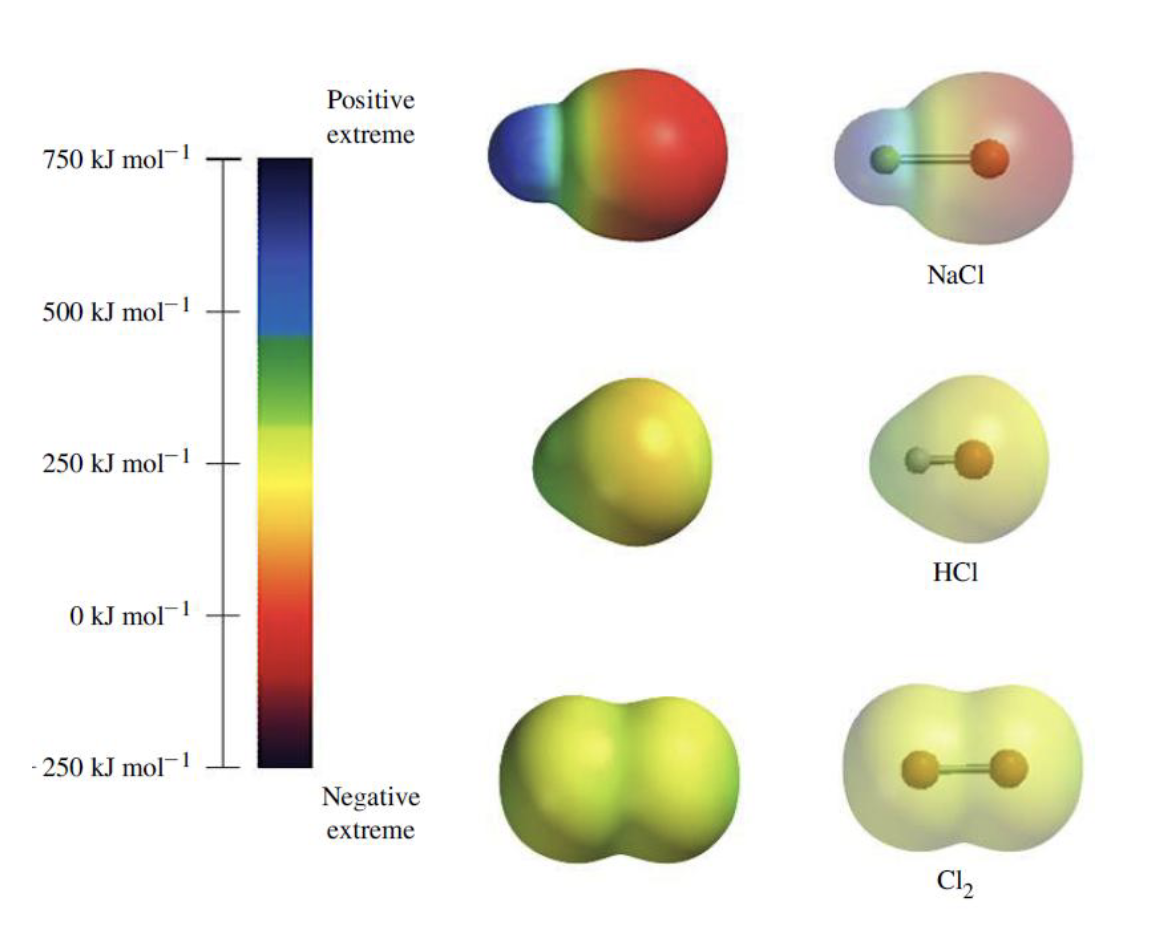
ionic
polar covalent
covalent
atoms that form covalent bonds
non-metals
atoms that form ionic bonds
TYPICALLY metal cations + non-metal anions
formal charge
#valence shell electrons (free atom) − # lone pair electrons − ½ # bonding electrons
total formal charge
sum of formal charges of all atoms = 0
equal to charge in ions
blackbody
perfect absorber of all electromagnetic radiation; emit radiation in characteristic continuous spectra dependent only on temperature
increasing temperature —> horter wavelength

energy of a quantum of electromagnetic radiation (photon)
quantum of energy → discrete, discontinuous amounts of energy
photoelectric effect
ejection of electrons from surface of a substance (metal) by light
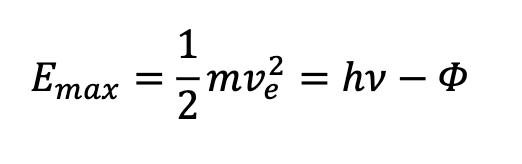
kinetic energy of emitted electron (m = mass of electron, v = velocity)

threshold energy for ejection of electrons (v0 = minimum speed of incoming photon)
frequency vs. intensity
freq. = energy; inten. = amplitude
photoelectron emission microscopy (PEEM)
uses local variations in electron emission to generate image contrast (differene in work function, density of electrons, etc.)
frequency vs. velocity symbol
freq: 𝜈
velocity: v (ve)
De Broglie waves
small particles of matter may at times display wave-like properties
for particles with momentum (p)

de broglie (p = momentum)
wave-particle duality
light and small particles behaves as waves in some experiments and particles in others
Heisenberg Principle
product of uncertainties in position and momentum of object mus exceed lower limit
can’t know precise position/momentum of particle

wave packet
group of waves with different wavelengths combined to produce an interference pattern that localizes the wave → each wavelength has different p, momentum is less precise
circular standing wave
electron in hydrogen atom can be described by (2d and 3d)
wavefunction
function that describes properties of a particle (𝜓)
𝜓2
probability of finding particle at particular point
Schrodinger Equation
fundamental equation of quantum mechanics
relates wavefunction of one or more particles to masses and potential energies
Particle-in-a-box models characteristiccs
simples way to solve SE
particle confined to line of length L
V(x) = ∞ outside box and V(x) = 0 inside box
free movement within box but fast-moving particles can’t escape
𝜓(x) = 0 for x ≤ 0 and x ≥ L (zero at walls of box)
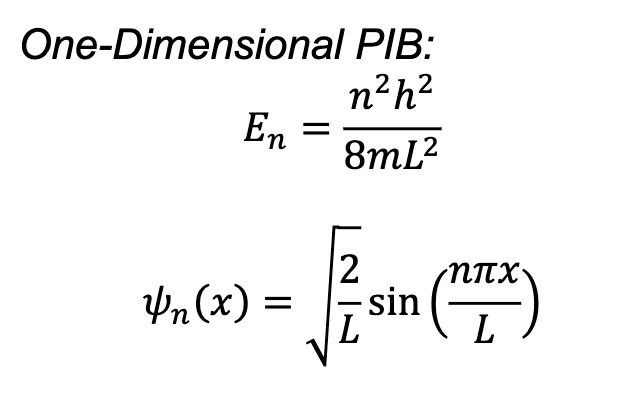
PIB formula (n = principle quantum number = discrete energy state)
En = allowed energy levels

psi(…) = wavefunction
R(…) = radial wavefunction
Y(…) = angular wave function

orbital energy in one-electron atoms (hydrogen atoms)
degenerate orbitals
orbitals at same energy level

average distance of electron from nucleus
Stern-Gerlach Experiment
evidence that orientation of magnetic moment is quantized
fourth quantum number based on electronic spin
number of orbitals
n2 (2 electron spin states in each orbital, 2 electrons in each orbital)
Hartree Orbitals
model for many-electron atomic orbitals
electron repulsino complicates model
not an explicit solution to SE — approximation
electrons closer to nucleus have…
lower orbital energy
order of electrons lost in cations (electron configuration)
(n)s → (n-1)d and (n-2)f
electron configuration exceptions
Cr, [Ar]3d54s1
Cu, [Ar]3d104s1
magnetic properties
behavior of atoms in magnetic field gives information about electron config.
paramagnetic → attracted to magnetic field (one or more unpaired electrons)
diamagnetic → weakly repelled by magnetic filed (all electrons paired)
covalent radii =
one-half distance between nuclei fo two identical atoms with covalent bond
atomic size periodic table
increases across group — higher n → more shells further from nucleus
decreases across period — increasing Zeff, stronger Coulombic attraction to nucleus

atomic radii exceptions
Ti (148 pm), Zr (164 pm), Hf (164 pm)
ionic radii
cations - less electron repulsion → smaller radius
anions - more electron repulsion → larger radius
isoelectronic - species with same number of electrons and same electron config.
ionization energy
IE - minimum energy to remove electron from neutral gaseous atom
ionization energy periodic table
decreases going down group - electrons more shielded from nucleus → less energy to remove
increases across period - increasing Zeff → electrons closer to nucleus → harder to remove

second ionization energy
IE2 → min. energy to remove second electron from gaseous cation
electron affinity
→ ease with which atom accepts electron to form anion
most elements - negative EA → exothermic, energy released by forming anion
electron affinity periodic table
period: higher Zeff → binds additional electron more strongly → easier to add electron → more energy released to form stable anion → larger negative value
group: largest Zeff at top of group, but n=1,2 subshells very small (electron repulsion). n=3 has largest EA

ionic bonding key points
ionic bond → strong electrostatic force of attraction between cations/anions
can be monatomic (single atom) or polyatomic (group of atoms)
formed by transfer of electrons
usually: metal + nonmetal
ionic compound → compound composed of cations/anions in ratio → electrically neutral substance held by ionic bonds
covalent bonding key points
covalent bond → bond formed when electrons shared between atoms
usually 2 nonmetal
formed between two atoms with similar tendencies to attract electrons (similar ionization energy and electron affinities)
sharing of electrons → stable noble gas config.
molecular compound → composed of molecules formed by 2+ elements held together by covalent bonds
covalent bond formation
when molecule has lower total energy than pair of isolated atoms → bond is the more stable config.
(covalent) bond properties
bond length → distance between nuclei of 2 bonded atoms with lowest potential energy
bond energy → amount of energy that must be transferred to a molecule to break a particular chemical bond
form bond → release energy (exothermic)
break bond → use energy (endothermic)
higher BE → more stable
bond order → measure of strength of chemical bond = number of shared electron pairs
bond length
homonuclear diatomic → two atom molecule of same element
heteronuclear diatomic → two atom molecule of diff. element
electronegativity
measure of tendency of atom/molecule to draw electrons to itself in chemical bond
electronegativity periodic table

pauling electronegativity scale
values assigned based on measured bond dissociation energies
higher diss. energy → higher ionic character (partial charge separation)
fluorine - most electronegative

electronegativity in bonds
pure nonpolar covalent bond - atoms of (almost) identical electronegativity → electrons equally shared
polar covalent bond - different electronegativities → unequally shared
bond polarity types
pure covalent: < 0.4
polar covalent: 0.4~1.8
ionic: > 1.8
resonance