PSYC: Week 9: Consciousness and Sleep Web Page
 Call Kai
 Learn
 Practice Test
 Spaced Repetition
 Match
 Flashcards
 Knowt Play
1/45

There's no tags or description
Looks like no tags are added yet.
46 Terms
What Is Consciousness?
Consciousness refers to our awareness and subjective experience of the world and ourselves.
It includes:
Sensory experiences (seeing, hearing, touching).
Thoughts and ideas.
Emotions and moods.
Memories.
Awareness of our surroundings.
Awareness vs. Self-Awareness vs. Conscious Experience
Awareness: Having conscious experiences of thoughts, sensations, or surroundings.
Self-awareness: Recognizing your own existence and individuality.
Conscious experience: Your personal, subjective experience of a mental event.
Example: Seeing a red apple is awareness. Recognizing that you are the person experiencing the apple is self-awareness.
Why Is Consciousness Difficult to Study?
What do they use to study it?
Consciousness is difficult to study because each person's conscious experiences are private.
We cannot directly experience another person's consciousness.
Scientists must therefore study consciousness indirectly.
Scientists use:
Behavioural observations.
Brain activity measurements.
Self-reported experiences.
Psychological experiments
First-Person vs. Third-Person Perspectives
Perspective | Meaning | Example |
First-person | Subjective observations of your own experiences. | Describing how you feel when frightened. |
Third-person | Objective observations that others can verify. | Measuring brain activity when someone feels fear. |
Consciousness is studied through several disciplines: What are the 5?
Psychology: Studies thoughts, behaviour, perception, and awareness.
Neuroscience: Investigates how brain activity relates to consciousness.
Philosophy: Examines the nature of consciousness and the mind.
Cognitive science: Studies how information is processed.
Contemplative science: Examines practices such as meditation and their effects on conscious experience.
Scientific Approaches to Consciousness":
Dualism vs. Reductionism
Dualism (René Descartes)
The mind and physical body are fundamentally different.
Consciousness cannot simply be understood as physical brain activity.
Reductionism
Mental experiences can be explained through physical processes.
Consciousness is studied by examining brain activity and neural mechanisms.
Main difference:
Dualism: Mind and body are fundamentally separate.
Reductionism: Mental processes can be explained through physical processes.
How conscious and unconscious processing differ….
What is the relationship between visual processing and conscious awareness?
The brain can process visual information without conscious awareness. We do not necessarily see everything our eyes detect.
Example in an experiment:
Participants were briefly shown a number.
The number was quickly replaced by another visual pattern.
Participants reported no conscious awareness of the number.
However, their brains could still process whether the number was greater than five.
Conclusion: The brain can analyze visual information without conscious awareness.
What is motion-induced blindness, and what does it demonstrate?
Bright objects temporarily disappear from conscious awareness, even when we are paying attention.
Demonstrates: Attention and visual stimulation do not guarantee conscious awareness.
What is cortical blindness?
Loss of conscious vision due to damage to the primary visual cortex, even though other visual-processing areas may still function.
What is blindsight?
The ability to respond to visual information without consciously seeing it.
Example: Correctly guessing the direction of movement despite reporting no visual awareness.
What brain regions are involved in visual awareness?
What is Reciprocal communication?
(occipital lobe)
Primary visual cortex : Early visual processing.
V5: Processes visual motion. (Situated at the junction of the occipital and temporal lobes)
Reciprocal communication: Information travels back and forth between these regions, supporting conscious visual awareness.
What did TMS (transcranial magnetic stimulation) research reveal about visual awareness?
RECALL: Transcranial magnetic stimulation (TMS)is a noninvasive medical procedure that uses magnetic fields to stimulate nerve cells in the brain
Disrupting feedback between V5 and the primary visual cortex (Reciprocal communication) can prevent conscious motion perception.
Conclusion: Conscious visual awareness appears to depend on coordinated communication between brain regions, not simply activation of one region.
What is neural synchronization, and how does it relate to consciousness?
Beta waves and gamma waves…
Neural synchronization occurs when groups of neurons coordinate the timing of their activity.
This helps neurons communicate effectively.
Beta waves (13–30 Hz) and gamma waves (30–100 Hz) are associated with visual awareness.
Remember: Communication between synchronized brain regions may contribute to consciousness.
What is the difference between conscious and unconscious memory?
Conscious memory: Intentionally remembering facts or past experiences.
Unconscious memory: Previous experiences influence behaviour without conscious recollection (e.g., Perceptual priming, habits and motor skills).
What is episodic recollection?
The conscious ability to remember and mentally reexperience past events.
Example: Remembering your first day at university.
What is declarative memory, and how is it affected by amnesia?
Conscious memory for facts and events.
People with amnesia often have difficulty consciously remembering this information.
Amnesia: a partial or complete loss of memory caused by brain injury, illness, psychological trauma, or fatigue.
What is perceptual priming?
Previous exposure to information makes it easier to process again without consciously remembering it.
Example: Recognizing a previously seen face more quickly without remembering seeing it.
How does amnesia demonstrate the difference between conscious and unconscious memory?
People with amnesia may struggle with conscious recall but still retain unconscious memories, such as habits, motor skills, and perceptual priming.
What role does the hippocampus play in conscious memory?
Helps form and store memories of experiences.
Interacts with the cerebral cortex to stabilize memories over time.
Conscious recollection depends on coordinated activity across cortical networks.
How does the brain develop body awareness?
What is the rubber-hand illusion, and what does it demonstrate?
The brain combines information from different senses (e.g., sight and touch) to recognize body parts as our own.
This helps distinguish between self and nonself.
Rubber-Hand Illusion
When a rubber hand and a hidden real hand are touched simultaneously, a person may feel that the rubber hand belongs to them.
Demonstrates: Body ownership is constructed by the brain using sensory information.
What is the role of the temporoparietal junction in consciousness?
What can a disruption cause?
A brain region involved in body awareness and the perceived location of the self.
Disruption can cause:
Distorted perceptions of body size.
Changes in perceived body location.
Out-of-body experiences. (The sensation that your perspective or sense of self is located outside your physical body)
What is presence in relation to consciousness?
Presence is the feeling of actually being somewhere, such as within a virtual reality environment.
The feeling of actually being present in a particular environment, such as a virtual reality world.
It demonstrates how the brain constructs our sense of location and self.
What is the difference between conscious and unconscious decision-making?
Conscious: Deliberate, analytical, and involves awareness of reasoning. Best for comparing a few known factors.
Unconscious: Automatic, intuitive (gut feeling), and processes multiple factors simultaneously. Can be useful for complex decisions when you have experience.
Ex.
In one experiment:
Participants chose whether to press a left or right button.
Researchers measured their brain activity using fMRI.
Brain activity predicted their choices up to 10 seconds before participants reported consciously deciding.
Some neural processes involved in decision-making begin before we become consciously aware of making a choice.
Why might we misunderstand our own decisions?
Decisions can be influenced by unconscious processing.
We may become aware of decisions only after processing has begun.
We sometimes create explanations for our actions that don't reflect their actual causes.
Key takeaway: Conscious awareness does not necessarily initiate every decision, even when we feel completely in control.
Theories of Consciousness
What is the Global Neuronal Workspace Theory of Consciousness?
Consciousness arises when information is widely shared across multiple brain regions through coordinated neural communication.
Important regions include:
Prefrontal cortex.
Inferior parietal cortex.
Occipital cortex.
Key concept: Consciousness depends on information becoming accessible across a broad network of brain regions.
Theories of Consciousness
What is the Information Integration Theory of Consciousness?
Consciousness depends on how complex and integrated information is within the brain.
Brain regions exchange and combine information.
The complexity of this integrated information determines the richness of conscious experience.
- Low integration: Limited consciousness.
- High integration and complexity: Richer conscious experiences.
Key idea: Complexity and integration of information.
Theories of Consciousness
What is the Social Neuroscience Theory of Consciousness?
consciousness may have developed from the brain's ability to understand and predict other people's behaviour.
The brain uses similar mechanisms to understand our own attention, intentions, and actions.
Example: Understanding that someone is looking toward a door may help you predict that they are about to leave.
The theory proposes that similar processes help us understand and anticipate our own actions.
Freud and the Subconscious
conscious vs. subconscious
Sigmund Freud proposed that some of our memories and motivations exist outside conscious awareness.
Conscious: Information we are currently aware of.
Subconscious: Information that influences us without necessarily entering conscious awareness.
Example: Automatically reacting to something without understanding why.
Low Awareness
What is low awareness, and how does it affect information processing?
The brain automatically processes information without conscious attention.
Requires little mental effort.
Can be influenced by unnoticed environmental cues.
Example: Hearing your name in a crowded room (cocktail party effect).

Low Awareness
What are cues and subliminal processing?
Cues: Meaningful stimuli that may trigger automatic responses.
Subliminal processing: Processing stimuli without conscious awareness.
Example: People afraid of snakes showed increased sweating when briefly shown snake images they couldn't consciously identify.
Low Awareness
What is priming, and how can it influence behaviour?
What is an important limitation of behavioural priming research?
Priming occurs when exposure to information activates related concepts in memory, potentially influencing later thoughts and behaviour.
Example: In one study, participants exposed to words associated with older adults reportedly walked more slowly afterward.
Some priming studies have failed to replicate, meaning other researchers could not consistently reproduce their findings.
High Awareness
What is high awareness, and what are its benefits?
High awareness involves deliberate attention and careful thinking.
Requires mental effort.
Supports decision-making.
Helps recognize and correct biases.
Example: Solving a difficult math problem.

High Awareness
What is mindfulness, and how does it relate to high awareness?
Mindfulness involves deliberately paying attention to present thoughts and experiences.
Helps recognize thoughts, emotions, and unconscious influences.
Encourages reflection rather than automatic reactions.
Example: Reflecting on why you reacted angrily.
How do high and low awareness influence bias?
Low awareness: Automatic processing allows unconscious associations and stereotypes to influence judgments without us realizing.
High awareness: Deliberate thinking helps us recognize, question, and correct biases.
Key takeaway: Higher awareness can reduce bias, but does not eliminate it completely.
What is the Implicit Association Test (IAT), and how does it work?
A test that measures automatic associations by comparing reaction times when categorizing stimuli (e.g., faces and words).
Faster responses may indicate stronger automatic associations.
Can reveal associations outside conscious awareness.
Does not definitively prove discriminatory beliefs or behaviour.
Ex in an experiment:
Participants see different categories of stimuli, such as faces or words.
They must quickly classify them using assigned buttons.
Researchers measure their response times.
Differences in reaction times may indicate differences in the strength of automatic associations.
What is the Flexible Correction Model?
People can deliberately adjust their judgments when they recognize that an irrelevant factor may have influenced them
Process: Form judgment → recognize bias → reconsider → adjust judgment.
Example: Evaluating a policy fairly after recognizing your preference for its political party.
Ex in experiment:
A person forms an initial judgment.
They recognize a possible biasing influence.
They consciously reconsider their judgment.
They attempt to correct for that influence.
What is hypnosis, and what is suggestibility?
Hypnosis: A state of intense focus, reduced awareness of surroundings, and increased responsiveness to suggestions.
Suggestibility: The tendency to respond to another person's suggestions.
People differ in suggestibility, which influences how responsive they are to hypnosis
What is dissociation, and how does it relate to hypnosis?
Dissociation involves focusing so intensely on something that awareness of the surrounding environment decreases.
During hypnosis, this focused attention can increase responsiveness to suggestions.
Example: Being so absorbed in a daydream that you don't hear your teacher.
What is the difference between stage hypnosis and therapeutic hypnosis?
Stage hypnosis: Entertainment that often exaggerates hypnotic control and uses highly suggestible participants.
Therapeutic hypnosis: Uses relaxation, focused attention, and suggestions to support treatment.
Important: Hypnosis is not sleep or complete mind control; participation is voluntary.
What are the therapeutic applications of hypnosis?
2 applications
Hypnotherapy uses relaxation, suggestions, motivation, and expectations to support treatment.
Pain management: Evidence suggests it can help reduce acute and chronic pain.
Addiction-related treatment: Has been investigated, but evidence is mixed.
Study: The chapter reports approximately 50% pain reduction with hypnosis versus 16% with placebo.
What are trance states, and how do they differ from hypnosis?
Trance: Altered attention and awareness, with a greater perceived loss of voluntary control.
ex. often occur in religious ceremonies, where the person believes he or she is “possessed” by an otherworldly being or force.
Hypnosis: Focused attention and increased responsiveness to suggestions.
Both may be explained by psychological factors such as expectations, imagination, and interpretation.
Sleep is a state of reduced conscious awareness in which the brain remains active.
What is the circadian rhythm, and how does it regulate sleep? (melatonin, jet lag)
Circadian rhythm: The body's natural daily sleep-wake cycle, influenced by sunlight, physical activity, and daily schedules.
Melatonin: Hormone that increases at night and promotes sleepiness.
Jet lag: Disruption of circadian rhythms after travelling across time zones.
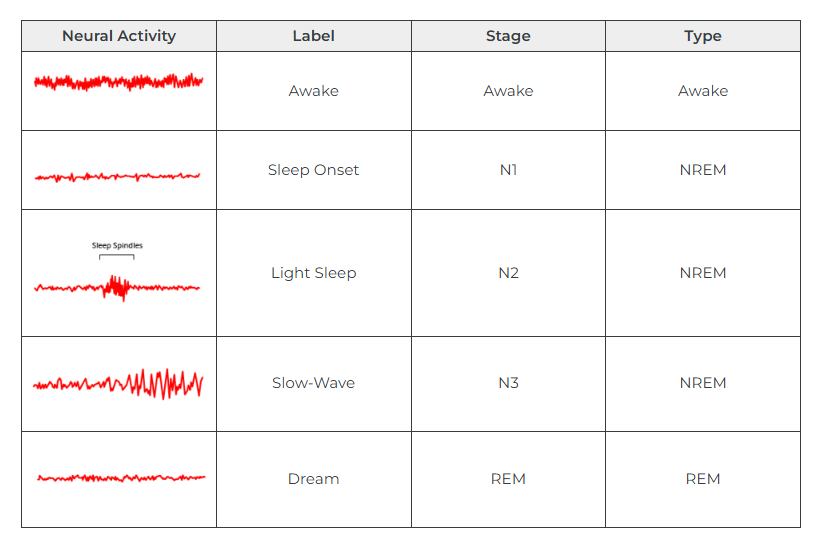
What are the stages of sleep and their associated brainwaves?
What are sleep spindles?
The chapter distinguishes three NREM stages and REM sleep.
Stage | Main Characteristics |
Awake | Beta waves during alertness; alpha waves during relaxation |
NREM 1 (N1) | Falling asleep; theta waves |
NREM 2 (N2) | Light sleep; sleep spindles; approximately 55% of sleep |
NREM 3 (N3) | Deep sleep; delta waves; greater muscle relaxation |
REM | Rapid eye movements; brain activity resembles wakefulness; vivid dreams are common |
Sleep spindles are brief bursts of brainwave activity during NREM 2.
They are associated with memory processing and consolidation.
What are the main theories of dreaming?
Information processing: Dreams may help process daily experiences and learning.
Freud's theory: Dreams may represent hidden wishes or desires.
Dreams can occur in all sleep stages, but are typically more vivid during REM sleep.
Why is sleep important, and what happens when we don't get enough?
Sleep supports:
Physical and mental restoration.
Attention, reaction time, and decision-making.
Sleep deprivation causes:
Irritability.
Slower reaction times.
Difficulty concentrating.
Poorer decision-making.
What are psychoactive drugs?
What are the three categories of psychoactive drugs, and how do they affect consciousness?
Psychoactive drugs are substances that alter mental processes, perception, or consciousness.
Hallucinogens: Alter perception and may cause hallucinations.
Examples: LSD, cannabis, psilocybin.
ex. Marijuana is the dried flowers of the hemp plant and is often smoked to produce euphoria.
Depressants: Slow mental and physical processes.
Examples: Alcohol, opiates.
Alcohol enhances GABA activity.
Effects: Reduced inhibition, impaired judgment, and poor coordination.
Stimulants: Increase mental and physical activity.
Examples: Caffeine, nicotine, cocaine.
Some block dopamine reuptake.
Effects: Increased alertness and arousal; may cause anxiety or difficulty sleeping.
