CHEMISTRY FULL SET
 Call Kai
 Learn
 Practice Test
 Spaced Repetition
 Match
 Flashcards
 Knowt Play
1/301

Earn XP
Description and Tags
contains modules 5,6,7 and 8
302 Terms
environmental monitoring
the processes and activities required to characterise and monitor the quality of the environment. Used in preparation of environmental impact assessments (where human activities pose a risk of harm to the natural environment)
environmental impact assessments
analytical chemists are often given the task of monitoring chemical components within the environment, such as:
air quality monitoring
soil monitoring
water quality monitoring
air quality monitoring
air pollutants are both naturally occurring and anthropogenic (i.e. pollutants originating from human activity)
may have negative impacts on abiotic and biotic components of the environment
development of chemicals and industrial processes had led to the introduction or elevation of pollutants into the atmosphere
e.g. nitrogen oxides, ozone, sulphur oxides, CFCs
soil monitoring
_________ analysis, of its quality, constituents, and physical status to determine its use
factors affecting it include: compaction, contamination, organic material loss, biodiversity loss, slope stability issues, erosion, salinization and acidification
helps us characterise potential risks to soil, surrounding environments, animal health and human health
e.g. salinity, presence/absence of essential nutrients used for agriculture
water quality
refers to the chemical, physical, and biological characteristics of water
measured against set standards, measures condition of the water relative to the requirements of one or more species or to any human need or purpose
potable water
the safety of human contact and suitability of the water for drinking purposes
water pollution
the contamination of water bodies (e.g. lakes, rivers, oceans, aquifers and groundwater), resulting when contaminants (e.g. chemicals, pathogens) or physical changes (e.g. elevated temperature, discolouration) are introduced to the natural environment
chemicals such as calcium, sodium, iron, nitrate, phosphate ions are naturally occurring → concentration determines whether these are contaminants
high conc of these substances can have -ve impacts on flora and fauna
e.g. oxygen-depleting plants like blue-green algae in an aquatic environment
e.g. other natural substances that can increase turbidity, which blocks light and disrupts plant growth (limits photosynthesis) and clogs up gills of fish
eutrophication
an increase in the concentration of nutrients in an ecosystem which increases the number of producers in the ecosystem
depending on the degree to which this occurs, effects such as anoxia or oxygen depletion and severe reductions in water quality may occur subsequently (if the concentration is too high)
organic water pollutants
detergents
insecticides and herbicides: a range of organohalides and other compounds
petroleum hydrocarbons, including fuels and lubricants and fuel combustion by-products, from storm-water runoff
volatile organic compounds, such as industrial solvents, from improper storage
various compounds found in personal hygiene and cosmetic products
pharmaceutical drugs and their metabolites, which can include antidepressant drugs or hormonal medicines, such as contraceptive pills
inorganic water pollutants
acidity caused by industrial discharges (e.g. SO2 from power plants may lead to acid rain)
chemical waste, as industrial by-products
fertilisers: containing nutrients, nitrates and phosphates, which are found in runoff water from agriculture, as well as residential use → leads to eutrophication
heavy metals: from motor vehicles, industrial discharges and acid mine drainage
silt: from construction sites, logging, agricultural practices or land clearing sites (i.e. turbidity)
macroscopic pollutants (large visible items polluting water)
garbage (e.g. paper, plastic, food waste) discarded or washed into storm drains
nurdles and microplastics
shipwrecks and large derelict ships
nurdles
type of pollutant; small ubiquitous waterbourne plastic pellets
thermal pollution
from water that was used as a coolant by power plants and manufacturing
heavy mining pollution
Lead (from mining, leaded fuel and old paints)
Mercury (from old batteries and mining)
Cadmium (from burning fossil fuels
Are all found in sediments at the bottom of lakes from years of dumping leads to accumulation of these heavy metals which are released into the environment
bioaccumulation
gradual buildup of harmful chemicals and toxins inside a single living organism over time
flame test
a qualitative analytical technique used to detect the persence of metal ions.
When the cation is ‘excited’ by strong heating, electrons can be promoted from ground state to a higher energy level (orbital) → Law of Conservation of Energy, they have to lose the energy which is emitted as a photon of a certain wavelength based on the type of transition which have different wavelengths and are thus different colours for different elements
Barium ion (Ba2+)
(pale) apple green flame
calcium ion (Ca2+)
reddish brown (or orange-red) flame
magnesium ion (Mg2+)
colourless flame (bright white, blinding -- teacher has said not to look directly at it)
lead (II) ion (Pb2+)
blue-grey flame
silver ion (Ag+)
colourless flame
copper (II) ion (Cu2+)
blue-green flame (white flashes)
sodium ion (Na+)
orange-yellow flame
iron (II) ion (Fe2+)
gold flame (very hot), blue-green to orange-brown flame
iron (III) ion (Fe3+)
orange-brown flame
SNAAP Rule of Solubility
Salts that contain one or more of the following ions ARE soluble:
Sodiun
Nitrate
Ammonium
Acetate
Potassium
NAG/SAG/PMS
NAG (always soluble):
nitrates
acetates
group 1A metals
SAG (generally soluble, with exceptions):
sulfates (SO42-)
exceptions: Ca2+, Sr2+, Ba2+, Pb2+, Ag+
ammonium
group 7A halides (Cl-, Br-, I-)
exceptions: Pb2+, Ag+ Hg2+
PMS (exceptions to SAG)
P - (lead = Pb)
M - (mercury = Hg)
S - (silver = Ag)
coordination complexes
aka complex ions that carry a net charge (e.g. [Fe(SCN)]²⁺)
are soluble in water
coordination compounds
aka. neutral complexes (same as coordination complexes but are neutral)
ligands
molecules/ions that come off of the central metal ion in a coordination compound
coordinate covalent bond
special type of covalent bond that ligands form with the central metal ion (ligands donate two electrons to form this bond different from regular covalent bonds where one electron is donated by each participant)
quantitative analysis
uses various chemical techniques and processes to determine the quantity of cations and anions in a certain amount of sample
gravimetric analysis
a procedure in which the masses of substances are measured to determine the composition of a sample (number of ions present can be determined using stoichiometry)
disadvantages:
generally time consuming
substance has to have specific properties for a precipitate to form (insoluble, be the only precipitate that forms, unable to decompose during the process, have a known chemical formula)
precipitation titrations
use precipitation reactions to determine the quantity of a chemical species in a sample
Mohr’s method
used to determine the concentration of anions such as chloride, bromide and cyanide by direct titration using a known concentration of silver nitrate.
Chromate ions are used as an indicator
NOTE: after the endpoint, the additional silver ions react with the chromate indicator, forming a red-brown precipitate of silver chromate
spectroscopy
the study of how matter interacts with electromagnetic radiation, revealing composition, structure and properties
spectrophotometry
a specific, quantitative technique within spectroscopy that measures the instensity of light absorbed or transmitted by a substance at different wavelengths to determine its concentration or quantity often using the Beer-Lambert Law
Beer-Lambert Law
states: “the concentration of a chemical is directly proportional to the absorbance of a solution”
A = εcL = log10(I0/I)
where:
A = absorbance
ε = molar absorption coefficient (M-1cm-1)
c = molar concentration (M)
L = optical path length
I0 = incident intensity (original intensity - light entering the sample)
I = final intensity (light exiting the sample)
Colourimetry
A type of spectrophotometry in which colour is used to determine the concentration of a chemical species in a solution
UV - visible spectrophotometry
Uses the ultraviolet and visible regions of the EM spectrum to excite electrons — uses a calibration curve to determine the concentration of the molecule in a sample
Atomic Absorption Spectroscopy (AAS)
Uses the absorption of light by electrons (in their ground state) in a metal ion to determine the concentration of the ion.
Atomised
Turned into individual atoms
Calibration curve
Plots absorbance values concentration of the ion of interest for several standard solutions at a range of concentrations. therefore, the absorbance of the unknown sample can be found using the calibration curve
Basic chemicals
One of the three sectors of the chemical industry.
e.g. Organic and inorganic chemicals, industrial gases, fertilisers and synthetic resins
Specialty chemicals
One of the three sectors of the chemical industry.
e.g. Explosives, paints, rubber products, plastics products, foam products, inks, adhesives, glues and surface cleaners
Consumer chemicals
One of the three chemical sectors.
e.g. Cosmetics and toiletries, soaps and detergents, pesticides, medicinal and pharmaceutical products
Synthesis reaction
Two or more simple substances combine to form a more complex product ( A+ B → AB)
Technical grade
Products used for non-critical laboratory tasks such as rinsing
Synthesis reagent
Suitable for organic synthesis
Analytical reagent
Suitable for quantitative analysis, research and quality control (high purity)
Pharmacopoeia grade
Product has met the purity requirement to be used in the production of pharmaceuticals
Atom economy
Expresses the proportion of reactant atoms that end up in a useful product measuring the number of atoms of the starting materials that end up as products that are wanted and the number that end up as waste.
% _________ = (mass of desired product/total mass of all reactants) *100
the closer to 100, the less the waste
% purity
= (mass of useful product in sample/total mass of sample) *100
green chemistry
the acceptance that the chemical industry must not adversely affect the environment for future generations is the driving force behind the development of ______.
Analytical chemistry
branch of chemistry which deals with the indentification and quantification of substances:
Qualitative
Quantitative
Qualitative analytic chemistry
what is present?
Quantitative analytical chemistry
how much is present?
Bromine water test
for unsaturation — used to identify the presence of double or triple bonds
electrophilic species (bromine water is an electrophilic reagent) will add across double or triple bonds.
distinct decolourisation of bromine water (from orange/brown to colourless) of the reagent when unsaturation is present
electrophilic species
electron-loving species
can add across double bonds
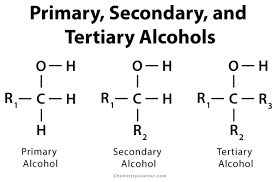
Identification of alcohols
have the hydroxyl (OH) group as their primary functional group
Primary and secondary can be oxidised using strong oxidant (e.g. acidified potassium dichromate)
oxidisation by strong oxidant
(potassium dichromate, acidified postassium permanganate)
tests for presence of primary or secondary alcohols
NOTE: aldehydes will also give a positive result
primary alcohol → aldehyde → carboxylic acid
secondary alcohol → ketone
orange dichromate ion (Cr2 O72-) will reduce to the green chromium (II) ion, Cr2+
purple permanganate ion (MnO4 -) will reduce to the colourless manganese (II) ion, Mn2+
NOTE: tertiary alcohols cannot be oxidised and thus will not change colour to any oxidants
Lucas test
distinguishes between the three classes of alcohols based on the difference in their reactivity with hydrogen halides
primary alcohols have no visible reaction after several minutes
secondary alcohols form an oily layer after several minutes
tertiary alcohols form an oily layer immediately
litmus tests, carbonate, metal tests
tests for carboxylic acids
as they are acids, they turn blue litmus paper red
produces CO2 gas (fizzing) when a carbonate is added
Hydrogen gas (fizzing) when reacted with sodium or magnesium metal
AgNO3 (aq) tests on haloalkanes
Fluoroalkanes do not react
Chloroalkanes form a white precipitate (AgCl) after several minutes
Bromoalkanes form a cream precipitate (AgBr) within a minute
Iodoalkanes form a yellow precipitate (AgI) within seconds
Infrared (IR) spectroscopy
used as a quantitative test of organic compounds to determine the presence of functional groups
wet chemical tests
classical laboratory methods that use liquid solutions, reagents, and basic glassware to identify or measure the amount of a substance
essentially limited to qualitative investigation
nature of an organic compound can give misleading results if more than one functional group is present.
they can:
identify each individual functional group present
identify the molecular formula of a compound
distinguish between structural isomers
analyse mixtures of organic compounds
quantify the amount of each organic compound present
mass spectrometer
an analytical instrument that identifies and quantifies molecules by converting them into ions and measuring their mass-to-charge ratio
ionisation chamber
here, the sample is bombarded by a high energy electron beam, which knocks a valence electron of the molecule to form a molecular ion (M+)
mass analyser
molecular ions are accelerated by an electric field which is curved, then deflected by a magnetic field. ions with different m/z (mass to charge) ratios are deflected to different extents
results in ‘sorting’ of ions according to their mass to charge ratio
detector
detects and quantifies the separated ions, producing a mass spectrum
base peak
most common fragmentation peak (mass spec) - highest relative intensity
parent peak
the signal that represents the complete, unfragmented molecule with a single electron removed (mass spec)
mass spectrometer
plot of relative intensity vs m/z
relative intensity assigns the molecular fragment with the highest abundance - a value of 100
NMR (nuclear magnetic resonance spectroscopy)
technique used to determine a compound’s unique structure
it identifies the carbon-hydrogen framework of an organic compound
HNMR spectroscopy or proton NMR - analyses the hydrogen-1 nucleus
CNMR spectroscopy - examines carbon-13 nucleus
magnetic moment
measure of a magnet's overall strength and the direction it tries to point inside an external magnetic field
resonance
the exact moment when an atomic nucleus in a magnetic field absorbs radio-frequency energy and flips its spin state
superconducting magnets
produce a very strong magnetic field
radio frequent (RF) generator
excites the nuclei causing a flip-spin
chemical environment
includes the atom and its surrounding electrons, for a specific atom within a molecule (used in HNMR and CNMR)
electron shielding
the way surrounding electron clouds protect a nucleus from an external magnetic field - reduces the experienced field. since the magnetic field experienced at the nucleus defines the energy between different spin states, it also defines what the chemical shift will be for the nucleus
signal splitting
many single peaks on a low-resolution spectrum will consist of multiple peaks on a high resolution spectrum (HNMR)
the division of a single NMR signal into multiple peaks caused by the magnetic influence of neighboring, non-equivalent nuclei
indicates with the n+1 rule how many hydrogens are on the neighbouring carbon for each environment
n+1 rule
predicts the number of peaks (multiplicity) a signal will split into based on the number of neighboring equivalent protons
e.g. if there are three peaks → the environment has two hydrogens on the neighbouring carbon (2 adjacent hydrogens)
relative peak area
HNMR - tells you how many hydrogens are in the environment that cluster of peaks represents - NOTE: THIS IS A RATIO (between the different environments)
Nomenclature
assigning of a name which uniqely identifies a substance
IUPAC
(International Union of Pure and Applied Chemistry) - systematic organic nomenclature
systematic rules for naming organic compounds
PIN
designated IUPAC name for each compound, usually uses the systematic naming rules, but occasionally the ___ is an established common name for a familiar compound (e.g. water, ammonia, acetic acid)
Alkane
straight chain of carbon and hydrogen atoms with only single bonds (-ane)
Alkene
if there is a c-c double bond, the chain becomes an alkene (-ene)
Alkyne
if there is a c-c triple bond, the chain becomes an ______ (-yne)
Locants
a number that is inserted into the name right before a functional group, locating it in the chain (functional groups are given the lowest locant number possible)
Vowel Rule (naming organic compounds)
the vowel is dropped if one portion of the name ends in a vowel and the next starts with a vowel (or a ‘y’)
e.g.
ene-3-ynebecomes en-3-yne
Commas and dashes (naming organic compounds)
numbers → numbers uses commas
letters → numbers / numbers → letters uses dashes
substituents
parts of the molecule that come off the main, “parent” chain
includes: halogens and alkyl (side chains)
halogens/haloalkanes
any group 7 atom that can take place of any hydrogen in the molecule
1st part of name + o
e.g. Fluoro- Chloro- Bromo- Iodo-
If there is no difference in locants, the substituent that comes first alphabetically is given the lowest locant number ALL SUBSTITUENTS ARE EQUAL
placed at the start of the molecule name
Alkyl/side chains
include any c-c bonds that aren’t part of the parent chain (-yl)
alkanes: parent chain is decided by length
If there are double/triple bonds or functional groups, the parent is the longest chain with a double bond etc.
placed at the start of the molecule name (e.g. 2-methyl-)
If there is no difference in locants, the substituent that comes first alphabetically is given the lowest locant number ALL SUBSTITUENTS ARE EQUAL
Functional groups
parts of an organic molecule that affect its physical and chemical properties. They either contain an oxygen or a nitrogen or both, they change the end of the name (the suffix)
alcohols
a hydroxyl group (OH) that is singly bonded to a carbon on the parent chain (-ol)
aldehydes
a carbonyl group (C=O) at terminal end of parent chain (-al)
ketones
a carbonyl group (C=O) that is not on a terminal carbon of parent chain (-one)
carboxylic acids
combination of a carbonyl (C=O) and hydroxyl (OH) group both coming from the same carbon. It can only form on a terminal carbon (-oic acid)