PHYSICS ELECTRICITY
 Call Kai
 Learn
 Practice Test
 Spaced Repetition
 Match
 Flashcards
 Knowt Play
1/54

Earn XP
Description and Tags
physics
55 Terms
Current
The rate of flow of charge
Ampere
The rate of flow of one coulomb of charge per second
Resistance
The opposition to the flow of electrical current
Potential difference
The work done per unit charge.
Volt
The potential difference when 1J of energy moves 1C of charge through a component.
Power
The rate of energy transfer
Drift velocity
The slow overall movement of the charges in a current.
Electronvolt
The amount of energy an electron gains by passing through a voltage of 1V
Electromotive force
The voltage supplied by a power source. Generates an electric force which pushes electrons around a circuit.
I =
ΔQ / Δt
Current (A) = Charge passing a point (C) / Time taken (s)
V =
W / Q
Potential difference (V) = Energy transferred (J) / Charge passing (C)
ε =
E / Q
emf (V) = Energy transferred (J) / Charge passing (C)
R =
V / I
The steeper the line of an I-V graph...
The lower the resistance
The steeper the line of an V-I graph…
The higher the resistance
Ohms law
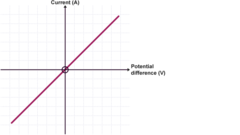
At a constant temperature for an ohmic conductor, the current through the conductor is proportional to the p.d across it.
What does the IV graph look like for a metallic conductor/ fixed resistor at constant temperature
The current is directly proportional to the p.d (straight line through the origin)
It obeys Ohm’s Law
Resistance is constant
Resistance is the same regardless of polarity
I-V graph for a filament lamp
The current is not proportional to the p.d
The lamp does not obey Ohm’s Law
The p.d is increasing at a faster rate than the current
The resistance is increasing

How does the resistance of a filament bulb change with an increase in temperature?
The lattice vibrations increase
There is an increase in the frequency of collisions of the electrons with the lattice
So the resistance increases
I-V graph of a negative temperature coefficient (NTC) thermistor
The current is not proportional to the p.d
The thermistor does not obey Ohm’s Law
The current is increasing at a faster rate than the p.d
Therefore resistance decreases at V increases.

How does the resistance of a thermistor change with an increase in temperature?
Thermistors are manufactured from a semiconductor.
This causes them to release more conduction electrons as the temperature rises, so the current increases.
Current is inversely proportional to resistance, therefore the resistance decreases.
I-V graph of a diode
The p.d is not proportional to the current.
The diode does not obey Ohm’s law.
The diode’s behaviour depends on the polarity.
At point 1, the resistance is high (infinite), no current.
At point 2, the threshold p.d, it starts conducting.
The resistance decreases, as the current rises at a faster rate than the p.d.
Above point 3, the diode has a small resistance.

Principle of charge conservation
Total electric charge in a closed system doesn't change
Derivation of rule for resistance in a series circuit
V (total) = V1 + V2 + V3
IR (total) = IR1 + IR2 + IR3
R (total) = R1 + R2 + R3, as I is the same in all parts of a series circuit
Derivation of rule for resistance in a parallel circuit
I (total) = I1 + I2 + I3
V/R (total) = V/R1 + V/R2 + V/R3
1/R (total) = 1/R1 + 1/R2 + 1/R3, as pd is the same in parallel branches
Kirchhoff's First Law
The total current entering a junction equals the total current leaving the junction. This law is based on the conservation of charge.
Kirchhoff's Second Law
The sum of the electromotive forces (e.m.f.) in a closed loop is equal to the sum of the potential differences in that loop. This law is based on the conservation of energy.
Factors affecting resistance
Density of charge carriers
Density of fixed atoms
Forces between them
Resistivity
The property of a material to resist the flow of electrical current
R =
ρL / A
Resistance (Ω) = Resistivity (Ωm) x Length (m) / Cross-sectional area (m^2)
The transport equation
I = nqvA
Current (A) = Charge carrier density (m^-3) x Charge of charge carrier (C) x Drift velocity (ms^1) x Cross-sectional area (m^2)
When temperature increases in a metal, drift velocity...
Decreases, as the lattice vibrations increase
There is an increase in the frequency of collisions of the electrons with the lattice
So the resistance increases
As temperature increases in a metal, n...
Decreases as the metal expands
Semiconductor
A solid material with a small number of conduction electrons (e.g. silicon)
As the temperature in a semiconductor increases, resistivity...
Decreases as semiconductors conduct better at higher temperatures as the density of conduction electrons increases
Electron bands
Electrons with low energies are in the valence band, and cannot take part in an electric circuit.
Electrons which gain enough energy to jump to the conduction band and become delocalised can move as a current
Electron bands in metals
There are many electrons in the conduction band, allowing electrical conduction at most temperatures
Electron bands in semiconductors
Semiconductors have very few delocalised electrons, so will only carry a small current. As temperature increases, more electrons gain enough energy to jump to the conduction band, so current increases.
There will also be a reduction in current due to increases collisions, but this is outweighed by the increase in conduction electrons.
As temperature increases, a semiconductor's resistivity decreases
Conduction holes
When an electron enters the conduction band and moves away, it leaves a positively charged ion behind. The space left by the electron is called a conduction hole. When another electron from another atom fills this hole, the hole has effectively moved to another atom. The holes move in the opposite direction to current, towards the negative terminal, and are effectively another charge carrier, contributing to the current in a semiconductor
Diode
Made by joining together different types of semiconductors. This creates an energy barrier at the junction between them, preventing both holes and electrons from crossing.
This barrier can be overcome in the forward direction if a very small forward voltage is applied.
In the reverse direction, only very few charge carriers can pass through at low voltages (leakage current). If the reverse current is great enough, it can overcome the barrier

LDR
The brighter the light, the lower the resistance. Made of semiconductors. Light energy boosts electrons to the conduction band, allowing better conduction
Thermistor
Work the same as LDRs but the effect is caused by thermal energy. The most common thermistors, negative temperature coefficient transistors, use thermal energy to boost the electrons into the conduction band
Electron bands in insulators
The energy gap between the valence band and the conduction band is much larger. Virtually no electrons are available for conduction and there are no conduction holes either. If enough energy were input to make the material conduct, it would usually melt or be damaged another way first
Superconductor
When a material has no resistance due to temperature being below the critical temperature
For two resistors in series, the share of the pd is...
Directly proportional to the ratio of the resistances. V1 / V2 = R1 / R2
Potential divider circuit
One where the voltages are distributed in proportion to the resistances of the components
In a potential divider circuit, V (out) =
V (in) x (R₂ / R₁ + R₂)
Potentiometer
A type of variable resistor which allows you to adjust the length of the wire.
Resistance is directly proportional to length, so moving the wiper changes the ratio of resistances and voltages across each length of wire
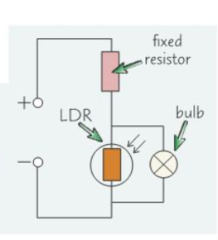
Sensor circuit- state and explain what will happen to the reading of the voltmeter (fixed resistor) if the light intensity on the circuit decreases.
Follow up- Explain what happens to the p.d across the LDR?
The lower the light intensity, the greater the resistance of the LDR.
The resistance in the circuit has increased
The current in the circuit has decreased
The p.d across the fixed resistor decreases as V = IR (R fixed)
Follow up- The p.d across the LDR has increased as they must add up to the fixed e.m.f by Kirchoff’’s 2nd Law.
Internal resistance, r
Lost volts per unit of current. Caused by electrons colliding with atoms inside the battery, so some energy is lost before the electrons leave the battery. Means a voltage smaller than the emf is supplied to the rest of the circuit
When accounting for internal resistance, ε =
IR + Ir
Emf = Load/terminal pd + lost volts
If you plot V against I...
y = mx + c
V = -Ir + ε
The gradient is -r and the y-intercept is ε
E =
QV
ItV
P =
IV
I^2 R
V^2 / R
Efficiency
Useful energy or power output / Total energy or power input