astronomy week 2: orbits, gravity, radiation, and spectra
 Call Kai
 Learn
 Practice Test
 Spaced Repetition
 Match
 Flashcards
 Knowt Play
1/17

Earn XP
Description and Tags
activities 2.1 & 2.2, homework 2
18 Terms

Shown below is an illustration of an electromagnetic wave that is moving to the right. Which of the labeled lines marks the wavelength of the wave?
Line B
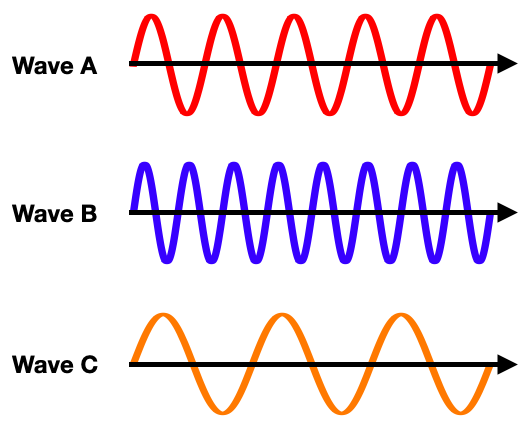
Shown below are illustrations of three electromagnetic waves, all moving to the right. Which wave has the longest wavelength?
Which wave has the highest frequency?
Which wave has the highest energy?
Which wave is moving the fastest?
Wave C
Wave B
Wave B
All the same
All of the light that you can see has wavelengths between about 400nm and 700nm. We can tell that light has different wavelengths because the wavelength of light determines what colors your brain sees.
Which color of light has the longest wavelength, close to 700nm?
Red light
Which type of light has the shortest wavelength?
Gamma Rays
Which type of light has the lowest energy?
Radio
Some sources of light create a single wavelength, while others create many wavelengths together. The colors we perceive depend on the total amount of light we receive at each color.
What colors does a regular white lightbulb produce?
All light in equal amounts
Suppose a star produces a lot of red light, a medium amount of green light, and only a little blue light. What color would it look to us?
Orange
Why do different types of atoms (elements) give off or absorb different spectral lines?
Because the spacing of the energy levels is different in different atoms
Match the sources of light spectra below with the type of spectrum they would create.
Light shining through a tube of cold gas: [?]
Neon sign: [?]
Light passing through a cold gas cloud in space: [?]
Hot gas energized by a young star: [?]
Absorption
Emission
Absorption
Emission
How does changing the temperature affect the peak wavelength?
Lower temperatures result in longer peak wavelenths
How does changing the temperature affect the peak intensity?
Lower temperatures result in lower peak intensities

In the graph of Star A and Star B, which gives off more red light? Which gives off more blue light? Which looks redder?
Gives off more red light: Star B
Gives off more blue light: Star A
Looks redder: Star B
We've established that the force of gravity acting on astronauts in the International Space Station (ISS) isn't much weaker than if they were on Earth's surface. They experience weightlessness because their stable orbit puts them in a sustained state of free-fall, meaning the "zero-gravity" they experience is the same feeling of being in temporary free-fall on Earth (think being in an elevator when the cable is cut).
Let's use the ISS's thrusters to stop its circular motion, then turn them off. What would happen next?
The station would fall toward Earth, and the astronauts would continue to experience weightlessness (until entering Earth's atmosphere).
In the Bohr model of the atom (the structure we discussed in class)...
Energy levels refer to the positions of the [?]
When light is absorbed by an atom, [?]
The particles of light that are absorbed or emitted are called [?]
A larger energy transition will create light with a [?]
Electrons
Electrons transition from low to high energy levels
Photons
Higher frequency

Which wave has the...
Highest Frequency?
Lowest Energy?
Highest Speed?
Wave A
Wave C
All the same
Which of the following is true when comparing Infrared light and Radio waves?
Radio waves have a lower frequency and travel the same speed as Infrared light

Which, if any, of the other stars has the same temperature as Star B?
There is insufficient information to answer this question

Which of these claims about the star temperatures is correct?
Star A is hotter than Star D, because its peak intensity occurs at a smaller wavelength.