ACCT 1130 Exam 2 Study Guide
 Call Kai
 Learn
Learn Practice Test
 Spaced Repetition
 Match
Match Flashcards
 Knowt Play
1/72

Earn XP
Description and Tags
Contains chapters 4 and 5
Name | Mastery | Learn | Test | Matching | Spaced | Call with Kai | Chat |
|---|
No analytics yet
Send a link to your students to track their progress
73 Terms
Merchandise
__________ refers to products, also called goods, that a company buys to resell.
Merchandiser
A(n) _________ earns net income by buying and selling merchandise.
Wholesaler
A(n) _________ buys products from manufacturers and sells them to retailers.
Retailer
A(n) _________ buys products from manufacturers or wholesalers and sells them to consumers.
Cost of Goods Sold
Revenue from selling merchandise is called sales, and the expense of buying and preparing merchandise is called ___________. (Some service companies use the term sales instead of revenues; ___________ is also called cost of sales.)
Gross Profit or Gross Margin
The merchandiser also reports ___________, which is net sales minus cost of goods sold.
Service Company
Is this net income is calculated for a Service Company or a Merchandising Company?

Merchandising Company
Is this net income is calculated for a Service Company or a Merchandising Company?

Service Company
Is this income statement for a Service Company or a Merchandising Company?

Merchandising Company
Is this income statement for a Service Company or a Merchandising Company?

Merchandise inventory or inventory
A merchandiser’s balance sheet has a current asset called __________, an item not on a service company’s balance sheet. __________, refers to products that a company owns and intends to sell. _________ cost includes the cost to buy the goods, ship them to the store, and make them ready for sale.
Two to Five Months
How long is the operating cycle for a Department Store
Two to Eight Weeks
How long is the operating cycle for a Grocery Store
Merchandiser’s Operating Cycle
What is this picture showing?

Merchandiser’s Cost Flow for a Single Time Period
What is this picture showing?

Perpetual inventory system
__________ records cost of goods sold at the time of each sale.
Periodic inventory system
__________ records cost of goods sold at the end of the period.
The cash purchase of merchandise without discount
This entry represents
Accounts | Debit | Credit |
Merchandise Inventory | 500 | |
——Cash | 500 |
Credit terms
The purchase of goods on credit requires _________. _________ include the amounts and timing of payments from a buyer to a seller.
Credit period
The amount of time allowed before full payment is due is the _________.
Cash discount
Sellers can grant a(n) _________ to encourage buyers to pay earlier.
Purchases discount
A buyer views a cash discount as a(n) _________.
Sales discount
A seller views a cash discount as a(n) __________.
2/10, n/60
What would the credit term be if there is a two percent discount on the invoice if payment is made within ten days or you have to make the full payment without discount in sixty day
4/15, n/30
What would the credit term be if there is a four percent discount on the invoice if payment is made within fifteen days or you have to make the full payment without discount in thirty days?
Discount Period
The buyer can deduct 2% of the invoice amount if payment is made within 10 days of the invoice date. This reduced payment is only for the _________.
Invoice
This form is a(n)

Gross method
The ________ records the purchase at its gross (full) invoice amount.
The credit purchase of merchandise
This entry represents
Accounts | Debit | Credit |
Merchandise Inventory | 500 | |
——Account Payables | 500 |
Full payment within discount period
This entry represents
Accounts | Debit | Credit |
Account Payable | 500 | |
——Merchandise Inventory | 10 | |
——Cash | 490 |
Full payment after discount period
This entry represents
Accounts | Debit | Credit |
Account Payable | 500 | |
——Cash | 500 |
Purchases returns
__________ are merchandise a buyer purchases but then returns.
Purchases allowances
__________ refer to a seller granting a price reduction to a buyer of defective or unacceptable merchandise.
Purchases Allowances
This entry represents
Accounts | Debit | Credit |
Accounts Payable | 30 | |
——Merchandise Inventory | 30 |
Allowance for defective goods
Purchases Returns
These entries Represent
June 1
Accounts | Debit | Credit |
Merchandise Inventory | 250 | |
——Accounts Payable | 250 |
Purchased goods, terms 2/10, n/60
June 3
Accounts | Debit | Credit |
Accounts Payable | 50 | |
——Merchandise Inventory | 50 |
Returned goods to seller
June 11
Accounts | Debit | Credit |
Accounts Payable | 200 | |
——Merchandise Inventory | 4 | |
——Cash | 196 |
Paid $200 of goods less $4 discount
FOB shipping point
__________ means the buyer accepts ownership when the goods depart the seller’s place of business. The buyer pays shipping costs and has the risk of loss in transit. The goods are part of the buyer’s inventory when they are in transit because ownership has transferred to the buyer.
FOB destination
__________ means ownership of goods transfers to the buyer when the goods arrive at the buyer’s place of business. The seller pays shipping charges and has the risk of loss in transit. The seller does not record revenue until the goods arrive at the destination.
FOB shipping point
What is this Shipping Term
Shipping Term | Ownership Transfers at | Goods in Transit Owned by | Transportation Cost Paid by |
??? | Shipping point | Buyer | Buyer Merchandise Inventory # Cash # |
FOB destination
What is this Shipping Term
Shipping Term | Ownership Transfers at | Goods in Transit Owned by | Transportation Cost Paid by |
??? | Destination | Seller | Seller Delivery Expense # Cash # |
Transportation-in or freight-in
When a buyer is responsible for paying transportation costs, the payment is made to a carrier or directly to the seller. The cost principle requires that transportation costs of a buyer be part of the cost of merchandise inventory.
Transportation-out or freight-out
When a seller is responsible for paying shipping costs, it records these costs in a Delivery Expense account. Delivery expense, also called __________ is reported as a selling expense in the seller’s income statement.
Itemized Costs of Merchandise Purchases
This table represents
Invoice cost of merchandise purchases | $235,800 |
Less: Purchases discounts received | (4,200) |
Purchases returns and allowances | (1,500) |
Add: Cost of transportation-in | $2,300 |
Total net cost of merchandise purchases | $232,400 |
Supplementary records or supplemental records
The accounting system described here does not provide separate records (accounts) for total purchases, total purchases discounts, total purchases returns and allowances, and total transportation-in. Many companies collect this information in _________ to evaluate these costs. __________ refer to information outside the usual ledger accounts.
Computation of Gross Profit
This table represents
Net sales (net of discounts, returns, and allowances) | $314,700 |
Cost of goods sold | $230,400 |
Gross profit | $84,300 |
Sales without Cash Discount
Revenue Side: Inflow of Assets
This entry represents
Nov. 12
Accounts | Debit | Credit |
Accounts Receivable | 1,000 | |
——Sales | 1,000 |
Goods sold on credit [Revenue recognition]
Sales without Cash Discount
Cost Side: Outflow of Assets
This entry represents
Nov. 12
Accounts | Debit | Credit |
Cost of Goods Sold | 300 | |
——Merchandise Inventory | 300 |
Record cost of Nov. 12 sale [Expense recognition]
Sales Discounts
__________ is a contra revenue account, meaning the __________ account is subtracted from the Sales account when computing net sales. The __________ account has a normal debit balance because it is subtracted from Sales, which has a normal credit balance.
Buyer pays within Discount Period
This entry represents
Nov. 22
Accounts | Debit | Credit |
Cash | 980 | |
Sales Discounts | 20 | |
——Accounts Receivable | 1,000 |
Received payment on Nov. 12 sale less discount
Buyer Pays after Discount Period
This entry represents
Dec. 27
Accounts | Debit | Credit |
Cash | 1,000 | |
——Accounts Receivable | 1,000 |
Received payment on Nov. 12 sale after discount period.
Sales Returns and Allowances
· When a return occurs, the seller debits ___________, a contra revenue account to Sales. The ___________ account has a normal debit balance as it is subtracted from Sales.
Buyer Returns Goods: Revenue Side
This entry represents
Dec. 29
Accounts | Debit | Credit |
Sales Returns and Allowances | 15 | |
——Cash | 15 |
Goods returned from Nov. 12 sale.
Buyer Returns Goods: Cost Side
This entry represents
Dec. 29
Accounts | Debit | Credit |
Merchandise Inventory | 9 | |
——Cost of Goods Sold | 9 |
Returned goods are added back to inventory.
Buyer Granted Allowance
This entry represents
Nov. 24
Accounts | Debit | Credit |
Sales Returns and Allowances | 10 | |
——Account Receivable | 10 |
Sales allowance granted
Merchandising Cost Flow in the Accounting Cycle
What is this picture showing?

Shrinkage
__________ is the loss of inventory; it is computed by comparing a physical count of inventory with recorded amounts.
Inventory Shrinkage
This adjusting entry represents
Dec. 31
Accounts | Debit | Credit |
Cost of Goods Sold | 250 | |
——Merchandise Inventory | 250 |
Adjust for $250 shrinkage
Closing Entries for a Merchandiser
What is this picture showing?

Multiple-step Income Statement
A(n) __________ details net sales and expenses, and reports subtotals for various types of items. The statement has three main parts: (1) gross profit, which is net sales minus cost of goods sold; (2) income from operations, which is gross profit minus operating expenses; and (3) net income, which is income from operations plus or minus nonoperating items
Selling Expenses
__________ are costs to market and distribute products and services such as advertising of merchandise, store supplies and rent, and delivery of goods to customers.
General and administrative expenses
__________ are costs to administer a company’s overall operations such as office salaries, office equipment, and office supplies.
Multiple-step Income Statement
What is this picture showing?

Other revenues and gains
__________ commonly include interest revenue, dividend revenue, rent revenue, and gains from asset disposals.
Other expenses and losses
_________ commonly include interest expense, losses from asset disposals, and casualty losses.
Net income
When there are no reportable nonoperating activities, its income from operations is simply labeled __________.
Single-step Income Statement
A(n) __________ lists cost of goods sold as another expense and shows only one subtotal for total expenses. Expenses are commonly grouped into categories.
True
(True or False) Net income is the same in single- and multiple-step income statement, so management chooses the format that best informs users.
Single-step Income Statement
What is this picture showing?
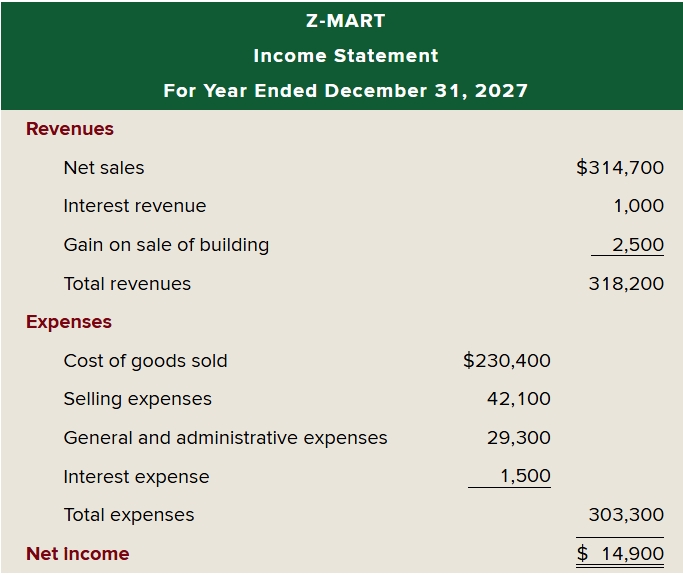
Classified Balance Sheet (Partial) of a Merchandise
What is this picture showing?

False
(True or False) Statement of retained earnings is different for merchandisers and service companies
Acid-test Ratio
The _________, also called quick ratio, is defined as quick assets (cash, short-term investments, and current receivables) divided by current liabilities. It differs from the current ratio by excluding less liquid current assets such as inventory and prepaid expenses that take longer to be converted to cash.
Acid-test Ratio
This equation is for
??? = (Cash and cash equivalent + short-term investment + Current receivables)/Current liabilities
Gross Margin Ratio (or gross profit ratio)
The ________ helps understand this link. It differs from the profit margin ratio in that it excludes all costs except cost of goods sold. The __________ is defined as gross margin (net sales minus cost of goods sold) divided by net sales.
Gross Margin Ratio
This equation is for
??? = (Net sales - Cost of goods sold)/Net sales