Revolutionary War
 Call Kai
 Learn
 Practice Test
 Spaced Repetition
 Match
 Flashcards
1/74

There's no tags or description
Looks like no tags are added yet.
75 Terms
Patrick Henry
Who said, "I know not what course others may take; but as for me, give me liberty, or give me death!"?
George Washington
Who was chosen by the Second Continental Congress to command the new Continental Army?
seeing cannons aimed down on them from nearby Dorchester Heights.
The British withdrew from Boston in 1776 after seeing...
It persuaded many colonists that the time had come to declare independence.
What was the main impact of Common Sense in the colonies?
King George to make peace with the colonies.
The purpose of the Olive Branch Petition was to persuade...
why it was time for the colonies to separate from Great Britain.
The Declaration of Independence was written to explain why...
right to life, liberty, and the pursuit of happiness.
The Declaration of Independence states that all people are born with certain rights that include the right to...
Independence Day.
The day on which the Declaration of Independence was approved in 1776 is celebrated today as ________ Day.
an able and inspiring leader in George Washington.
The main American strength when the war began was
better led.
Compared to the Continental Army, British troops were all of the following except betterfed, led, trained, or equipped
independence would lead to the end of slavery.
Many African Americans joined the Continental Army hoping that...
showed that the Americans could beat the British and their allies.
American victories at Trenton and Princeton showed that...
fight a defensive war and tire the British out.
After 1776, Washington's basic military strategy was to fight by...
brought France into the war as an American ally.
The Battle of Saratoga was a turning point in the war because it...
guerrilla troops.
What kind of fighters kept the American cause in the South alive?
all the territory lying to the east of the Mississippi River.
In the Treaty of Paris, the Americans won their independence and what territory?
The Triangle Trade
The best title for this map is:

New England merchants
Which group benefited most from this trade?

enslaved Africans
Which group suffered most?

The Declaration of Independence.
What document does this picture illustrate the writing of?

Thomas Jefferson.
The first draft of this document was written by...

Revised several times.
The picture suggests that the first draft was Choices: difficult to understand, the length of a book, revised several times, or perfect as first written

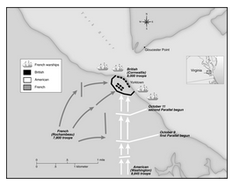
Yorktown.
The map shows the battle of

Virginia
In which state did this battle take place?
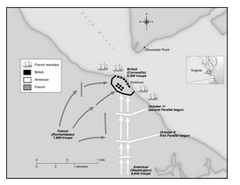
Britain, France, and the United States
Which three countries were involved in this battle?

8,000
How many troops did Cornwallis have?

two to one.
Cornwallis was outnumbered by a ratio of about ____ to one.

Cornwallis surrendered, ending the war.
What was the outcome of this battle?(use map from #23)
Thomas Paine in The Crisis
"These are the times that try men's souls. The summer soldier and the sunshine patriot will, in this crisis, shrink from the service of their country; but he that stands it NOW, deserves the love and thanks of man and woman.
Tyranny, like hell, is not easily conquered; yet we have this consolation with us, that the harder the conflict, the more glorious the triumph. What we obtain too cheap, we esteem too lightly: it is dearness only that gives every thing its value.
Heaven knows how to put a proper price upon its goods; and it would be strange indeed if so celestial an article as FREEDOM should not be highly rated."
Who wrote this passage?
test
"These are the times that try men's souls. The summer soldier and the sunshine patriot will, in this crisis, shrink from the service of their country; but he that stands it NOW, deserves the love and thanks of man and woman.
Tyranny, like hell, is not easily conquered; yet we have this consolation with us, that the harder the conflict, the more glorious the triumph. What we obtain too cheap, we esteem too lightly: it is dearness only that gives every thing its value.
Heaven knows how to put a proper price upon its goods; and it would be strange indeed if so celestial an article as FREEDOM should not be highly rated."
What is the best synonym for try as it is used in the first line?
quitters.
"These are the times that try men's souls. The summer soldier and the sunshine patriot will, in this crisis, shrink from the service of their country; but he that stands it NOW, deserves the love and thanks of man and woman.
Tyranny, like hell, is not easily conquered; yet we have this consolation with us, that the harder the conflict, the more glorious the triumph. What we obtain too cheap, we esteem too lightly: it is dearness only that gives every thing its value.
Heaven knows how to put a proper price upon its goods; and it would be strange indeed if so celestial an article as FREEDOM should not be highly rated.""Summer soldiers and sunshine patriots" might best be described as Choices: quitters, optimists, fighters, or traitors.
arguments for continuing to fight.
"These are the times that try men's souls. The summer soldier and the sunshine patriot will, in this crisis, shrink from the service of their country; but he that stands it NOW, deserves the love and thanks of man and woman.
Tyranny, like hell, is not easily conquered; yet we have this consolation with us, that the harder the conflict, the more glorious the triumph. What we obtain too cheap, we esteem too lightly: it is dearness only that gives every thing its value.
Heaven knows how to put a proper price upon its goods; and it would be strange indeed if so celestial an article as FREEDOM should not be highly rated."
The passage contains arguments for...
We value most what we struggle hardest to achieve.
"These are the times that try men's souls. The summer soldier and the sunshine patriot will, in this crisis, shrink from the service of their country; but he that stands it NOW, deserves the love and thanks of man and woman.
Tyranny, like hell, is not easily conquered; yet we have this consolation with us, that the harder the conflict, the more glorious the triumph. What we obtain too cheap, we esteem too lightly: it is dearness only that gives every thing its value.
Heaven knows how to put a proper price upon its goods; and it would be strange indeed if so celestial an article as FREEDOM should not be highly rated."
What is the main idea of the second section of the passage?
Persuade.
"These are the times that try men's souls. The summer soldier and the sunshine patriot will, in this crisis, shrink from the service of their country; but he that stands it NOW, deserves the love and thanks of man and woman.
Tyranny, like hell, is not easily conquered; yet we have this consolation with us, that the harder the conflict, the more glorious the triumph. What we obtain too cheap, we esteem too lightly: it is dearness only that gives every thing its value.
Heaven knows how to put a proper price upon its goods; and it would be strange indeed if so celestial an article as FREEDOM should not be highly rated."
This passage was written to...
The war because the Battle of Bunker Hill was in June of 1775.
35. Which came first, war or the Declaration of Independence? Provide evidence for your answer.
They were all important events leading up to the Revolution and the Declaration of Independence. They all are in common because they are part of America's struggle for independence from Britain.
35. How are the Boston Massacre, Intolerable Acts, and the Boston Tea Party related? What do they share in common?
The Common Sense publication made sure that the Declaration of Independence took place. The Common Sense publication urged people to be patriots and without their support, the Declaration of Independence may not have occurred.
35. Which of the events may have caused another event to happen? Provide one example and explain.
No, the American Revolution was not inevitable. The Olive Branch Petition could have been sent earlier to stop it. If the Olive Branch Petition had been sent in early January of 1775, the King would not have declared the colonies to be in "open and avowed rebellion" and the war may not have proceeded. I would place it on the timeline between 1770 and May of 1775.
35. Was the American Revolution inevitable? Could something have been done to stop it? Can you think of an event that did not happen which might have prevented the Declaration of Independence and the American Revolution? Explain. Where would you place it on the timeline?
The Battle of Bunker Hill, The Siege of Boston, The Olive Branch Petition, and Common Sense.
1. What are 4 events that occurred in the colonies that starting changing the opinions of American colonists against Great Britain?
The British attacked the Militiamen's fort at Bunker Hill and during the fighting, the Americans ran out of gun powder and retreated. The British won the battle.
2. What happened during the Battle of Bunker Hill? Who won?
"*he had 1,800 barrels of gunpowder (more than he knew what to do with) *to deceive the British because they really didn't have any
3. What rumor did George Washington start? Why? Why did the British abandon Boston?
"A petition sent to King George III asking him to end the quarrel. He reacted by calling the colonies traitors and wanted to "bring the traitors to justice"."
4. What was the Olive Branch Petition? How did King George react to it?
to formally declare independence and to explain why they no longer want to be part of Britain
5. What was the purpose of the Declaration of Independence (i.e. what was paragraph 1 all about - 2 things!!)?
life, liberty, and the pursuit of happiness
6. What did the 2nd paragraph discuss? What 3 rights did the Declaration state that all people have?
the government is established by the people for the people
7. What is established to protect the rights discussed in paragraph 2? Where does the power come from to do this?
they can get rid of it and start a new one since they created it
8. What can people do if their rights aren't protected? Why or why not?
ways the king has violated the colonists' rights, 20
9. What is a grievance? How many are listed in the Declaration?
King George III
10. Many of the grievances begin with "he" (as in, He has refused to...). Who is the "he" that the document is referring to?
they pledged to support independence with "our lives, our fortunes, and our sacred honor"
11. What is the pledge that all of the signers of the Declaration make to the world?
Philadelphia's State House, Pennsylvania
12. Where did the Second Continental Congress meet? What state is that in?
Thomas Jefferson, he was shy but spoke brilliantly with his pen
13. Who was the primary author of the Declaration? Why was he chosen to write the document over John Adams?
human rights that are fundamental, that are not awarded by human power, and cannot be surrendered
14. What does "unalienable" mean?
7/4/1776
15. When was the Declaration official (month, day, and year)?
1st - John Hancock since he was the President of the Continental Congress, other signers were the members of the Continental Congress like Roger Sherman, Thomas Jefferson, John Adams, Sam Adams, Benjamin Franklin and many others (56 total)
16. Who signed the document first? Who else signed the document?
mercenaries (hired foreign soldiers) for the British Redcoats
17. What is a German Hessian?
America was able to defeat Great Britain because of their patriotism, their help from overseas, and the great leadership of George Washington, who was an able and inspiring leader. The Americans figured out how to trick the British and found ways to tire out their army.
18. Why was America - a relatively new and inexperienced country - able to defeat Great Britain's resources and army?
"*Their hatred of the English. *They had help from France. *George Washington's help to encourage confidence and courage."
19. List 3 advantages the American colonies had when fighting the British army.
"*Not many patriots were trained for battle There were food shortages. The lack of supplies, such as shoes and uniforms."
20. List 3 disadvantages the American colonies had when fighting the British army.
"*The British had a large army of 50,000. The British were well trained in their fighting tactics. They had many supplies (food, weapons, and uniforms.)
21. List 3 advantages the British army had when fighting the American colonies.
"*The sending of troops and supplies across the Atlantic Ocean was very slow and expensive. Planning was difficult. *Lack of interest in the war by the British people. *Poor leadership by Lord George Germain."
22. List 3 disadvantages the British army had when fighting the American colonies.
Baron Friedrich von Steuben is from Prussia and continually drilled the American soldiers.
23. Who is Baron Friedrich von Steuben? How did he aid the American cause?
Marquis de Lafayette is from France and used his own money to buy warm clothes for the soldiers.
24. Who is Marquis de Lafayette? How did he aid the American cause?
The Battle of Saratoga was important because it made Americans realize they could win the war. The battle was considered the turning point in the war because it gave the Americans much hope.
25. Why was the Battle of Saratoga so important? What is the Battle of Saratoga considered to be?
The Battle of Saratoga began when British General Burgoyne arrived on the Hudson River near Saratoga Springs, New York in June, 1777. Burgoyne's goal was to take control of the Hudson River river valley in New York. This would help the British to cut New England off from the rest of the states. Burgoyne wanted to collapse the Continental Army. British Generals Burgoyne and Howe planned to meet with their armies in Albany, New York, but General Howe had different ideas on how to win the war. He went to Philadelphia instead of Albany, New York, but General Washington refused to fight another battle. He hid from General Howe. General Burgoyne was outnumbered but still fought. On October 17, 1777, he surrendered and accepted defeat.
26. Briefly describe the major points of the Battle of Saratoga (the goal, the plan, the major generals involved, etc.).
Yorktown, October 6, 1781
27. Where did the last major battle of the Revolutionary War occur? What date?
"In 1780, General Washington sent General Nathaniel Greene to try to slow down the British advance through the South. He tired out General Corwallis' Army and their army moved to Yorktown to take a rest on the Chesapeake Bay. General Washington surprised General Cornwallis with more than 16,000 troops that included 8,000 French troops. They were able to cut off Cornwallis' troops from the British Navy. Cornwallis surrendered to the Americans and the French troops on October 19, 1781."
28. Briefly describe the major points of the Battle of Yorktown (the goal, what happened, the major generals involved, etc.).
troops and warships helped the Americans trap the British army at Yorktown
29. How did the French help the Americans during the Battle of Yorktown?
Britain recognized the US as an independent countryBritain handed over territory from the Atlantic Coast to the Mississippi RiverThe US agreed to return all rights and property taken from Loyalists during the war
30. What were the three terms of the Treaty of Paris?
Britain handed over territory from the Atlantic Coast to the Mississippi River
31. What were the land claims to North America after the Revolutionary war?
Women took the roles of Patriots during the Revolutionary War, even though their rights were not recognized in the Declaration of Independence.
32. Describe the roles that women took during the war.
slaves could fight for Britain to gain freedom, Lord Dunmore's Proclamation, afterwards free African Americans could enlist in the Continental Army
33. Describe the roles of African Americans during the war. What document allowed slaves to fight for Britain? Who was allowed to fight for the Americans?(
"The Battle of Trenton occurred on December 25, 1776, in Trenton, New Jersey after crossing the icy Delaware River. General Washington's Army surprised the Hessians and they surrendered before any Americans were killed. They took 868 prisoners. The Battle of Princeton, New Jersey took place one week later and 300 British soldiers were captured."
34. Describe the Battles of Trenton and Princeton.
The "swamp fox" who used guerilla war tactics.
35. Who was Francis Marion?
Vincennes
36. What was the greatest Patriot victory in the west?
Vincennes and Kaskaskia
37. What two villages did George Rogers Clark capture to weaken the British support system in the west?