c2 waves in communication
 Call Kai
 Learn
 Practice Test
 Spaced Repetition
 Match
 Flashcards
 Knowt Play
1/20

There's no tags or description
Looks like no tags are added yet.
21 Terms
principle of optical fibres
optical fibres transmit pulses of light over long-distances using total internal reflection. It consists of a glass core, which has a higher refractive index than the surrounding cladding that has a lower refractive index.
refractive index
measures of how much the medium slows down the light compared to a vacuum.
formula for refractive index
sin (I) / sin ( r )
or
c (speed of light in vacuum) /v (speed of light in medium)
total internal reflection
occurs when all light is reflected back inside the denser medium instead of refracting out.
two conditions for total internal reflection to occur
when the incidence angle is greater than the critical angle
light MUST travel from a dense medium to a less denser medium.
critical angle
the angle of incidence that produces the refraction 90 degrees to the normal.
formulka for critical angle
since ( c ) = 1 / refractive index.
how are optima fibres used in medicine
endoscope, it is a flexible medical instrument that is inserted into the body to view internal organs without doing major surgery.
two types of optical fibres used for medicine
incoherent bundle (fibres are randomly arranged , it carries light from the external light source down into the body cavity to illuminate the tissue.)
coherent bundle (fibres are kept in the exact same relative position at both ends, each fibre transmits one pixel f the reflected light to a camera or eyepiece so it produces a clear image for the doctor to see the internal organs)
analogue signal
a signal that varies continuously in amplitude and frequency over time , they can be affected by noise and they can lose signal over distance.The analogue signal can get amplified along with the signal when boosted.
Digital signal
consists of discrete values that is represented as binary (0s and 1s). Digital signals can be regenerated without amplifying it, much more data can be transferred over longer distances than an analogue signal.
analogue to signal transformation
sampling, measuring the amplitude of the continuous analogue signal at regular, fixed intervals.
quantisation, rounding each sampled amplitude value to the nearest discrete voltage.
binary encoding, converting each quantised level into brainy code hat is transmitted as light pulses down the fibre.
broadband
high speed, high bandwidth internet transmission. A fibre-optic broadband uses infrared travelling total internal reflection reflecting through glass fibres providing a higher bandwidths, faster speeds and minimal signal attuention.
electromagnetic waves
transverse waves consisting oscillating electric an magnetic fields at 90degres to each other. All electromagnet waves travel at the same speed in a vacuum (3.0 × 10⁸)
the inverse square law
as a wave radiates outward from a source point, its energy spreads over the surface area of the expanding sphere causing its intensity to decrease rapidly with distance increasing.
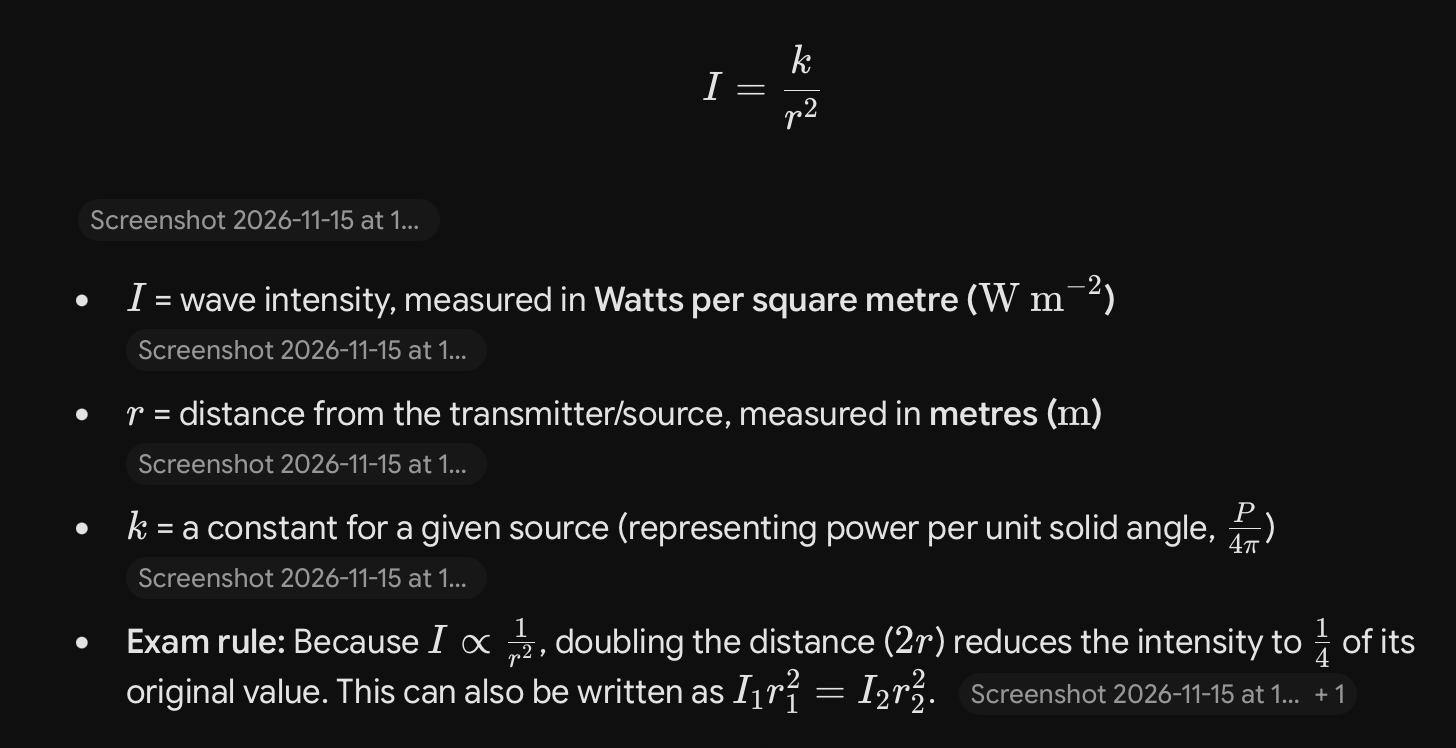
EM spectrum order (lowest frequency to highest frequency)
radio waves
microwaves
infrared radiation
visible light
ultraviolet
x rays
gamma rays
what wave does satellite communication use and why
microwaves because since microwaves has a high frequency it can pass through the atmosphere as well as it can carry high bandwidths of data
what wave does mobile phones use and why
microwaves because the microwaves frequency can pass through walls and buildings reasonably well, as well as its frequency is high enough to transmit voice, video and mobile data quickly between handsets and local base stations.
what wave is used for bluetooth and why
microwaves because it is suitable for short range communication s well as it can pass through the walls if needed, doesn’t require a line of sight
what is infrared radiation used for and why
TV remote controls because t is suitable for short range communication, however since it has a higher frequency and a shorter wavelength it cant pass through walls as well as microwaves so ti requires a direct line of sight.
what wave is wifi used for and why
microwaves because since microwaves have a longer wavelength it can penetrate through walls more easier as well as having a faster data transfer and less congestion over shorter distances