WEEK 3: Bed Mobility Lab Techniques + Lecture Notes
 Call Kai
 Learn
Learn Practice Test
 Spaced Repetition
 Match
Match Flashcards
 Knowt Play
1/109

There's no tags or description
Looks like no tags are added yet.
Name | Mastery | Learn | Test | Matching | Spaced | Call with Kai | Chat |
|---|
No analytics yet
Send a link to your students to track their progress
110 Terms
Define hemiplegia in the context of a Cerebral Vascular Accident (CVA).
It is paralysis of one side of the body caused by a stroke.
Why must a therapist be alert to 'one-sided neglect' in patients with a CVA?
The patient may not realize where the affected extremity is positioned in space.
During bed mobility for a patient with hemiplegia, which side is typically easier for the patient to sit up from side-lying?
The weaker side, because the strong side is positioned to do the majority of the pushing.
How should a patient's weak arm be positioned before rolling to prevent shoulder joint compression?
It should be placed in 45∘ of abduction.
Where should the weak arm be placed when a patient with hemiplegia is rolling toward their strong side?
It should be placed across the patient’s chest and supported.
What is the 'kickstand' position used by a CVA patient once they have reached a sitting position?
The strong arm is positioned straight and out to the side for trunk support.

What is the primary goal of the log rolling technique for a post-operative back surgery patient?
To avoid segmental rotation of the thoracolumbar spine.
In log rolling for back surgery patients, which body part should initiate the push to move the trunk as a single unit?
The lower extremities (LE).
Why is early use of the upper extremities (UE) avoided during log rolling after back surgery?
It tends to promote trunk rotation.
What device is used during bed mobility for patients under sternal precautions to prevent pushing with the arms?
A heart pillow placed over the chest.
A patient following a heart surgery is instructed not to hold their breath or strain while sitting up; what is the therapist preventing?
The Valsalva maneuver or excessive internal thoracic pressure.
What are the three standard movement restrictions for a posterolateral approach Total Hip Arthroplasty (THA)?
No hip flexion past 90∘, no internal rotation (IR), and no hip adduction past midline.
For a patient with a fresh THA (posterolateral), which side of the bed is typically easiest to exit from?
The surgical (involved) side.
While sitting, how must a THA patient position their trunk to maintain safety precautions?
The trunk should be leaned back to prevent hip flexion past 90∘.
Which movements must be avoided following an anterior approach Total Hip Replacement (THR)?
Combined hip extension and external rotation.
At what level of Spinal Cord Injury (SCI) is an individual typically considered to be at the 'transitional level' for independent bed mobility?
At or below the level of C6.
Which physical ability is a strong predictor of independence in rolling for a patient with a SCI (spinal cord injury)?
Good spinal rotation.
How does a patient with an SCI move from supine on their elbows into an erect upright sitting position?
By using momentum to propel themselves upward.
What is the key difference in arm positioning between rolling into side-lying and rolling supine to prone?
Rolling to prone is performed without shoulder abduction.
When rolling a patient into the prone position, what action must be taken to ensure the airway is clear?
The patient's head must be turned to the side.
A patient has been on prolonged bed rest; what equipment provides a controlled progression from supine to standing?
A tilt table.
What physiological tolerance benchmark indicates a patient can likely tolerate standing upright after tilt table sessions?
The ability to tolerate 20 minutes at 70∘ of tilt.
At what rate is a tilt table typically elevated per the plan of care?
In increments of approximately 15-20∘ at a time.

What are the three primary objectives of short-term patient positioning?
Safety, comfort, and access.
In short-term supine positioning, why is a pillow placed under the patient's knees?
To reduce strain on the low back and normalize the curvature of the spine.
What is the purpose of placing a pillow under the hips in short-term prone positioning?
To alleviate strain on the low back and accommodate tight hip flexors.
Identify the specific bony prominences at risk of pressure in a short-term side-lying position.
The greater trochanter, lateral and medial malleoli, and the lateral knee.
How should a patient's hips be positioned in a chair for proper short-term sitting?
Hips should be placed all the way back in the chair.
What are the three primary 'prevention' goals of long-term positioning?
Prevention of pressure ulcers, contractures, and edema.
Define the angle range for the Head of Bed (HOB) in the semi-reclined position.
Between 20∘ and 45∘.
What is the range for the Head of Bed (HOB) in a standard Fowler's position?
Between 45∘ and 60∘.

What is a significant long-term orthopedic risk of maintaining a patient in a semi-reclined or Fowler's position?
Development of hip and knee flexion contractures.
What is the maximum amount of time a patient should remain in one position while in bed?
Two hours.
What is the maximum amount of time a patient should remain in one position while seated?
15 minutes.
List three high-risk risk factors for the development of pressure ulcers.
Decreased mobility, fragile skin, and impaired sensation.
Name the high-risk pressure ulcer areas for a patient in the supine position.
Occiput, scapulae, spinous processes, elbows, sacrum/coccyx, ischial tuberosity, lateral malleoli, and heels.
Name the high-risk pressure ulcer areas for a patient in the prone position.
Ear/face, chin, anterior shoulder, iliac crests/ASIS, knees/patella, and dorsal surface of feet.
Following a transtibial amputation, what is the preferred sitting position to prevent contractures?
The residual limb is completely supported with the knee resting in extension.
What is the clinical term for a sudden drop in blood pressure when a long-term immobile patient moves to an upright position?
Orthostatic hypotension.
To prevent edema, how should a patient's distal extremities be positioned relative to the heart?
At or above the level of the heart.
Describe the '90-90-90' rule for long-term sitting posture.
90 degrees of flexion at the hip, 90 degrees at the knee, and 90 degrees (neutral) at the ankle.
What is the primary function of positioning devices?
To reduce or eliminate load on tissues and help maintain a static position.
What is the definition of a physical restraint?
Any device, material, or manual method that limits a client's ability to move their body or head freely.
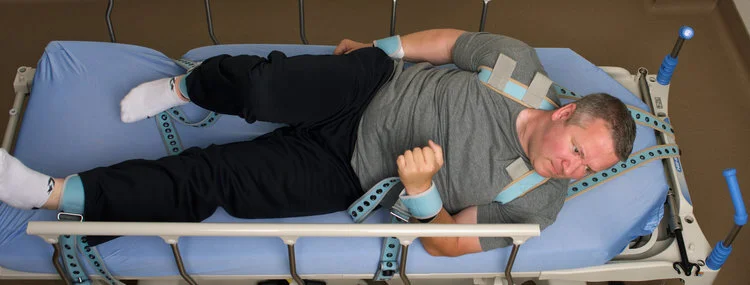
What is the maximum duration a medical order for a physical restraint is valid for an adult (ages 19+)?
Four hours.
How often must a physician or advanced practice provider reevaluate a patient for a new restraint order?
Every 24 hours.
During a Moist Heat Pack (MHP) treatment, what short-term positioning aid is used specifically because of the weight of the patient's body on the pack?
An extra towel layer.
In long-term supine positioning, what can be placed under the calves to decrease pressure on the heels?
A pillow.
Why should Head of Bed (HOB) elevation be kept below 30∘ for patients at high risk for sacral pressure ulcers?
Elevating above 30∘ increases shearing and pressure forces on the sacrum.
A patient with hemiplegia is sitting; why is a therapist guarding the patient specifically on their weak side?
To prevent the patient from falling toward the side without motor control.
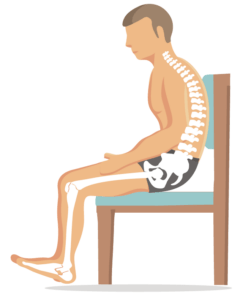
What is 'sacral sitting' and why should it be avoided?
It is a slumped posture that increases pressure on the sacrum and coccyx.
What are the two primary medical complications bed mobility helps eliminate by reducing pressure and immobility?
Pressure ulcers and contractures.
According to the progressions for motor development, what must a patient achieve before working on mobility?
Stability.
In the progression of bed mobility and transfers, how should the Base of Support (BOS) change over time?
It starts with a larger BOS and progresses to a smaller BOS.
Which position utilized in PT offers the largest Base of Support (BOS)?
Supine.
What is the defining characteristic of the 'hook-lying' position?
The patient is supine with knees bent and feet flat on the bed.
Why does the 'bridging' position require significantly more core stabilization than supine positioning?
It involves raising the Center of Mass (COM) to a higher position.
In the quadruped position, how does a patient transition from a wider BOS to a narrower BOS?
By moving the hands and knees closer together.
Position: Modified Plantigrade
Definition: The patient is standing with a wide BOS, holding onto a table and slightly leaning.
What is the primary rule for a clinician regarding a patient's weak limbs during bed mobility?
Do not pull on weak limbs.
When planning bed mobility, what does the term 'Guarding' refer to for the therapist?
Staying watching and readily available in case the patient rolls the wrong way.
What is the correct sequence of actions for a patient to 'scoot in supine'?
Press elbows into the bed, lift hips, and push caudally.
To perform 'scooting laterally,' what must a patient do first after achieving a hook-lying position?
Lift and shift the hips laterally.
Why is it discouraged to have all four bed rails up simultaneously during patient care?
It is overly restrictive and creates a safety hazard if the patient needs to be removed quickly.
A patient requires a trapeze bar for bed mobility. What is the minimum physical requirement for their extremities?
Fair upper extremity (UE) strength OR one strong UE and one strong lower extremity (LE).
During the transition from supine to side-lying, why might a therapist ask the patient to scoot to the left before rolling to the right?
To ensure they have enough space on the bed so they do not fall off.
In the steps for rolling to the right, to what degree should the right arm be abducted?
45∘.
When rolling to the right side, what should the patient do with their left lower extremity to initiate the move?
Bend the left hip and knee (or cross the left leg over the right).
Position: Short Sitting
Definition: Sitting with feet planted on the ground and hands placed on the bed for extra support.
When assisting a patient to move from side-lying to sitting at the Edge of Bed (EOB), where should the PT provide control if the patient is generally deconditioned?
One hand at the pelvis (iliac crest) and the other at the scapula/shoulder.
What area should a therapist strictly avoid wrapping their arms around when helping a patient sit up?
The patient's neck.
When a patient is rolling from supine to side-lying on their weaker side (e.g., post-stroke), why is the weak arm abducted to 45∘?
To keep the arm from being compressed under the body in side-lying.
When rolling from supine to the stronger side, what is the recommended position for the patient's weaker hand?
Placed across their body.
What is the primary role of the therapist positioned 'in front' during a two-person assist for supine to short sit?
Maintaining a wide BOS and lowering the patient's legs while squatting.
When moving from short sitting back to supine, where should the patient sit on the bed to ensure better final positioning?
One-third of the way down the bed toward the foot rail.
What is the first step for a patient to achieve 'long sitting' from a supine position?
Elevate the head, extend the shoulders, and move elbows back behind the trunk.
In a posterior approach Total Hip Arthroplasty (THA), the patient must avoid hip or trunk flexion past _____.
90∘.
What internal movement of the hip is restricted following a Total Hip Arthroplasty (THA)?
Internal Rotation (IR).
Following a THA, the patient is restricted from moving their hip into _____ past the midline.
Adduction.
How should a PTA support the affected limb of a patient who just underwent a Total Knee Replacement (TKR)?
Support them at the back of the knee (similar to holding a football).
What are the three 'surgical precautions' for a patient following lumbar surgery (lumbar fusion)?
No bending, no twisting, and no lifting of the spine.
When performing a log roll with a lumbar surgery patient, how must the shoulders, trunk, and hips be moved?
As a single unit, kept in alignment.
In lumbar surgery log rolling, why must the arms push the trunk upright at the exact same time the legs come over the EOB?
To avoid lateral flexion of the spine.
What is the purpose of having a sternal precaution patient hug a 'heart pillow' above their chest?
To prevent the use of their arms for pushing or pulling.
What phrase describes the arm restriction for patients with sternal precautions during movement?
Stay in the tube.
During a log roll for sternal precautions, what should the patient be cautioned NOT to do while coming up to sit?
Hold their breath or strain.
When preparing for a lateral seated transfer (using a transfer board), which direction of scooting is utilized?
Scooting sideways.
Which scooting maneuver is specifically used for repositioning in a chair prior to sit-to-stand transfers?
Scooting forward or backward.
A patient is sitting on the EOB and needs to scoot to the right. What is the first step they should take with their arms?
Abduct the right arm and place the hand on the bed.
What is the primary mechanical reason for raising the height of the hospital bed before assisting with bed mobility?
To minimize stress on the therapist's back.
After a patient successfully reaches a sitting position, what must the therapist remember to do to the bed height before leaving?
Lower the bed again.
Which position involves the patient being on 'all fours'?
Quadruped.
Why is the hook-lying position beneficial for moving one leg then the other?
It allows the patient to brace their core.
In the context of bed mobility, what does 'COM' stand for?
Center of Mass.
When rolling to the stronger side, how can the strong leg be used to assist the weak leg?
The strong leg can hook under the weak leg or bring the weak leg with it at the same time.
For a patient with general deconditioning, where does the PT stand during a supine to sit transition?
At the side the patient is rolling toward.
When performing a 'short sit to supine' maneuver, which arm provides support as the patient lays on their side?
The top arm.
A patient with lumbar precautions is lying back down from a sitting position. When must the legs come up off the floor?
At the same time the arms help the trunk go down (log roll method)

NPTE-PTA Style: A patient 2 days post-op for a right TKR is struggling to move to the EOB. How should the PTA prompt the patient to move their non-involved (left) limb?
Prompt the patient to move the non-involved limb independently.
NPTE-PTA Style: When assisting a patient with a posterior-lateral THA from supine to sitting, what is the primary movement risk during 'scooting' to the edge?
Accidental hip flexion beyond 90∘.
In terms of Base of Support, how does kneeling compare to half-kneeling?
Kneeling has a larger BOS than half-kneeling.