Genetics test dos
 Call Kai
 Learn
Learn Practice Test
 Spaced Repetition
 Match
Match Flashcards
 Knowt Play
1/140

There's no tags or description
Looks like no tags are added yet.
Name | Mastery | Learn | Test | Matching | Spaced | Call with Kai | Chat |
|---|
No analytics yet
Send a link to your students to track their progress
141 Terms
G1 phase
chromosomes are NOT duplicating or dividing
S phase
duplication of chromosomes into sister chromatids
G2 phase
sythesis of proteins required for mitosis
Prophase
chromosomes condense and become visible
Centrosomes move apart toward opposite poles
Nucleoli begin to disappear

Prometaphase
nuclear envelope breaks down
microtubules from centrosomes invade the nucleus and connect to kinetochores in centromere of each chromatid

Metaphase
chromosomes align on the metaphase plate with sister chromatids facing opposite poles
Forces pushing and pulling chromosomes to or from each pole are in balanced equilibrium

Anaphase
centromeres of all chromosomes divide simultaneously
Kinetochore microtubules shorten and pull separated sister chromatids to opposite poles

Telophase
nuclear envelope forms around each group of chromatids
nucleoli re-form
spindle fibers disperse
chromosomes decondense
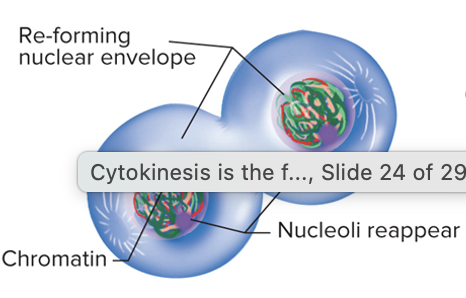
Cytokinesis
parent cells split into two daughter cells with identical nuclei

Leptotene
chromosomes thicken and become visible, but chromatids remain invisible
Centrosomes begin to move toward opposite poles
Zygotene
homologous chromosomes enter synapsis
the synaptonemal complex forms
Pachytene
synapsis is complete
crossing over
Diplotene
Synaptonemal complex dissolves
a tetrad of four chromatids is visible
Crossing over points appear as chiasmata
Meiotic arrest occurs at this time in many species
Diakinesis
chromatids thicken and shorten
At the end of prophase I, the nuclear membrane breaks down and spindle begins to form
Metaphase I
Tetrads line up along the metaphase plate
Each chromosome of a homologous pair attaches to fibers from opposite poles
Sister chromatids attach to fibers from the same pole
Anaphase I
Sister centromeres remain connected to each other
The chiasmata dissolve
Homologous chromosomes move to opposite poles
Telophase I
The nuclear envelope re-forms
Resultant cells have half the number of chromosomes, each consisting of two sister chromatids
Cytokinesis separates the daughter cells
Interkinesis
This is similar to interphase with one important exception: No chromosomal duplication take place
In some species the chromosomes decondense
between Meiosis I and II
Prophase II
chromosomes condense
Centrioles move toward the poles
the nuclear envelope breaks down at the end of prophase II
Metaphase II
chromosomes align at the metaphase plate
sister chromatids attach to spindle fibers from opposite poles
Anaphase II
sister centromeres detach from each other, allowing sister chromatids to move to opposite poles
Telophase II
Chromosomes begin to uncoil
Nuclear envelopes and nucleoli re-form
Cytokinesis
the cytoplasm divides, forming four haploid cells
a. anaphase of mitosis
96, 96
b. anaphase I of meiosis
48, 96
c. anaphase II of meiosis
48, 48
d. G1 prior to mitosis
48, 48
e. G2 prior to mitosis
48, 96
f. G1 prior to meiosis I
48, 48
g. Prophase of meiosis I
48, 96
i. an oogonial cell prior to S phase
48, 48
ii. a spermatid
24, 24
iii. a primary oocyte arrested prior to ovulation
48, 96
iv. a secondary oocyte arrested prior to fertilization
24, 48
v. a secondary polar body
24, 24
vi. chimpanzee sperm
24, 24
YyRr x YyRr
9:3:3:1
recessive epistasis
homozygous recessive alleles at one specific gene locus mask the expression of alleles at another locus
reciprocal recessive epistasis
homozygous alleles at either of two loci can mask the other
Metacentric chromosome
centromere is in the middle
Acrocentric chromosome
centromere is near one end
Homologs
contain the same set of genes, but can have different alleles for some genes (one from mom and one from dad)
Interphase
has 3 parts: gap 1 (G1) phase, synthesis (S) phase, and gap 2 (G2) phase
Mitosis
divides chromosomes equally to two genetically identical daughter cells
Centrosome
microtubule organizing center near the nuclear envelope
Centrioles
core of centrosome not found in plant cells
contractile ring
contract to from cleavage furrow in animal cells during cytokinesis
cell plate
forms near equator of plant cells during cytokinesis
at checkpoints (3)
prior events must be completed before the next step of the cycle can begin
somatic cells
make up the vast majority of cells in the organism (enter mitosis)
Germ cells
precursors to gametes (enter meiosis)
nondisjunction
homologs of a chromosome pair do not segregate during meiosis I
Independent assortment of homologs
creates different combinations of alleles
Crossing over between homologs
creates different combinations of alleles within each chromosome
germ line
specialized diploid cells set aside during embryogenesis
gametogenesis
the formation of gametes
oogonia
diploid germ cells in ovaries of female embryos
spermatogonia
diploid germ cells found only in testis, divide by mitosis to form primary spermatocytes
SRY
single gene that is the primary determinant of maleness
pseudoautosomal regions (PARs)
enable sex chromosomes to pair during meiosis I
Barr body
inactive x chromosome that condenses in female cells
biopotential cells (SRY dependent)
gonad precursors
external sex organ precursors
female/male sex organ precursors
are specific to each sex
testes secrete 2 hormones:
testosterone and AMF
testosterone
stimulates precursor cells to form male sex organs
AMF
inhibits female internal sex organ formation
inheritance of mutant AMFR
results in complete male sex organs plus internal female sex organs

complete androgen insensitivity syndrome
mutant androgen receptor and mutant AMF receptor results in no male/female internal sex organs
heterogametic sex
two different kinds of gametes (XY)
Homogametic sex
one type of gamete (XX)
Hemizygous
having only one copy of a gene in an otherwise diploid organism (X-linked genes in males)
x linked recessive
mutation never passes from father to son
daughters of affected males are carriers- ½ of sons of carriers will inherit the trait
x linked dominant
trait seen in every generation
affected male will produce affected daughters and unaffected sons
Y linked
only in males
sex influenced traits
appear in both sexes but hormonal differences may cause difference (male pattern baldness)
sex limited traits
affect a structure or process found in only one sex
syntenic genes
genes located on the same chromosome
linked genes
genes close enough together that they are inherited together
Chi square test

2-point test cross
1 parent should be heterozygous for both genes and the other should be homozygous recessive
Recombination frequency

bacteriophages
viruses that infect bacteria
phosphodiester bonds
covalent bonds joining adjacent nucleotides, always form covalent link between 3’ carbon of one nucleotide and 5’ carbon of the next nucleotide

5’ end of chain
phosphate group
3’ end of chain
hydroxyl group from deoxyribose sugar
Chargaff’s rule
A pairs with T and C pairs with G
Base pairs consist of
hydrogen bonds between a purine (A,G) and pyrimidine (C,U,T)
G-C pairing
3 hydrogen bonds
A-T pairing
2 hydrogen bonds
DNA sequences are read
5’ —> 3’
3 point crosses result in
8 potential F2 classes
Exons
coding sequences
Semiconservative
the Watson Crick model
Conservative
parental double helix remains intact, both strands of daughter helices are newly synthesized
Dispersive
both strands of both daughter helices contain original and newly synthesized DNA
Initiator protein
binds to the origin of replication
Helicase
unwinds the helix
Single-strand binding proteins
keep the DNA helix open
Primase
synthesizes RNA primers
RNA primers
are complementary and antiparallel to each template strand