Competitive Rivalry and Competitive Dynamics (copy)
 Call Kai
 Learn
 Practice Test
 Spaced Repetition
 Match
 Flashcards
 Knowt Play
1/15

There's no tags or description
Looks like no tags are added yet.
16 Terms
Competitive Rivalry
Competitive Rivalry is the ongoing set of competitive actions and competitive responses that occur among firms as they maneuver for an advantageous market position
Rivalry results from firms initiating their own competitive actions and then responding to actions taken by competitors
Of Porter’s Five Forces, the effect of competitive rivalry is the most significant factor on the attractiveness (e.g. measured by profitability) of an industry
Who are “competitors”?
Competitors are firms operating in the same markets, offering similar products, and targeting similar customers.
Competitive Behavior
Competitive Behavior is the set of competitive actions and responses a given firm takes to build or defend its competitive advantages and to improve its market position.
Multimarket Competition occurs when firms compete against each other in several product or geographical markets
The total set of actions and responses taken by all firms competing within a market (all competitive behavior) is called competitive dynamics
From Competition to Competitive Dynamics
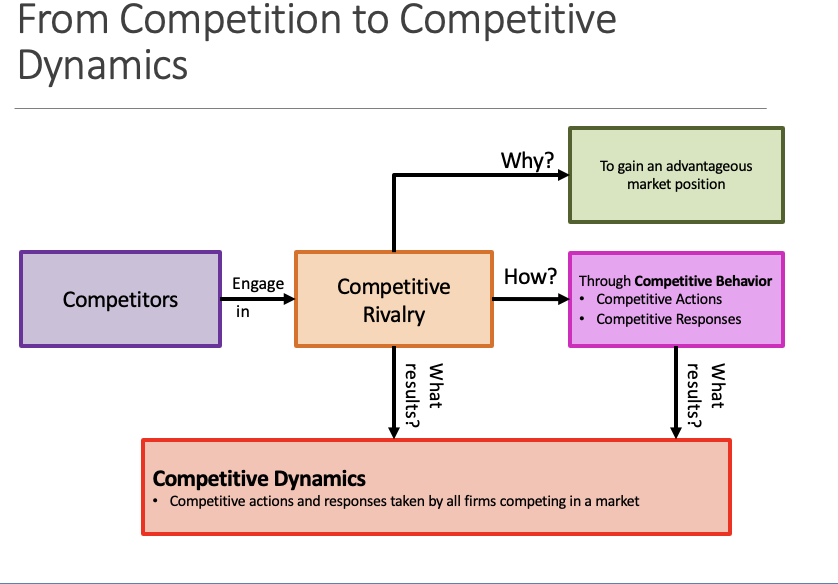
Model of Competitive Rivalry

Competitor Analysis
Competitor Analysis involves the studying of competitors’ future objectives, current strategies, assumptions, and capabilities.
The first purpose of this is for a firm to understand its competitors
The second is to be able to predict competitors’ behavior in the form of their competitive actions and responses
A situation in which a firm is unaware of competitors’ objectives, strategies, assumptions, and capabilities is called its competitive blind spot.
A firm’s board of directors is expected to use its knowledge and expertise about other businesses and the industry to avoid competitive blind spots.
Porter’s Framework for Competitor Analysis

Market Commonality
Every industry is composed of various markets
An industry’s markets can be further subdivided into:
Market/customer segments
Product segments
Geographic segments
Although differences exist, many industries’ markets are partially related in terms of technologies used or core competencies needed to develop a competitive advantage.
Market commonality is concerned with the number of markets with which the firm and a competitor are jointly involved and the degree of importance of the individual markets to each
Resource Similarity
Resource Similarity is the extent to which the firm’s tangible and intangible resources are comparable to a competitor’s in terms of both type and amount
Firms with resource similarity will likely have similar strengths and weaknesses and therefore use similar strategies to pursue the same opportunities.
Drivers of Competitive Behavior
Awareness is the extent to which competitors recognize the degree of their mutual interdependence that results from market commonality and resource similarity
Affects the extent to which the firm understands the consequences of its competitive actions and responses.
Motivation concerns the firm’s incentive to take action or to respond to a competitor’s attack
Motivation reflects a firm’s perception of the relative improvement of positioning (or lack thereof) from engaging in a rivalry
Ability reflects a firm’s resources and the flexibility they provide to engage in competitive rivalry
Strategic vs Tactical Actions
A strategic action (or strategic response) is a market-based move that involves a significant commitment of organizational resources and is difficult to implement and reverse.
Examples of these moves would include partnering with another firm or entering a new geographic / product market
A tactical action (or tactical response) is a market-based move that is taken to fine-tune a strategy
This usually involves fewer resources and is relatively easy to implement and reverse, e.g. price matching
Likelihood of Attack - First Mover
First-mover benefits relate to a firm that takes an initial competitive action in order to build or defend its competitive advantages, or to improve its market position
Can earn above-average returns until competitors respond
Can gain loyalty of customers who become committed to products/services
Involve higher risk due to loss of resources and potentially no traction
Especially important in fast-cycle markets (e.g. Rapidly-developing technological markets with relatively short product life cycles)
Firm must have readily available resources to invest in R&D and rapidly and successfully produce innovative products or services
Likelihood of Attack - Later Movers
Second movers are firms who respond to the first mover’s competitive action, typically through imitation
In some instances the second mover can produce a better product at a lower cost, by avoiding the mistakes of the first mover and by studying the market reaction
Late movers respond to a competitive action a significant amount of time after the first mover’s actions and the second mover’s response.
While typically better than no response at all, the success from the competitive response tends to be considerably less than that of a first or second mover.
A successful late mover will often need to enter the market with a niche strategy and with low-cost production and manufacturing
Likelihood of Attack - Organizational Size, Quality
Slack refers to the buffer or cushion provided by actual or obtainable resources that aren’t currently in use, and are in excess of the minimum resources needed to produce a given level of organizational output. Slack allows firms to be first-movers.
A large organizational size will provide a firm with available slack to allow it to initiate more competitive actions along with more strategic actions during a given period
However, small firms that have enough slack are often the more nimble and flexible in launching a competitive action
Quality from a strategic perspective is defined as the outcome when a firm’s goods or services meet or exceed customers’ expectations. A problem in quality will have detrimental consequences on a firm’s ability to initiate competitive actions.
Likelihood of Response
A firm’s competitive action is affected by the likelihood that a competitor will respond to it, as well as by the type (strategic or tactical) and effectiveness of that response:
Type of competitive action: A strategic action commonly receives a strategic response, while a tactical action will receive a tactical response
In general, due to the time and resources needed to commit to a strategic response, those responses are fewer than are tactical responses.
A positive actor’s reputation may be a source of its strategic advantage, and so a higher reputation will lead to more rivalry from competitors
In particular, competitors are more likely to respond to strategic or tactical actions when they are taken by a market leader
Market dependence is the extent to which a firm’s revenues or profits are derived from a particular market. High market dependence will likely lead to strong responses that might attack a firm’s market position.
Competitive Dynamics - Slow-Cycle Markets
Competitive Dynamics concerns the ongoing actions and responses among all firms competing within a market for advantageous position. While competitive behavior as well as the reason for taking them will be similar within each market type, they will differ based on the varying rate of competitive speed in different markets.
Slow-cycle markets are markets in which the firm’s competitive advantages are shielded from imitation, commonly for long periods of time, and where imitation is costly.
In this type of market, the building of a unique and proprietary capability produces competitive advantage.
Difficult-to-understand and costly-to-imitate capabilities result from unique historical conditions, causal ambiguity, and/or social complexity
Patents and copyrights, and their protection, are key competitive actions taken within a slow-cycle market.
Competitive Dynamics:
Fast-Cycle, Standard-Cycle Markets
Fast-cycle markets are markets in which the firm’s capabilities that contribute to competitive advantages aren’t shielded from imitation and where imitation is often rapid and inexpensive.
Critical to a fast-cycle market is the ability to make strategic decisions quickly but in a comprehensive approach
Reverse engineering and the rate of technology diffusion facilitate the rapid imitation that takes place in these markets.
Rapid price declines in these markets require companies to profit quickly from their product innovations.
Firms will often prefer to cannibalize their own sales with new products, rather than try to develop loyalty to one particular product
Hence, the strategy is often to develop a new (temporary) competitive advantage even while exploiting a previous product for as long as possible
Standard-cycle markets exist when a firm’s competitive advantages are partially shielded from imitation and imitation is moderately costly